The Algorithm That IS The Scientific Method [Dr. Jeff Beck]
Dr. Jeff Beck argues that the future of AI lies not in scaling up large language models, but in building systems that mirror the brain's approach to understanding the world. He posits that true intelligence is grounded in physics and object-centered models, not language. Beck's vision involves creating AI composed of numerous small, modular models—much like a video game engine—that can be dynamically combined, updated through continual learning, and understand the world through causal relationships and forces. This approach, he claims, will solve key challenges in generalization, robotics, and alignment by enabling machines to 'know what they don't know' and reason about the physical world in a way that is fundamentally similar to humans.
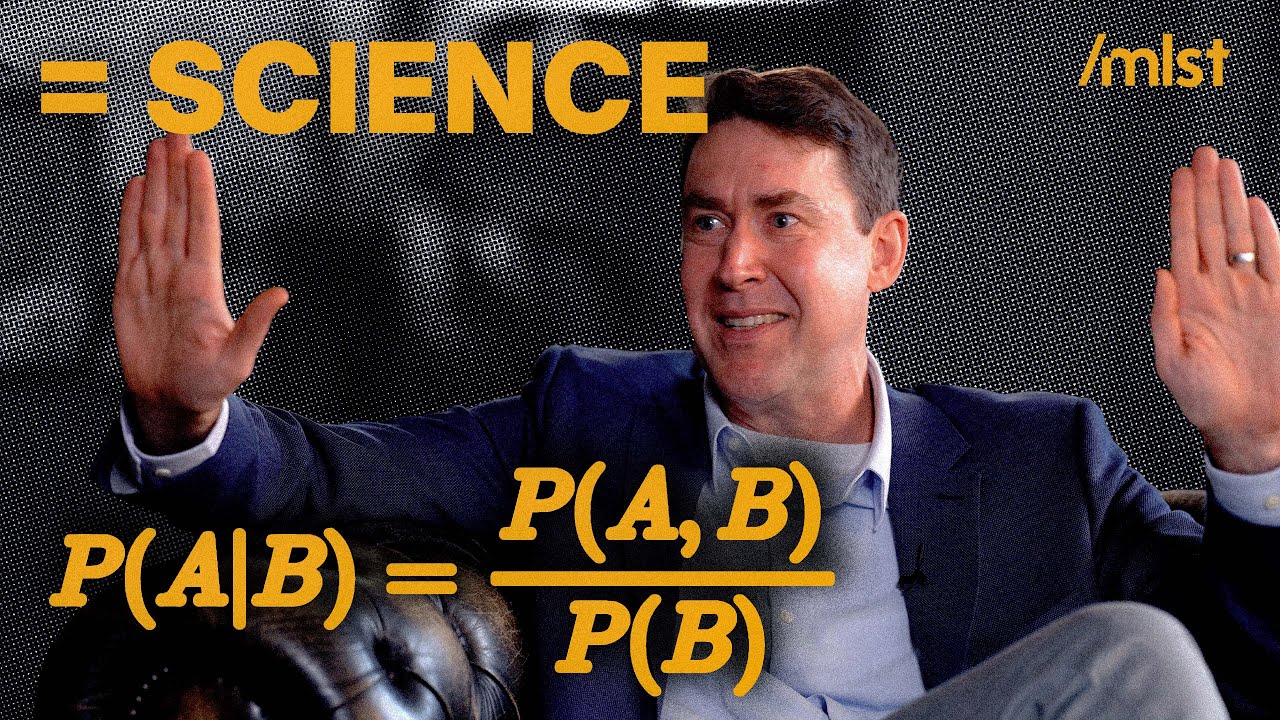
The Bayesian Brain: A Normative Approach to Inquiry
Dr. Jeff Beck, a mathematician turned computational neuroscientist, argues that Bayesian inference is the cornerstone of empirical inquiry and encapsulates the scientific method. He believes the brain operates on Bayesian principles, a conclusion supported by behavioral experiments showing humans are “surprisingly efficient” at tasks like optimal cue combination. For instance, when presented with conflicting visual and auditory cues of varying reliability, humans optimally weigh them on a trial-by-trial basis, demonstrating an inherent ability to manage uncertainty. This isn’t just about efficiency; it’s about the brain behaving as if it is optimally combining information and accounting for uncertainty, much like one does when driving in fog.
Rethinking AI: From Prediction Engines to Scientific Models
Beck posits that the current trajectory of AI, focused on scaling up large language models and transformers, is fundamentally misguided. He suggests we are “building AI backwards.” The brain, he argues, is not a giant prediction engine operating on pixels and tokens. Instead, it functions like a scientist, constantly forming and testing hypotheses about a world composed of macroscopic objects that interact through forces.
The real hero of the recent AI boom wasn’t the transformer architecture, but automatic differentiation (AutoGrad). AutoGrad transformed AI development from a complex mathematical exercise into an engineering problem, enabling rapid experimentation and the hyperscaling that led to today’s powerful models. However, in this process, the community lost sight of the structured, causal models that underlie true intelligence.
The Case for Object-Centered, Grounded AI
Beck advocates for a shift towards cognitively inspired, object-centered models. Here’s a breakdown of his proposed approach:
- Grounding in Physics, Not Language: Current models are often grounded in language, which Beck considers a poor and unreliable representation of both reality and thought. Citing the fact that “self-report is the least reliable form of data” in psychology, he argues that AI should be grounded in the domain we are grounded in: the physical world. The “atomic elements of thought” are models of macroscopic objects and their interactions.
- “Lots of Little Models” Architecture: Instead of a single monolithic network, Beck envisions an AI system built like a video game engine. This system would consist of thousands of small, modular object models that can be combined, updated, and swapped independently. For any given task or environment, the AI would only need to instantiate a small, relevant subset of these models, making the approach highly efficient and scalable.
- Enabling Systems Engineering: An object-centered approach allows for true creativity and problem-solving, analogous to systems engineering. Just as an engineer combines knowledge of airfoils and jet engines to invent an airplane, an AI with a relational, object-based understanding of the world can combine components to create novel solutions. This is a capability that purely predictive models, which mine existing data, inherently lack.
Practical Applications and The Path Forward
This new paradigm has practical implications for solving some of AI’s most difficult problems:
- The “Cat in the Warehouse” Problem: Imagine a warehouse robot that has never seen a cat. A standard AI might crash or hallucinate. Beck’s model would recognize the novelty through a high “surprisal” signal, effectively “knowing what it doesn’t know.” It could then query a larger model database, download a “cat model,” test its hypothesis through observation, and integrate this new knowledge—a powerful demonstration of continual learning.
- Solving the Sim-to-Real Gap in Robotics: The difficulty in transferring models from simulation to the real world stems from inaccurate physics in simulations and, more importantly, the robot’s lack of a world model structured like reality. By building robots with object-centered internal models and training them in physically accurate simulations, they can learn the underlying principles of the world, leading to better generalization.
- A New Approach to Alignment: Beck critiques the arbitrary nature of reward functions in reinforcement learning. He proposes an alignment strategy based on how humans align: through belief exchange. Since actions conflate beliefs and values, we cannot align with an AI without understanding its beliefs. By creating systems that can articulate their underlying models and beliefs, we can distinguish disagreements in belief from disagreements in values, making the alignment problem more tractable. In the meantime, he suggests the safest use of AI is as “oracles” or prediction engines, not autonomous decision-makers.
The Future is Structured and Scalable
Beck emphasizes that scaling Bayesian inference is no longer an insurmountable obstacle, thanks to modern techniques like normalizing flows and natural gradient methods. The future of AI, in his view, lies in combining these scalable Bayesian methods with structured, object-centered models. This approach promises to create more flexible, efficient, and truly intelligent systems that reason about the world in a way that is recognizably human. He sees promise in related fields like program synthesis, which could benefit from the same principles of composing modular components to generate complex and legible solutions.