Computational neuroscience

The Algorithm That IS The Scientific Method [Dr. Jeff Beck]

The Algorithm That IS The Scientific Method [Dr. Jeff Beck]

Dr. Jeff Beck argues that the future of AI lies not in scaling up large language models, but in building systems that mirror the brain's approach to understanding the world. He posits that true intelligence is grounded in physics and object-centered models, not language. Beck's vision involves creating AI composed of numerous small, modular models—much like a video game engine—that can be dynamically combined, updated through continual learning, and understand the world through causal relationships and forces. This approach, he claims, will solve key challenges in generalization, robotics, and alignment by enabling machines to 'know what they don't know' and reason about the physical world in a way that is fundamentally similar to humans.

Karl Friston - Why Intelligence Can't Get Too Large (Goldilocks principle)

Karl Friston - Why Intelligence Can't Get Too Large (Goldilocks principle)

Professor Karl Friston provides a 20-year retrospective on the Free Energy Principle, exploring its implications for life, intelligence, and consciousness. The discussion delves into the nature of agency in "strange things" that can model their own future, the crucial distinction between intelligence and consciousness, the potential for a "Goldilocks zone" for intelligent systems, and the profound challenges of building conscious AI, which may require a move beyond current computer architectures toward "mortal computation".

Computational models for brain science

Computational models for brain science

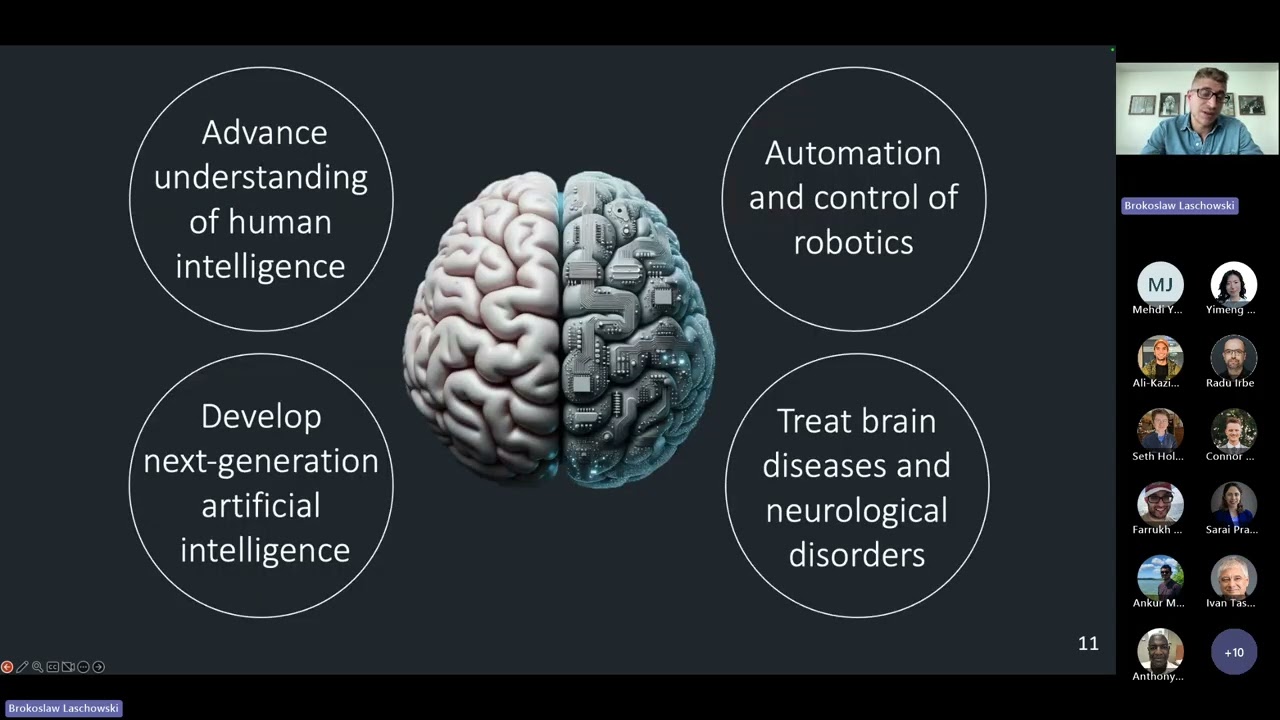
Dr. Laschowski discusses his lab's research in computational neuroscience, focusing on three core areas: reverse-engineering human motor control using reinforcement and optimal control models, developing high-accuracy neural decoding algorithms for brain-machine interfaces (BMIs), and creating brain-inspired deep learning models for computer vision. The talk highlights a long-term vision of discovering the fundamental principles of intelligence to build more efficient and robust AI.

907: Neuroscience, AI and the Limitations of LLMs — with Dr. Zohar Bronfman

907: Neuroscience, AI and the Limitations of LLMs — with Dr. Zohar Bronfman

Zohar Bronfman discusses why current LLMs are not on a path to AGI, contrasting their combinatorial creativity with the transformational, domain-general intelligence of humans. He argues that predictive models, not generative ones, deliver the most business value and explains how his platform, Pecan AI, automates the critical data preparation bottleneck to democratize predictive analytics for all businesses.