How Block is becoming the most AI-native enterprise in the world | Dhanji R. Prasanna
Block CTO Dhanji R. Prasanna shares how the company is becoming AI-native. He discusses their internal open-source AI agent, Goose, which saves employees 8-10 hours weekly, how they measure productivity gains, and the organizational changes that have had an even greater impact than AI tooling.
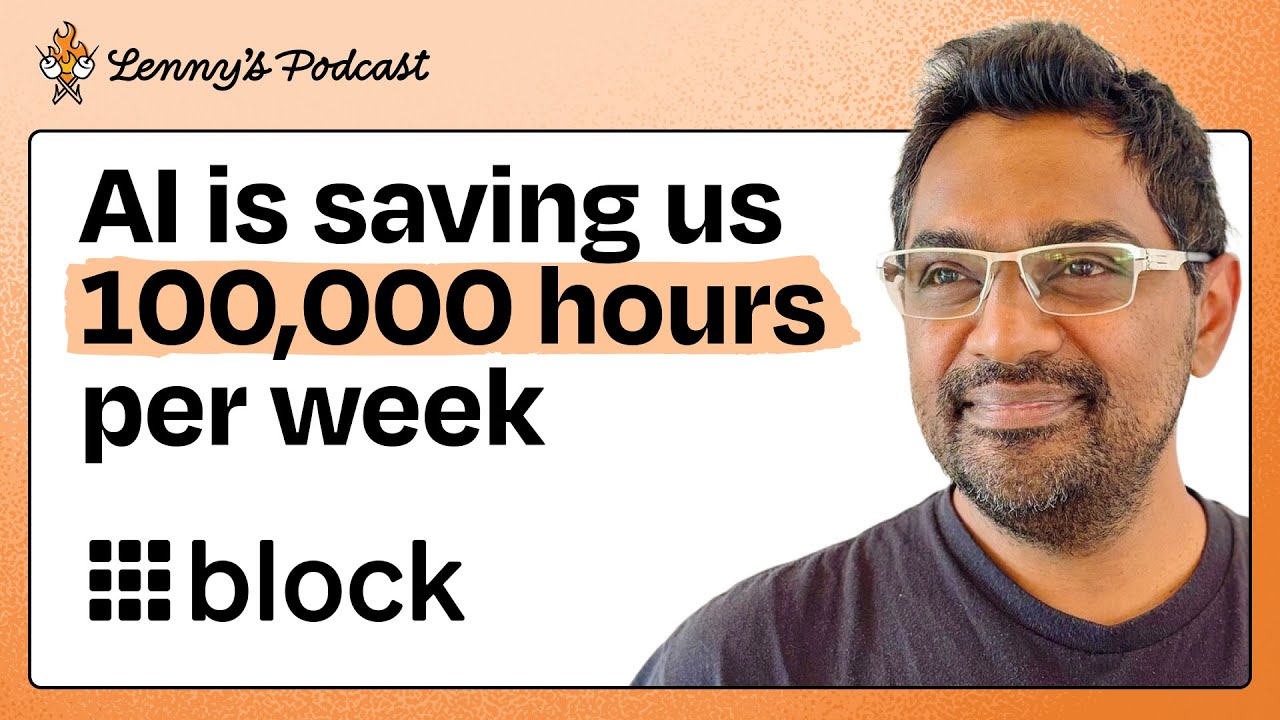
Dhanji R. Prasanna, CTO at Block, outlines the company’s journey to becoming an AI-native organization, a transformation sparked by an “AI manifesto” he wrote before becoming CTO. The core of this shift was not just adopting new tools, but fundamentally rethinking the company’s structure and development philosophy.
The Foundational Shift: From GM to Functional Org
The most significant change Block made to boost productivity and technological depth was moving from a General Manager (GM) structure to a functional organization.
- Previous State (GM Structure): Business units like Square and Cash App operated as a portfolio of independent companies. They had their own engineering, design, and product teams, leading to silos and a lack of a unified technical strategy. Engineering headcount was often treated as a commodity to add more features.
- Current State (Functional Structure): All engineers now report to a single head of engineering, and similarly for design and other functions. This change, inspired by Steve Jobs’ reorganization of Apple, was the key to driving a singular focus on technology. It allows for the creation of common platforms, better leverage of expertise across the company, and a focus on technical excellence.
As Prasanna notes, this aligns with Conway’s Law—“you ship your org structure.” The organizational change was more impactful for productivity than any specific AI tool.
Goose: Block’s Open-Source AI Agent
Goose is Block’s general-purpose, open-source AI agent that is central to its AI strategy. It’s a desktop application that gives large language models (LLMs) the ability to interact with other software and perform tasks.
- Core Technology: Goose is built on the Model Context Protocol (MCP), a system of formalized wrappers around existing tools (like Salesforce, Snowflake, or even command-line tools). This gives the LLM “arms and legs” to act in the digital world.
- Capabilities: It can orchestrate complex workflows across multiple systems. For example, a user can ask Goose to create a marketing report, and it will:
- Write SQL to pull data from Snowflake.
- Write and execute Python code for analysis.
- Generate charts using JavaScript libraries.
- Compile everything into a PDF or Google Doc and email it.
- Extensibility: Goose is model-agnostic, supporting APIs from Claude and OpenAI, as well as local open-source models. Because it’s open-source, any company can adopt it, and many have.
Measuring AI’s Impact and Surprising Beneficiaries
Block is seeing tangible productivity gains, which they measure in terms of manual hours saved across the company.
- Engineering Gains: AI-forward engineering teams report saving 8 to 10 hours per week.
- Company-Wide Gains: Across all departments (including legal, risk, and support), the company is trending towards 20-25% of manual hours saved.
- Biggest Surprise: The most significant impact has been on non-technical teams. These teams now use Goose to build their own internal tools, compressing weeks of work into hours without waiting for an internal development team.
One anecdote highlights the future potential: an engineer has Goose watch his screen as he works. Based on his conversations in Slack, Goose will proactively attempt to build the discussed feature and open a pull request.
The Future of Engineering and Product Development
Prasanna envisions a future where AI’s role evolves from a simple “vibe coding” assistant to a fully autonomous partner.
- Autonomous Agents: The goal is to have LLMs working 24/7, even overnight and on weekends, to build out multiple experiments in parallel. This allows teams to explore many paths simultaneously and discard the ones that don’t work.
- Rewriting from Scratch: This new paradigm could upend long-held engineering wisdom. Instead of fearing rewrites, teams might “delete the entire app and rebuild it from scratch” for every release, with the AI ensuring that all previous learnings and edge cases are incorporated.
- The Role of Human Taste: Despite this automation, human taste and judgment will become more critical than ever to guide the AI, prevent “AI slop,” and ensure the final product is valuable and useful to people.
Counterintuitive Lessons
- Code Quality Doesn’t Equal Product Success: Prasanna argues that code quality and product success are entirely uncorrelated. He cites YouTube, which was built on what Google engineers considered a “horrible” tech stack (videos as blobs in MySQL) but was wildly more successful than the technically superior Google Video. The focus should be on solving a user’s problem, not on architectural purity.
- Embrace Controlled Chaos: In the early days of Cash App, the environment was chaotic, with engineers shipping random experiments. This chaos, when built on a stable foundation that prevents major failures, breeds creativity and allows for rapid innovation.
- Start Small: Most of Block’s biggest successes, including Cash App and its Bitcoin integration, began as small hack week projects. The key is to start with an achievable scope and build momentum.