Giga: The AI Platform for Enterprise Support
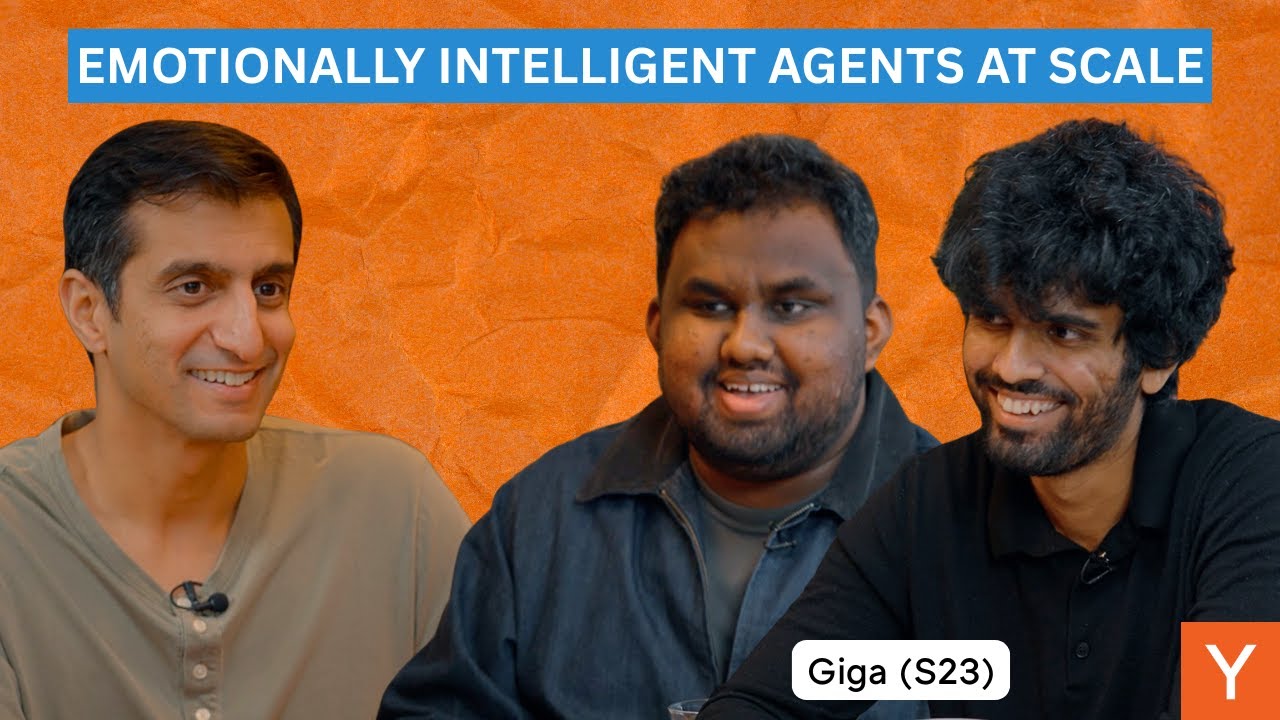
Giga co-founders Varun and Esha discuss their product-first approach to enterprise AI, detailing their innovative 'AI Forward-Deployed Engineer' model that enables rapid, scalable customer support automation. They break down how they solve complex, multi-party use cases for clients like DoorDash and share their vision for expanding beyond support to become a comprehensive ops automation platform.
Giga differentiates itself in the competitive AI customer support space through a strict product-first philosophy, contrasting with the common consultative, “forward-deployed engineer” model used by competitors. This approach was critical in winning large enterprise clients like DoorDash, where Giga went live in one week, compared to the months-long timelines required by other vendors. The core principle is that nothing is custom-built for a single client; every feature developed for a complex use case must be integrated into the core product, making it available to all customers.
The “AI Forward-Deployed Engineer”
To avoid the scalability issues of manual, custom deployments, Giga has developed what can be described as an “AI Forward-Deployed Engineer.” This system is built on a key architectural decision: making Python a first-class citizen within the product.
- AI-Generated Code: The platform empowers non-technical operations staff at client companies to define business logic and outcomes in natural language. Giga’s AI then translates these requirements directly into executable Python code, effectively automating the role of a deployment engineer.
- Generalizability: Since the platform’s fundamental primitive is Python, it is inherently general and extensible. This allows Giga to tackle novel and complex use cases by developing new protocols on top of this foundation, rather than building bespoke solutions. This model has proven powerful enough to convert tens of thousands of lines of a client’s internal JSON files into natural language instructions and Python code, automating a significant part of the sales and deployment process.
Solving High-Complexity, Multi-Party Use Cases
Giga’s ability to handle intricate, real-time scenarios is a primary reason for its success. A key example from their work with DoorDash illustrates this capability:
A Dasher delivers an order to a customer’s home instead of their office, as the customer mistakenly used the wrong address. Because the delivery location is outside the expected geofence, the Dasher cannot mark the order as delivered and calls for support.
- Contextual Verification: The Giga AI agent first checks the chat history between the customer and the Dasher to see if an address change was requested.
- Parallel Outbound Call: While keeping the Dasher on the line, the agent initiates a simultaneous, parallel outbound call to the customer to verbally confirm the address change.
- Real-Time Coordination: The Dasher can still interact with the AI while the customer call is in progress. Once the customer confirms, that context is relayed back to the primary agent, who then marks the order as delivered for the Dasher.
This multi-party communication, managed by a single AI agent, creates a more efficient and seamless experience than a human agent could provide, as a human would need to place one party on hold.
The Future: From Support to an Ops Automation Platform
The founders see customer support as the ideal entry point into the enterprise. The context scope is narrow enough for current LLMs to handle effectively, as all necessary information about a customer’s issue can be gathered during the interaction.
Giga’s long-term vision extends beyond customer support. By solving a company’s most challenging support problems, Giga gains deep contextual understanding of its operations, data, and customer interactions. This strategic position allows them to expand into other operational-expenditure (OpEx) heavy verticals like compliance. The ultimate goal is to leverage this accumulated context to build a comprehensive ops automation platform, making enterprise processes more efficient and execution-driven. Data and context are the ultimate moat; even with more powerful general models, a system without deep, specific enterprise context will be unable to compete.