No Priors Ep. 139 | With Snowflake CEO Sridhar Ramaswamy
Snowflake CEO Sridhar Ramaswamy discusses the company's rapid transformation into an AI-first data platform. He introduces Snowflake Intelligence, an agentic system for enterprise data, and explores the strategic pivot, the ROI of AI for businesses, and the evolving roles of data platforms, partnerships, and search in the age of AI.
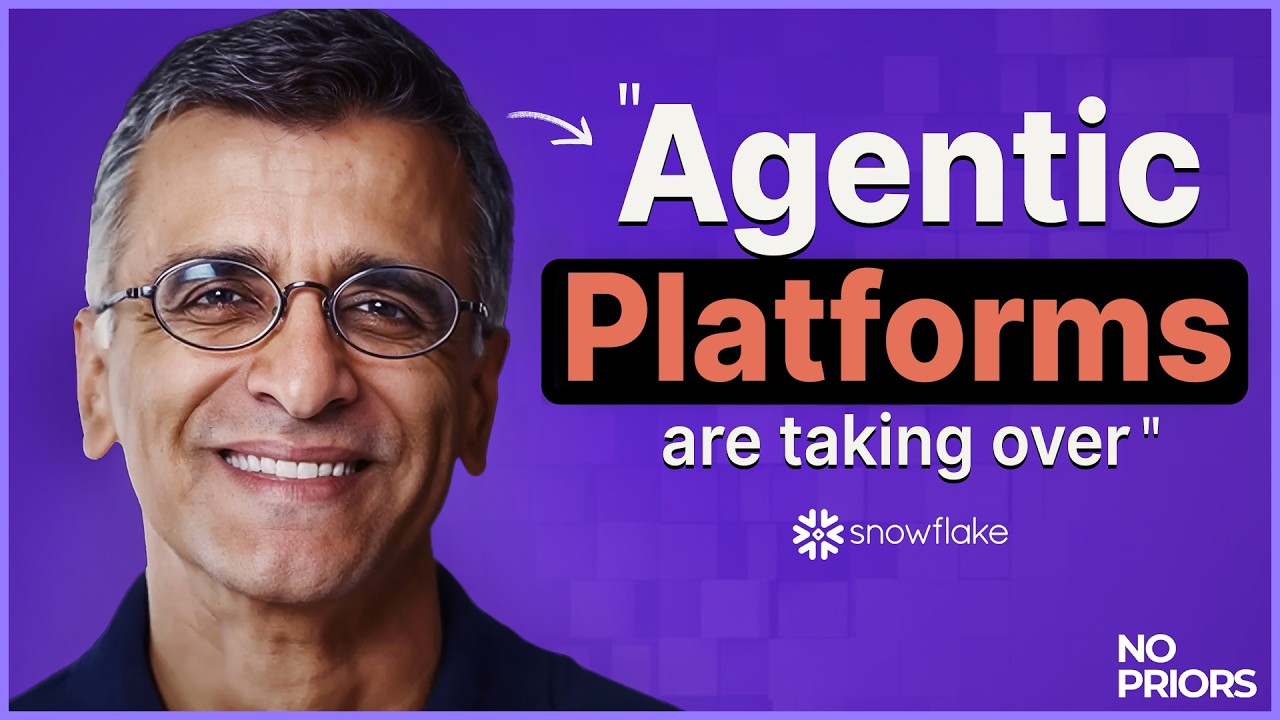
In his first 18 months as CEO of Snowflake, Sridhar Ramaswamy has spearheaded a significant transformation, pivoting the data giant to be AI-first. This shift was driven by the realization that the company needed to adapt to the tumultuous pace of change in AI to maintain its leadership position and unlock new value for customers.
Organizational Restructuring for Speed and Iteration
Upon taking the helm, a primary focus was on restructuring the organization to increase speed and accountability. The previous structure, highly specialized and optimized for a period of hyper-growth with a clear product-market fit, created too much distance between engineers and customers. In a world where AI capabilities evolve monthly, this model was no longer viable.
Key changes included:
- Clear Accountability: Reorganizing product and engineering into distinct, accountable areas like AI and core warehousing.
- The “Pod Model”: Creating integrated teams where product, engineering, and go-to-market functions work closely together. This “war room” approach establishes a straight line from product creation to market delivery.
- Emphasis on Iteration: A core belief that “speed wins” and the “ability to iterate always trumps carefully laid out strategies.” The goal was to accelerate the cycle of product creation and customer feedback.
Introducing Snowflake Intelligence: An Opinionated Agentic Platform
A core part of the new strategy is the launch of Snowflake Intelligence, an agentic platform designed to help every employee in an enterprise derive value from data.
“Snowflake Intelligence is very focused on how do you create value from data whether it’s structured or unstructured a whole lot faster.”
It is intentionally not a general-purpose agent framework that can do anything. Instead, it’s an opinionated platform with a clear focus. This contrasts with broader offerings from Cloud Service Providers (CSPs) that can be overwhelming due to an “infinity of things that you can do.”
The user experience is designed for business users, not just data teams who can write SQL. It’s an interactive interface where users can ask questions in natural language, moving beyond the “2D view of a complex surface” that traditional dashboards offer.
A prime example is an internal tool called Raven, a sales data assistant. It provides a single interface for sales teams to access:
- Contract details and consumption data.
- Summaries of recent customer conversations.
- Information on outstanding support issues.
A critical component of all Snowflake AI products is trust. The company treats AI development with the same rigor as software engineering, emphasizing that there is a “right and a wrong,” not a “yolo AI” approach. Every new feature or model change requires a robust evaluation (eval) to ensure it doesn’t degrade existing functionality.
Blurring Lines: Data Platform, Agent, and Application
Snowflake Intelligence begins to blur the line between a data platform and an application. While Snowflake has no ambition to become SAP or Salesforce, the platform can enable application-like functionality. For example, an HR agent built on Snowflake could allow an employee to file for vacation time by interacting with Workday via APIs. The strategy is to be opportunistic, focusing on where Snowflake can provide durable value from its position of strength in data, rather than pursuing “naked ambition.”
Strategic Positioning and Partnerships
Snowflake’s existence, alongside competitors like Databricks, proves that strong product-market fit can allow a company to thrive even when competing with hyperscalers who want to own the entire data space. However, the current environment requires constant innovation.
“Defensibility is built, not strategized. It’s built every single day. You have to keep moving.”
The strategy involves:
- Navigating the “Elephants”: Foundation model companies like OpenAI and Anthropic are like “empires that have not met their oceans just yet.” It’s crucial to understand their likely trajectory (e.g., coding agents) and build durable value in differentiated areas.
- The Data Platform as a Durable Category: The core vision is for Snowflake to be the data platform that guides customers from “inception to insight.” By providing the integrated data capabilities of companies like Google and Meta, Snowflake enables any enterprise to become truly data-first. AI serves as a massive accelerant for this vision.
- Mature Partnership Mentality: Moving beyond a “Snowflake-centric” view to create deep, collaborative partnerships. This involves working with CSPs like Microsoft to find win-win scenarios where Azure + Snowflake is a net positive for customers. A key new partnership is with SAP, focusing on bidirectional data sharing and collaboration on analytics and AI to make it easier for customers to build on top of SAP data.
ROI and the Enduring Role of Search
When advising customers on AI adoption, the recommendation is to start small and iterate rather than obsessing over immediate, large-scale ROI.
- High-ROI Starting Points: Coding agents, customer support, and democratizing data access are identified as easy wins.
- Iterate to Value: The key is to take many “shots on goal.” The Raven sales assistant was the culmination of three previous, smaller-scale projects. The advice is to “spend a thousand bucks at a time” and scale when value is proven.
Regarding the architecture of AI systems, there is a strong conviction that Large Language Models (LLMs) do not make traditional search and information retrieval obsolete.
“A smarter person is going to say no they [LLMs] should not do math. Instead I should write the two lines of Python… I think of trust in a very similar way. There are well-known solutions for figuring out what is the most trustworthy when it comes to a question that you want to answer. Why would you not use that?”
Just as a powerful AI should use a calculator for math, it should use specialized, reliable search tools to retrieve trustworthy information. The feedback loops inherent in search systems (e.g., click behavior) are a fundamental construct for improving relevance and trust over time, a value that is not easily internalized by a static model. Practical builders will always use the best tool for the job.