AI ATTACKS! How Hackers Weaponize Artificial Intelligence
AI is no longer just a tool for defense; it's being weaponized by malicious actors. This summary explores six emerging AI-powered cyber attacks, from automated login attempts and polymorphic ransomware to hyper-personalized phishing and deepfake fraud. It details how AI agents and Large Language Models (LLMs) are used to automate the entire attack kill chain, significantly lowering the skill barrier for attackers and necessitating an evolution in cyber defense strategies.
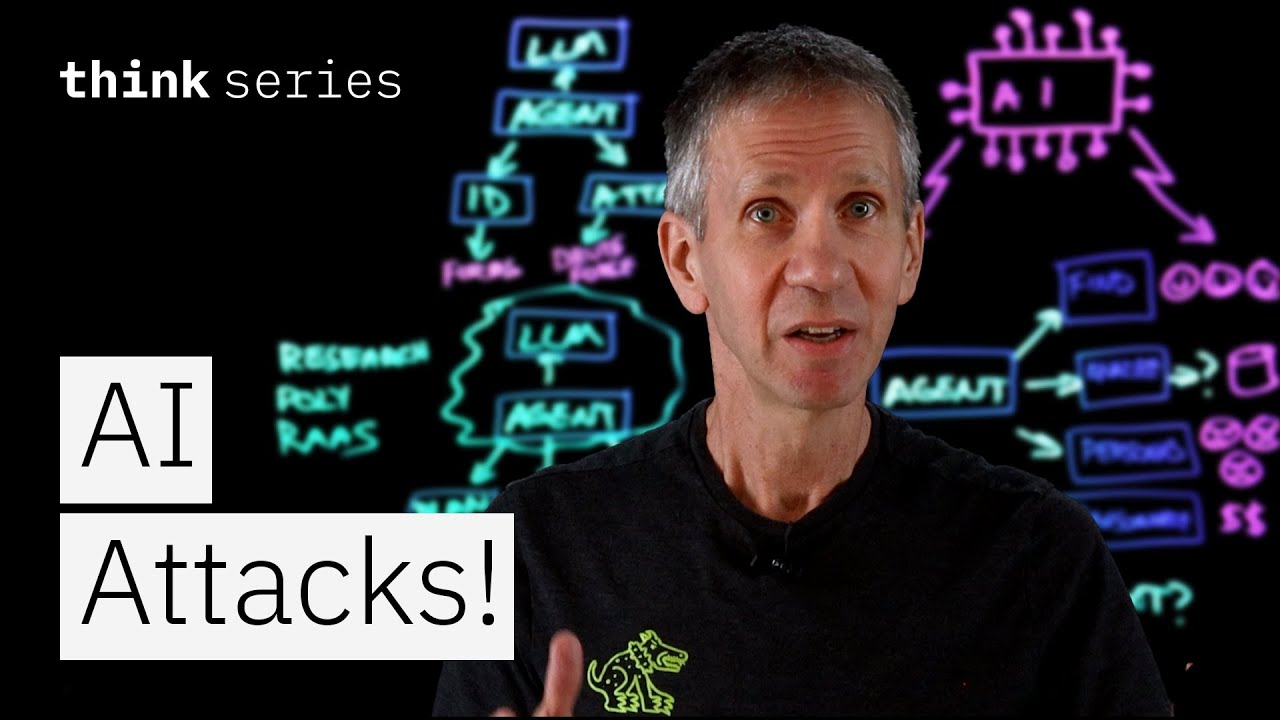
The landscape of cybersecurity is undergoing a significant transformation as artificial intelligence becomes a powerful tool for malicious actors. While AI offers positive advancements, it also amplifies the capabilities of attackers, enabling more sophisticated, automated, and effective cyber threats. Here is a breakdown of six emerging categories of AI-powered attacks.
1. AI-Powered Login and Authentication Attacks
AI is being leveraged to automate the process of breaching system authentication. Penetration testing frameworks, such as BruteForceAI, utilize an AI agent paired with a Large Language Model (LLM) to conduct these attacks autonomously.
- Discovery: The AI agent scans for web pages with login forms. The page’s content is sent to an LLM, which parses the HTML to identify user ID and password fields with approximately 95% accuracy.
- Execution: Once a login form is identified, the agent directs the attack. It can employ two main strategies:
- Brute Force: Systematically trying every combination of credentials, though this is often thwarted by account lockout policies.
- Password Spraying: Attempting a single common password against a large number of different user IDs. This method is more likely to bypass lockout policies that trigger after multiple failed attempts on a single account.
The key takeaway is that the entire process, from reconnaissance to execution, is handled by the AI, requiring minimal human intervention.
2. AI-Orchestrated Ransomware
The concept of “Ransomware-as-a-Service” is evolving with AI. Research projects like Prompt Lock demonstrate how an AI agent, leveraging an LLM, can orchestrate a complete ransomware campaign.
- Automated Attack Lifecycle: The AI agent manages every stage of the attack:
- Planning: It strategizes the attack, identifying valuable targets.
- Analysis: Upon infiltrating a system, it uses the LLM to analyze files, identify sensitive data, and assess its value to calibrate the ransom demand.
- Generation: It generates the necessary code to encrypt, exfiltrate, or erase the victim’s data.
- Execution: It deploys the ransomware, writes a personalized ransom note detailing the compromised files, and manages the extortion process.
- Polymorphic Nature: Because the attack is generated by an AI, each instance can be unique, creating polymorphic ransomware that is significantly harder for traditional signature-based security tools to detect.
3. Hyper-Personalized Phishing
AI-powered phishing attacks overcome the traditional giveaways, such as poor grammar and spelling, that users are trained to spot.
- Flawless Content Generation: LLMs can generate perfectly written phishing emails in any language, even if the attacker is not a native speaker. Uncensored models, often found on the dark web, are readily available for these malicious purposes.
- Hyper-Personalization: AI can scrape a target’s social media profiles and other public data to craft highly convincing and personalized phishing messages, dramatically increasing the likelihood of success.
- Efficiency: An IBM experiment demonstrated that an AI could produce a phishing email in five minutes that was nearly as effective as one that took a human expert 16 hours to create. As AI models improve, this efficiency gap will only widen.
4. AI-Powered Fraud via Deepfakes
Generative AI enables the creation of highly realistic “deepfakes,” which are now being used for large-scale fraud. The process is straightforward:
- A generative AI model is trained on a small sample of a person’s voice (as little as three seconds) or video.
- The model learns to mimic their voice, likeness, and mannerisms.
- The attacker provides a script, and the model generates a new audio or video file of the person saying those words.
This technology has already led to significant financial losses, including:
- An audio deepfake that convinced an employee to wire $35 million.
- A video deepfake of a CFO in a conference call that led to a fraudulent $25 million transfer.
The core challenge is that our inherent trust in what we see and hear can be easily exploited. As the expert warns, “if you aren’t in the room, you can’t believe it.”
5. Automated Exploit Generation
AI can automate the creation of exploits for known vulnerabilities, lowering the technical barrier for attackers.
- From Vulnerability to Exploit: Research projects like CVE Genie use an AI agent to process publicly available security reports (Common Vulnerabilities and Exposures, or CVEs).
- Mechanism: The agent feeds the CVE document into an LLM, which extracts the critical details of the vulnerability. The agent then uses this understanding to automatically write the functional exploit code.
- Economics of Hacking: This method has shown a 51% success rate in generating working exploits at a cost of less than $3 each, making sophisticated cyber attacks accessible to a much broader audience of less-skilled individuals. This same technique can be used to generate polymorphic and evasive malware.
6. The Fully Autonomous AI Kill Chain
The culmination of these capabilities is the weaponization of AI to run an entire attack campaign autonomously. An AI agent can manage the full “kill chain” from start to finish.
- Strategic Decision-Making: The agent identifies high-value targets, plans the attack vector, and makes tactical decisions.
- End-to-End Execution: It analyzes exfiltrated data, creates false personas for extortion, generates the ransomware, and calibrates ransom demands based on the target’s perceived value.
This trend effectively reduces the required skill level for a successful cyberattack. An attacker no longer needs to be an elite coder; they can simply provide a high-level objective to an AI agent—a concept described as “vibe hacking”—and let the AI handle the complex execution.
The Inevitable Arms Race: AI vs. AI
AI-powered attacks are rapidly becoming more common and sophisticated. To counter this rising threat, defenders must also embrace AI. The future of cybersecurity will be defined by a continuous battle between malicious AI and defensive AI. Leveraging AI for advanced prevention, detection, and response is no longer optional—it is essential to ensure the “good AI” prevails.