Amjad Masad & Adam D’Angelo: How Far Are We From AGI?
Adam D’Angelo (Quora/Poe) and Amjad Masad (Replit) debate the future of AI. They clash on whether LLMs are hitting limits, the timeline to AGI, and the societal impact of automating entry-level jobs while expert roles remain, potentially creating a "missing middle" in the workforce.
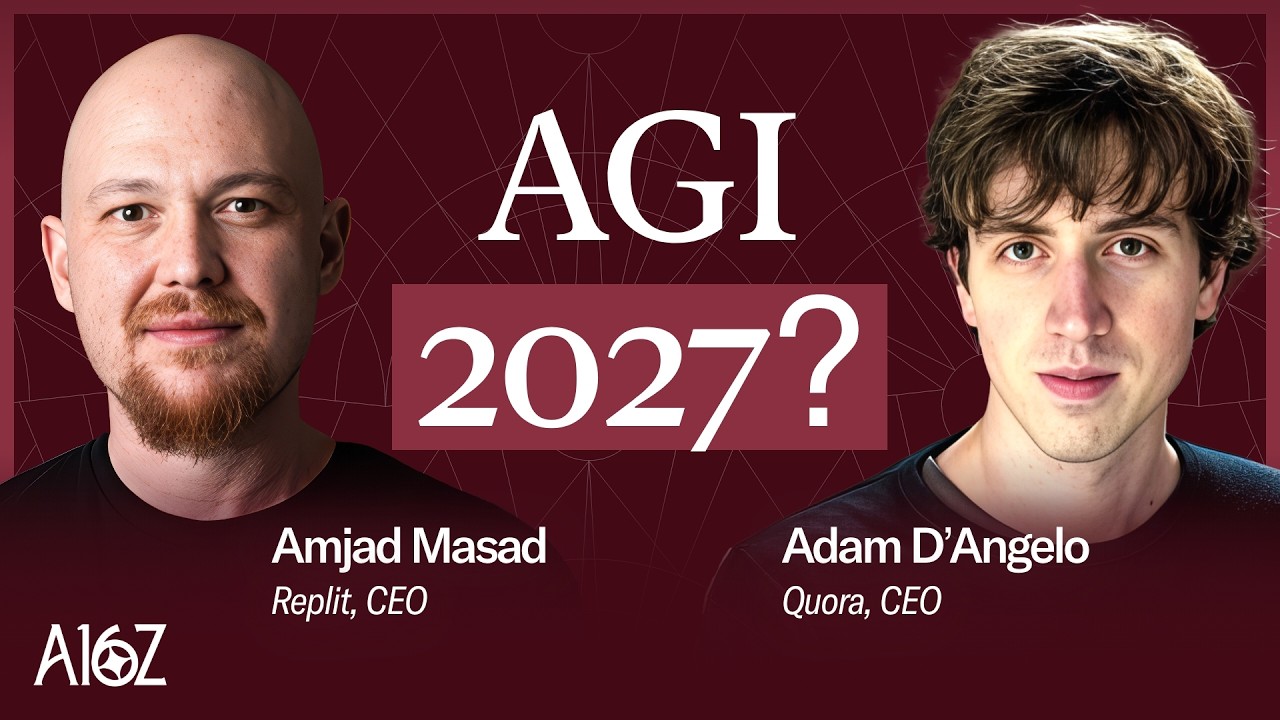
The Great Debate: Brute Force vs. Imminent Breakthrough
The conversation highlights a fundamental disagreement on the current trajectory of AI. Adam D’Angelo expresses strong optimism, stating, “I don’t know what people are talking about” regarding recent bearishness on LLMs. He argues that progress in areas like reasoning and code generation is faster than ever. He believes the primary bottleneck isn’t intelligence itself, but rather context injection and computer use, problems he sees as solvable within a year or two. D’Angelo proposes a functional definition for AGI: an AI that can perform any job that a remote human worker can. He feels we are not hitting fundamental architectural limits and can continue to make significant progress within the current paradigm.
Amjad Masad presents a more cautious perspective, arguing that we are “brute-forcing” our way to “functional AGI” without truly understanding intelligence. He believes LLMs are a different kind of intelligence, not an equivalent to human intellect, pointing to their limitations on simple reasoning tasks. Masad’s view is that the current progress relies heavily on a “human expertise regime”—massive, non-scalable efforts in data labeling and creating contrived Reinforcement Learning (RL) environments. He worries this focus on engineering solutions distracts from fundamental research into the nature of intelligence and consciousness, comparing the current LLM focus to a research “bubble” that sucks in all the talent.
“My view is LLMs are amazing machines. I don’t think they are exactly human intelligence equivalent… we’re papering over the limitations and we’re kind of working around them in all sorts of ways.” - Amjad Masad
The Economic Impact: A “Missing Middle” and the Expert Paradox
A key area of concern discussed is the potential for a “weird equilibrium” in the job market. Both agree that AI is highly effective at automating entry-level tasks, making it a substitute for junior employees. However, it still relies on expert human knowledge for training and handling long-tail events. This creates a scenario where the productivity of senior experts is massively amplified (e.g., one expert managing hundreds of AI agents), but the pipeline for training new experts is cut off because entry-level positions disappear.
This leads to the “Expert Data Paradox”: if AI automates the jobs of junior practitioners, and the models themselves depend on expert data for improvement, where will the next generation of experts—and the data they produce—come from? This poses a significant challenge to the long-term, continuous improvement of AI systems that rely on human-generated data.
The Sovereign Individual and the Solo Entrepreneur
Despite the challenges, both speakers are incredibly bullish on how AI empowers individuals. They see the “Sovereign Individual” thesis—a framework predicting that technology will empower skilled individuals to operate independently of traditional structures—as a relevant lens for the AI era. AI vastly increases what a single person can accomplish, enabling a new wave of “solo entrepreneurs.” Ideas that previously required a team and significant capital can now be brought to life by one person, democratizing opportunity on a massive scale.
“It’s vastly increased what a single person can do… For the first time, opportunity is massively available for everyone. Just the ability for more people to be able to become entrepreneurs is massive.”
The Decade of Agents: The Future of Development
Amjad Masad predicts that “it’s gonna be the decade of agents.” He outlines the evolution of AI in coding from autocomplete (Copilot) and chat to the agentic modality that Replit is pioneering. This involves AI not just writing code, but managing the entire development lifecycle: provisioning infrastructure, running tests, executing a debug loop, and deploying.
He details the rapid progress in agent autonomy:
- Agent V1: Could run for about 2 minutes.
- Agent V2: Ran for 20 minutes.
- Agent V3: Can run indefinitely (tested for over 28 hours) by incorporating a verifier in the loop to test the application, read error logs, and self-correct.
The future roadmap includes parallel agents, where a developer can manage 5-10 agents working on different features simultaneously, with the AI handling task parallelization and code merges. This promises another significant leap in developer productivity.
Market Dynamics and The End of Disruption?
The speakers discuss whether AI is a “sustaining” or “disruptive” innovation. They conclude it’s both. While it supercharges incumbents like Google and other hyperscalers, it also enables new business models. A key insight is that the classic “Innovator’s Dilemma” may no longer apply in the same way because “everyone read the book.” Today’s tech leaders, many of whom are founder-controlled, and public market investors understand the threat of disruption and are willing to make long-term, cannibalistic investments to adapt, preventing them from being caught off guard as mainframe manufacturers were by the PC.