Shaping Model Behavior in GPT-5.1— the OpenAI Podcast Ep. 11
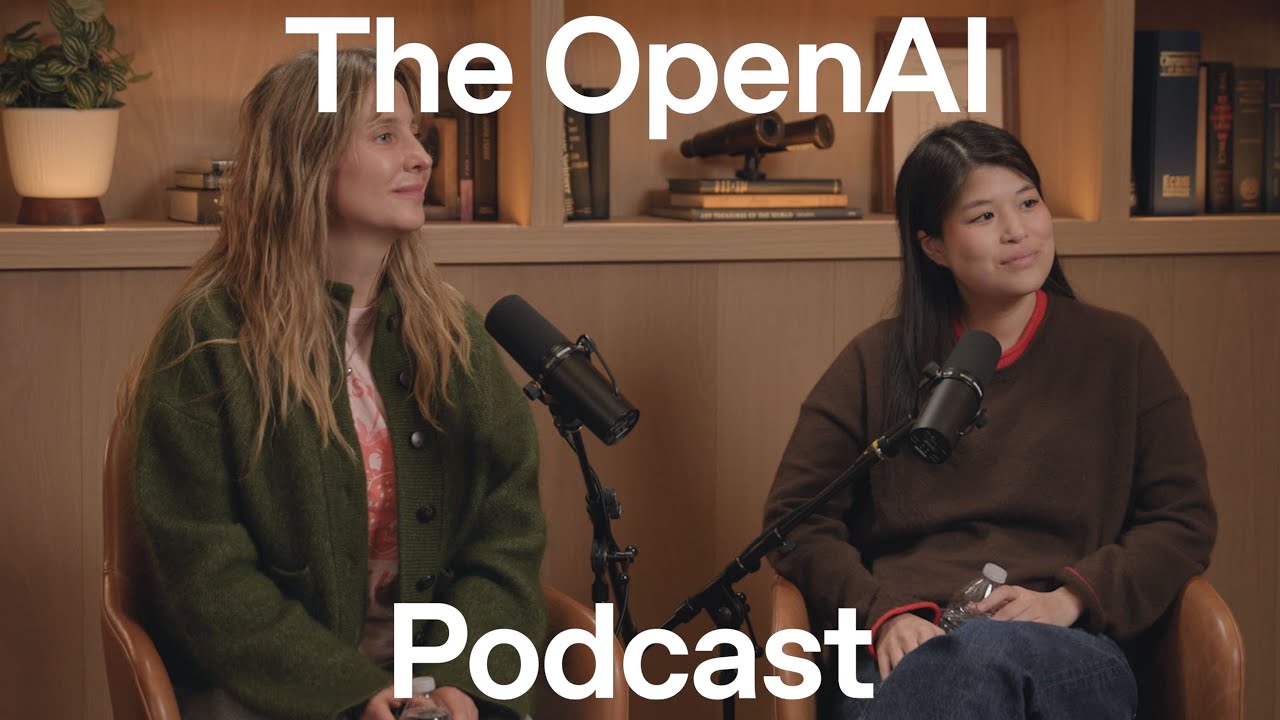
Researchers and product managers from OpenAI discuss the evolution from GPT-5 to GPT-5.1, detailing the shift to universal reasoning models. They explore the nuanced concept of model "personality," the technical challenges of balancing steerability with safety, and how features like Memory and improved context awareness are creating more emotionally intelligent and personalized AI interactions.
The Shift to Universal Reasoning Models with GPT-5.1
A primary goal for the GPT-5.1 release was to address user feedback about GPT-5 and to transition the entire user base, including free-tier users, to reasoning models. For the first time, all models within the chat experience are capable of “deciding to think” before responding, a process analogous to a Chain of Thought. This approach, which mirrors Daniel Kahneman’s System 1 (fast, intuitive) and System 2 (slow, deliberate) thinking, allows the model to dynamically allocate cognitive effort based on the complexity of the prompt.
For simple queries, the model responds quickly. For more difficult questions, it engages in a deeper reasoning process, refining its answer and utilizing tools if necessary. This enhancement provides a significant boost in intelligence across the board, most notably improving instruction following and performance on tasks that might not seem to require deep reasoning at first glance.
Refining User Experience: From “Cold” to “Warm”
Feedback on GPT-5 indicated that users sometimes found the model to have “weaker intuition” and feel less “warm.” Investigation revealed this was not just about the model’s innate response style but was a product of the entire system, or “harness.” Several key adjustments were made in GPT-5.1 to address this:
- Improved Context Awareness: The context window was enhanced to carry more information from previous turns. This prevents situations where the model “forgets” important user-disclosed information (e.g., “I’m having a bad day”), which could feel cold and jarring.
- Consistent Custom Instructions: GPT-5.1 is significantly better at adhering to custom instructions, giving users more reliable control over the model’s behavior and preventing it from reverting to default quirks.
- Smoother Model Switching: The previous auto-switcher, which moved users between different models (e.g., a base chat model and a reasoning model), could create an inconsistent experience. For example, a user discussing a sensitive personal topic might be suddenly switched to a reasoning model that provides a very clinical, jarring response. The system is now designed to make this transition feel more seamless.
Deconstructing “Model Personality”
The term “personality” is overloaded and refers to two distinct concepts in the context of ChatGPT.
- Response Style (The Feature): This is the narrow definition, referring to controllable traits like tone, verbosity, and emoji usage. The product feature named “personality” allows users to select these styles to better suit their preferences.
- The Holistic Experience (The “Harness”): For most users, “personality” is the aggregate of their entire interaction with the application. This includes everything from the UI font and response latency to how the model handles rate limits or integrates different capabilities like image generation and voice. Users perceive this complex assembly of systems as a single, unified personality.
The art of this work involves mapping user feedback about the broad “personality” to specific technical components within the models and the surrounding application to improve the overall experience.
The Technical Challenge: Steerability vs. Hard-coded Behavior
A central challenge in post-training is balancing model behavior with user freedom. The guiding principle is to “maximize user freedom while minimizing harm.” This creates a delicate trade-off.
Part of the art here is figuring out how to pull out these quirks of the model that can come across as personality without breaking steerability, which is what users ultimately want. That’s the freedom component.
For instance, if the model develops a quirk of overusing m-dashes, simply training it to never use them would be a mistake. This would remove the user’s ability to request an m-dash, thus reducing steerability. The goal is to refine the default behavior without making the model incapable of following explicit user commands.
This philosophy extends to safety systems. Early models were prone to refusing requests broadly to avoid misuse. The approach has evolved toward “safe completions,” where the model attempts to fulfill the user’s request in earnest while avoiding the specific harmful component. This allows for more nuanced and useful interactions, such as a writer exploring a crime scene for a novel without being completely blocked.
Personalization, Memory, and the Future
As models become more intelligent, they become more steerable, opening the door for deeper personalization. The introduction of the Memory feature is a key step in this direction. Memory allows the model to retain key facts about a user across conversations, eliminating the need for repetition and enabling it to provide more grounded, context-aware responses. Users retain full control, with the ability to view, delete, or disable memories.
Looking ahead, the goal is for models to infer more about the user’s context—such as their level of expertise in a given field—to tailor the interaction automatically, while always keeping the user in control. As one speaker noted, a PhD researcher was initially unimpressed by a response, but after prompting the model to act as a frontier researcher in their specific field, it “proposed something that my lab just broke through with two weeks ago but hasn’t published yet.” The future lies in making this level of powerful customization more accessible and intuitive, moving beyond the need for explicit and complex prompt engineering.