Shaping Model Behavior in GPT-5.1— the OpenAI Podcast Ep. 11
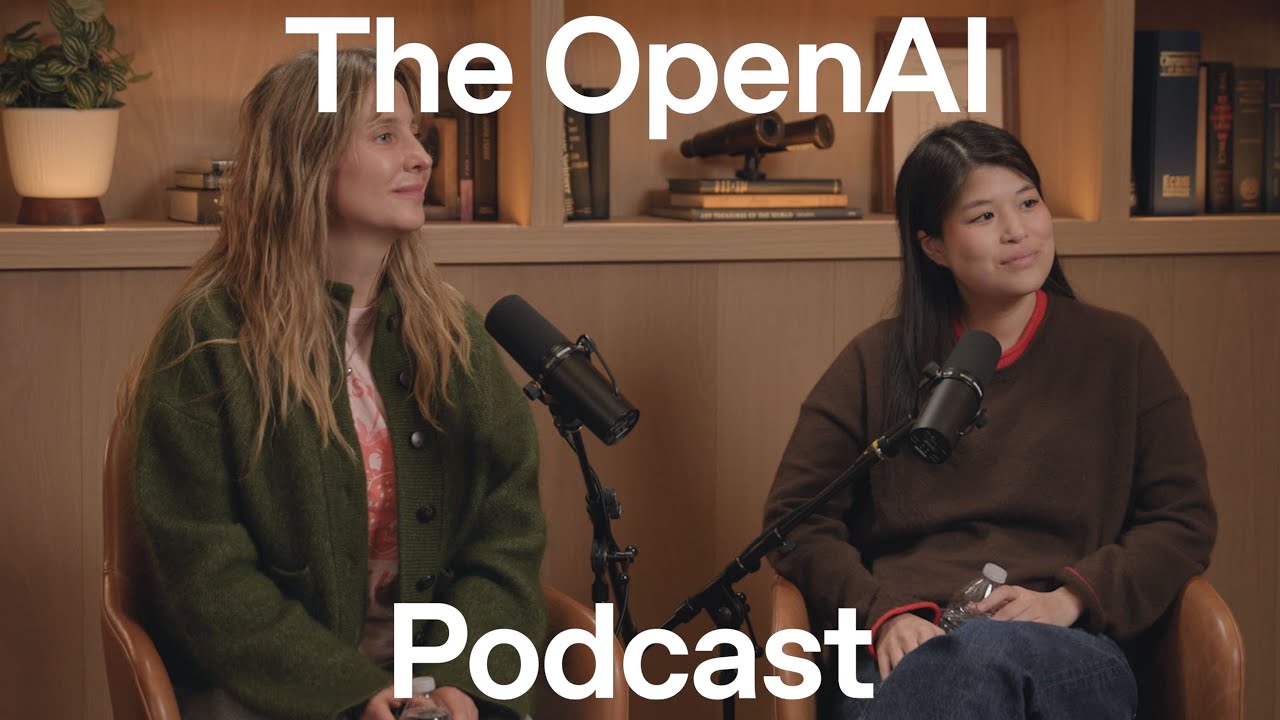
Researchers Christina Kim and Laurentia Romaniuk discuss the development of GPT-5.1, focusing on the shift to making reasoning models the default. They explore the nuanced concept of model "personality" as a blend of response style and the entire user experience, and detail the ongoing work of balancing model steerability with safety.
The Shift to Reasoning Models in GPT-5.1
A primary goal for GPT-5.1 was to make reasoning models the default for all users for the first time. This represents a significant architectural shift where the model can intrinsically decide when to “think” more deeply about a prompt, a process analogous to Daniel Kahneman’s “System 2” thinking. For simple queries, the model responds quickly (“System 1”), but for more complex questions, it engages in a Chain of Thought-like process to refine its answer and use tools if necessary.
This enhancement leads to broad improvements in intelligence across the board, particularly in instruction following. Even for use cases that don’t seem to require deep reasoning, the capability for the model to think before responding results in higher quality and more accurate outputs.
Addressing User Feedback and Improving “Warmth”
GPT-5.1 was developed to directly address community feedback that its predecessor, GPT-5, felt like it had “weaker intuition” and was less “warm.” The investigation into this feedback revealed several contributing factors:
- Context Window: The previous model’s context window didn’t carry enough information forward, making it feel forgetful and “cold,” especially in conversations where users shared personal information.
- The Auto-Switcher: A new feature in GPT-5 was an auto-switcher that moved users between different models (e.g., chat and reasoning). This could be jarring, as the models have different response styles. A user having an emotional conversation might suddenly be switched to a reasoning model that provides a very clinical answer, breaking the conversational flow.
- Instruction Following: GPT-5.1 is significantly better at adhering to custom instructions, giving users more consistent control over the model’s behavior and quirks.
The overall effort was an aggregate of changes designed to make the model feel warmer and more intuitive, acknowledging that “personality” is the sum of the entire user experience.
Personality: A Dual Definition
The term “personality” is overloaded and is understood in two distinct ways:
- Response Style & Tone: This is the most direct interpretation, referring to controllable traits like conciseness, verbosity, or emoji usage. New features allow users to guide the model toward a preferred style.
- The Holistic User Experience: For most users, “personality” encompasses the entire interaction with the application. This includes the UI’s font, response latency, the integration of different modalities (text, image, voice), and even system behaviors like rate limits. It’s an “omni experience” that feels like a single entity but is actually an “assembly of many things.”
The Art of Steerability vs. Safety
A core challenge in shaping model behavior is the balancing act between user freedom and safety, guided by the principle of “maximizing user freedom while minimizing harm.”
- The Risk of Over-Correction: If researchers apply too much pressure to remove a specific quirk (e.g., the model’s overuse of em-dashes), it can break “steerability.” A model trained to never use an em-dash cannot fulfill a user’s request to use one. The art is in removing undesirable default behaviors without removing the capability itself.
- Evolution from Refusals: Early models were trained to be overly cautious, often refusing requests with “I cannot do this.” The approach has evolved toward “safe completions.” If a user’s request crosses a safety boundary, the model now attempts to fulfill the user’s underlying intent in a safe and helpful way, rather than issuing a blanket refusal. This allows for more nuanced and useful interactions, such as a mystery writer exploring a fictional crime without being blocked.
- Handling Subjectivity: The models are being improved to handle subjective topics with more nuance. This involves expressing uncertainty where appropriate, exploring ideas the user brings, and staying anchored in objective truths when they exist.
The Future: Customization, Memory, and New Form Factors
The ultimate goal is to create a world where users can shape the model into the tool they need it to be.
- Memory and Inference: Features like Memory allow the model to retain user-specific context, eliminating the need for repetition and enabling more personalized and proactive responses. As models become more intelligent, they should be able to infer a user’s context and expertise level, reducing the need for extensive prompt engineering. However, users will always remain in control, with the ability to view, edit, or disable these inferred memories.
- Beyond the Chat Interface: The current chat application is just one form factor. As intelligence becomes “too cheap to meter,” smarter models will unlock entirely new use cases and product experiences that we are just beginning to explore.
For users looking to get the most out of the models, the advice is to continuously test them with hard questions in domains they know well. The models are updated constantly, and a capability that was missing three months ago might be fully functional today.