He saved OpenAI, invented the “Like” button, and built Google Maps: Bret Taylor (Sierra)
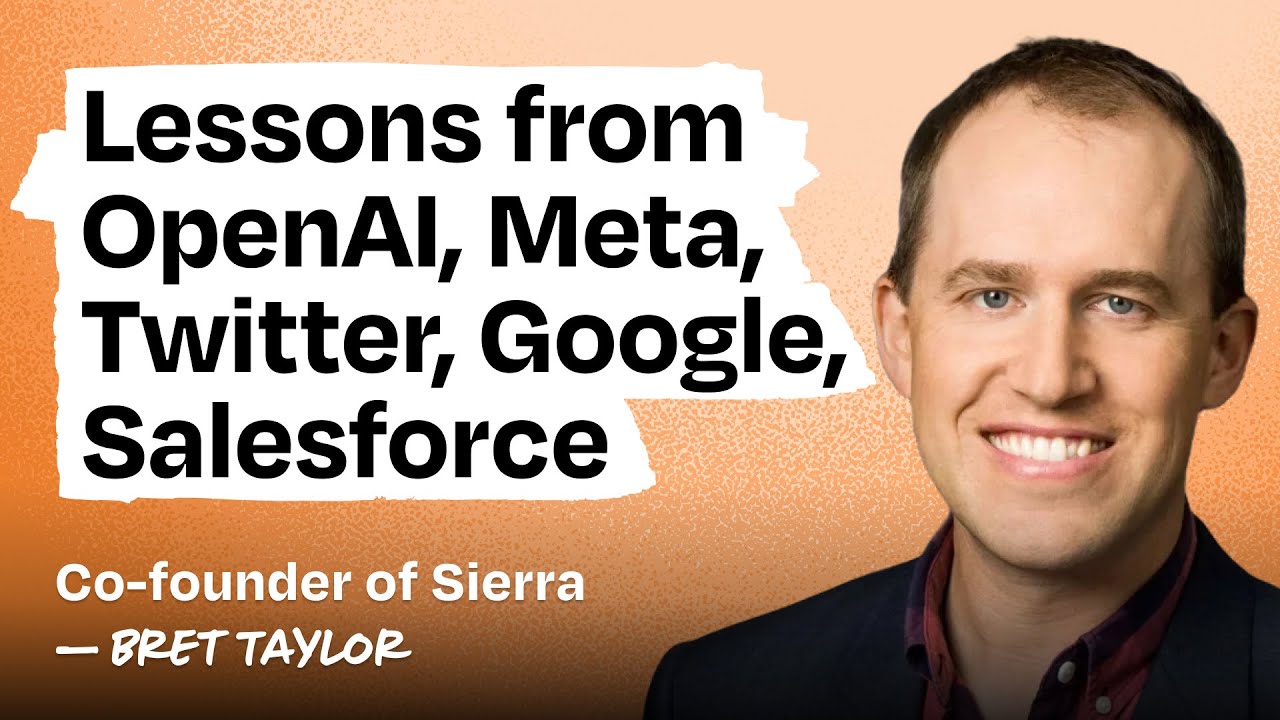
Bret Taylor discusses the AI market's shift to autonomous agents and outcome-based pricing, the future of coding with AI, and strategic advice on GTM, pricing, and where to build in the new AI landscape. He shares career-defining lessons from Google, Facebook, and Salesforce.
The Inevitable Shift from SaaS to AI Agents
The software industry is on the cusp of a transformation as significant as the advent of the cloud. The future is not just another iteration of Software as a Service (SaaS), but a complete paradigm shift towards autonomous AI agents. This transition moves software from being a tool that assists a human to a system that accomplishes a job autonomously.
This creates true, measurable productivity gains, much like how CAD software eliminated the need for manual drafters in engineering. Because the value is tangible and directly attributable, the business model will also evolve. The entire market will be pulled towards outcomes-based pricing. Instead of paying for seats or consumption (like tokens), customers will pay for successful results, such as a resolved customer service ticket or a qualified sales lead. This aligns the incentives of the technology provider and the customer, turning vendors into true partners. At Sierra, for example, customers are billed on a per-resolution basis, directly tying cost to value.
The whole market is going to go towards agents. I think the whole market is going to go towards outcomes-based pricing. It’s just so obviously the correct way to build and sell software.
A New Programming Paradigm for an AI-Powered World
While learning the fundamentals of computer science—like complexity theory, algorithms, and systems thinking—remains critical, the act of writing code is fundamentally changing. We are moving from a world where humans type code to one where they operate a “code-generating machine.”
This shift necessitates a new programming system designed not for human ergonomics but for AI generation and verification. Today’s popular languages, like Python, were optimized for human readability and ease of use, often at the cost of performance and runtime safety. A future system would prioritize:
- Verifiability: The ability to programmatically ensure the generated code is correct, safe, and does what the operator intended. This might involve bringing back techniques like formal verification or building on compile-time safety checks, similar to what Rust does for memory management.
- Robustness: The system should make it easy to build, maintain, and change complex applications with agility, avoiding the pitfalls of massive rewrites.
- Leverage: The goal is to maximize the operator’s leverage, allowing a single person to create and manage incredibly complex systems by effectively directing the AI.
The Three Segments of the AI Market
For founders and builders, the AI landscape can be broken down into three primary segments, each with different opportunities and risks:
- Frontier Models: This market will be dominated by a handful of hyperscalers (like Google, Microsoft, and Amazon) and large labs (like OpenAI). The immense and ongoing Capital Expenditure (CapEx) required to train state-of-the-art models makes this an unviable space for most startups.
- Tooling & Infrastructure: This is the “picks and shovels” market, including data labeling, evaluation tools, MLOps platforms, and specialized models (e.g., ElevenLabs for voice). While there are significant opportunities here (akin to Snowflake or Databricks in the cloud era), these companies are “close to the sun.” They risk being made obsolete as foundation model providers move up the stack and offer competing services.
- Applied AI (Agents): This is the most promising area for startups and will mirror the growth of the SaaS market. The focus is on building agents that solve specific business problems in verticals like customer service (Sierra), legal (Harvey), or marketing. Over time, the technical moat of orchestrating AI will diminish, and success will depend on product quality, domain expertise, and delivering measurable business outcomes.
Go-to-Market and Pricing Strategies for AI
Many AI startups struggle with go-to-market (GTM) because they misalign their strategy with their product and buyer. It’s crucial to be first-principles-driven about how a customer discovers, evaluates, and purchases your software.
- Developer-Led Growth: Works for platform products where engineers are the buyers and have the autonomy to choose tools (e.g., Stripe, Twilio).
- Product-Led Growth (PLG): Effective when the user and buyer are the same person, common in SMB software.
- Direct Sales: This traditional motion is making a comeback and is often the right choice for AI companies, especially when selling to a line of business where the buyer (e.g., a department head) is different from the end-user. Founders, particularly those with technical backgrounds, should not shy away from building a direct sales muscle.
On achieving productivity gains today: While there’s skepticism about AI’s current impact, real gains are achievable but require work. Simply using a tool like GitHub Copilot can be counterproductive if the generated code is subtly wrong, as debugging someone else’s (or an AI’s) logic is harder than writing it yourself. To realize gains now, engineering teams must:
- Build a System of Improvement: Instead of just fixing bad code, teams should perform root-cause analysis to understand why the model failed.
- Focus on Context Engineering: Often, model failures are due to a lack of context. Engineering the right context—for example, through a Model Context Protocol (MCP) server for a tool like Cursor—is key to improving the model’s output for your specific codebase.
Career Lessons from a Legendary Builder
Bret Taylor’s success across roles from engineer to co-CEO stems from a few core principles:
- Maintain a Flexible Identity: Rather than being defined by a single role like “engineer” or “PM,” think of yourself as a “builder.” This allows you to transform into what the company needs you to be, whether that’s selling, designing, or managing.
- Ask “What is the most impactful thing I can do today?”: A lesson from Sheryl Sandberg, this question forces you to reframe your job around the company’s most critical needs, rather than conforming the job to your personal preferences. This shift in perspective unlocks a deeper sense of fulfillment derived from impact.
- Practice Intellectual Honesty: Be wary of “incorrect storytelling.” Founders often default to their area of expertise as the solution to every problem (e.g., an engineer thinks every problem requires an engineering solution). It’s critical to honestly diagnose the root cause of a problem, even if the solution lies outside your comfort zone.
- Learn from Failure: The initial version of Google Local was a failure because it was merely a digital copy of the Yellow Pages. The breakthrough for Google Maps came from inverting the experience to be map-native, creating something fundamentally new that couldn’t exist on paper. This lesson highlights the need for true differentiation rather than incremental improvement.