Llm inference

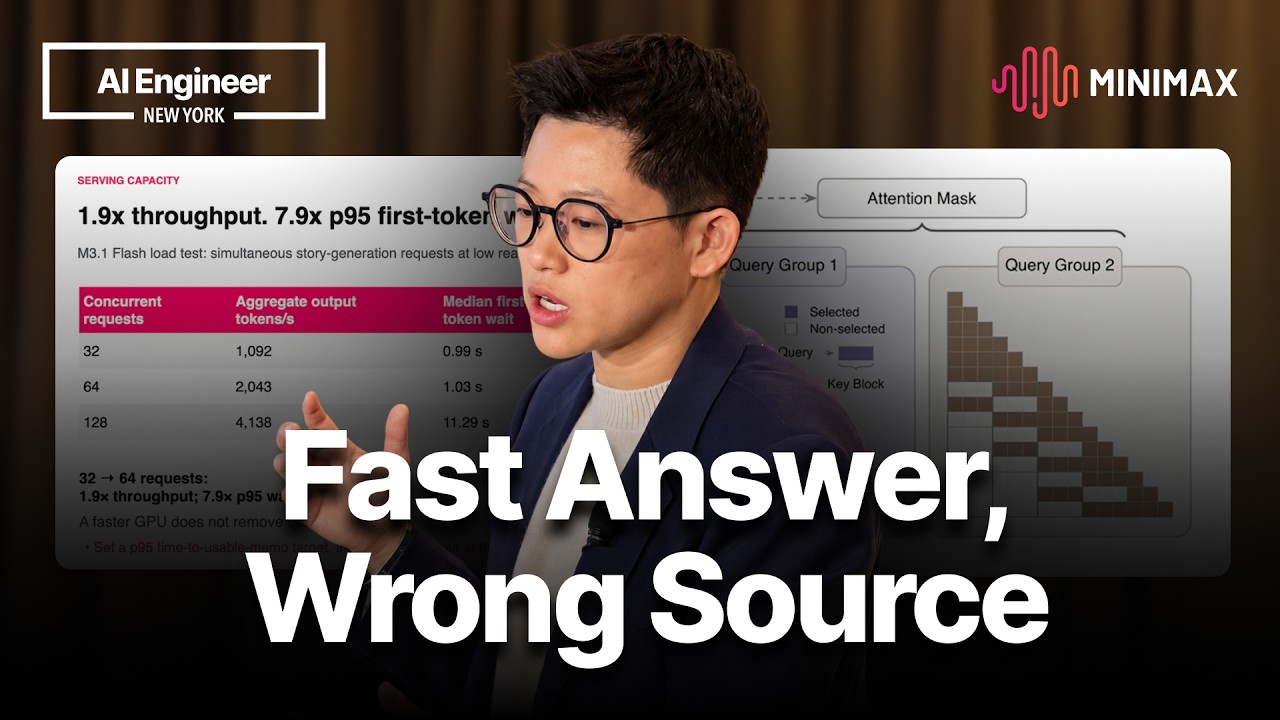
Is a Faster Model Actually Faster? Test the Whole Job — Morgan Suo, MiniMax

Is a Faster Model Actually Faster? Test the Whole Job — Morgan Suo, MiniMax

Morgan Suo of MiniMax tests the changes inside M3.1 Flash on a realistic analyst research task about circuit-board suppliers and AI-driven cash flow. She examines sparse attention, 4-bit KV caches, low-precision MoE experts, speculative decoding, serving concurrency, and reasoning budgets, showing how each saves compute while potentially costing accuracy or latency. She closes with a framework for judging a model switch by verifiable output, the full cost of a usable report, and repeatable results.
The AI Memory Wall: Why LLMs & AI Accelerators Hit a Bottleneck

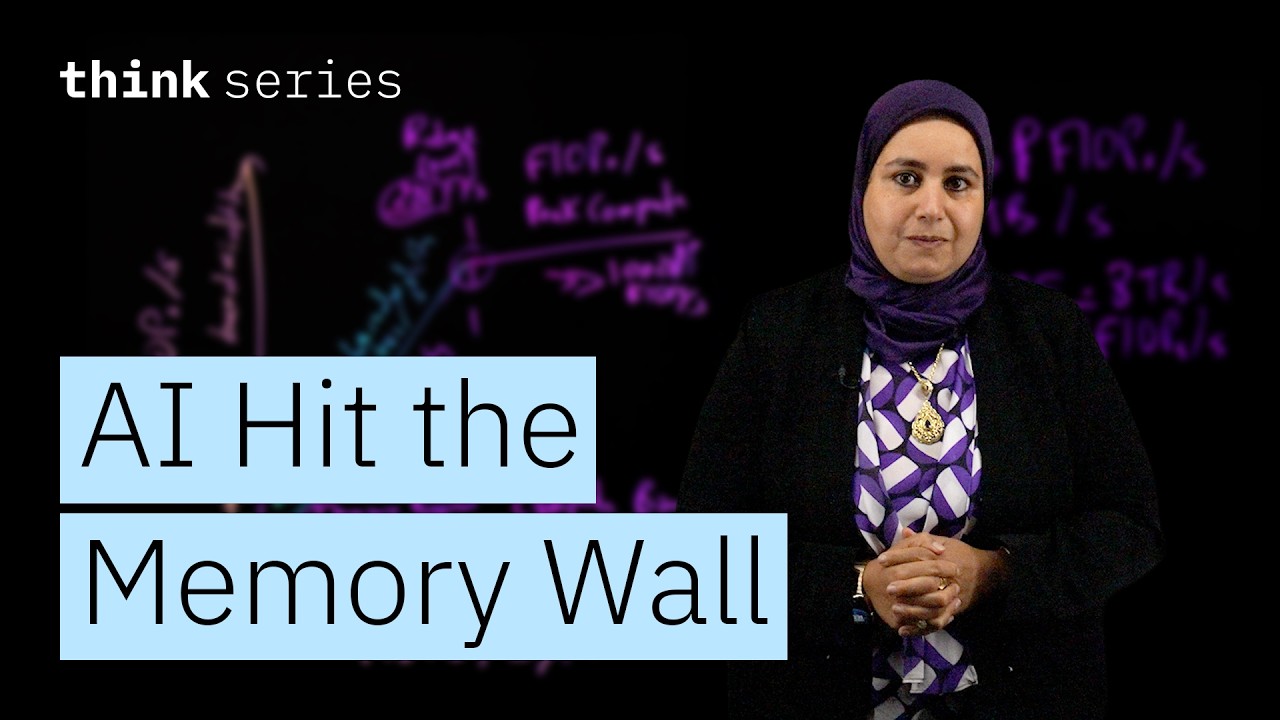
The AI Memory Wall: Why LLMs & AI Accelerators Hit a Bottleneck

A walkthrough of the memory wall, explaining why raw chip compute growth has not translated into proportional AI workload speedups. It covers arithmetic intensity, the roofline model and ridge points for the B200 GPU, why LLM decode is memory-bound while prefill is compute-bound, and how batching and continuous batching shift workloads toward higher efficiency.

The true price of Intelligence: an economic study by Signal65

The true price of Intelligence: an economic study by Signal65

A Signal65 TCO study, presented with CoreWeave, examining the fully loaded economics of AI training and inference. It covers hidden costs such as storage fees, support, and reliability, how performance compounds with price to set cost per million tokens, and how serverless and dedicated inference models differ on useful-token economics.

How Standard Kernel uses compound AI systems to optimize code and extract maximum GPU performance

How Standard Kernel uses compound AI systems to optimize code and extract maximum GPU performance

Chris from Standard Kernel explains how the company uses two autonomous optimization systems, one for whole workloads and one for individual CUDA kernels, to speed up AI inference. He walks through a roughly 2x vLLM speedup on Qwen with a CoreWeave team, details the kernel generation search and the correctness checks needed for frontier-model-written kernels, and presents case studies including 11x faster world models, faster time-series and LLM serving, and customer-driven requirements.

Data Architecture for AI: From Training Pipelines to Agent Memory

Data Architecture for AI: From Training Pipelines to Agent Memory

Alan Kourev, co-founder and CTO of VAST Data, explains how AI workloads (training, inference with KV cache offload, RAG, and agents) access data in fundamentally different ways, and presents a disaggregated, shared-everything architecture, shaped in part by work with CoreWeave, that serves all of them from one unified platform.

Is Speculative Decoding Worth It? Profiling vLLM on NVIDIA Blackwell — Akamai

Is Speculative Decoding Worth It? Profiling vLLM on NVIDIA Blackwell — Akamai

Sheilah Kirui explains speculative decoding for LLMs, detailing how a small draft model proposes tokens for a larger target model to verify in a single pass, accelerating the decoding phase. She covers the memory costs of hosting two models, criteria for choosing an effective draft model, and demonstrates its benefits for structured output (1.6x faster with high acceptance) versus its limited gains for creative tasks. The talk concludes by outlining when speculative decoding is most advantageous, considering VRAM availability, batch size, workload type, and context length.