Latency optimization

Large clusters for small models — Daniel Svonava, Superlinked

Large clusters for small models — Daniel Svonava, Superlinked

Daniel Svonava argues that small open-source models, when specialized and properly served, can achieve frontier performance for specific tasks, offering significant cost savings and latency improvements over large, generalized models or managed endpoints. He highlights challenges with existing serving infrastructure for a fleet of diverse small models and introduces Superlinked's open-source solution, which leverages a pull-based, centralized queuing system, a Rust sidecar for runtime abstraction, and an autoresearch loop for automated model tuning, enabling high throughput (e.g., half a million embedding tokens/sec on one GPU) and efficient deployment of specialized models and LoRAs.
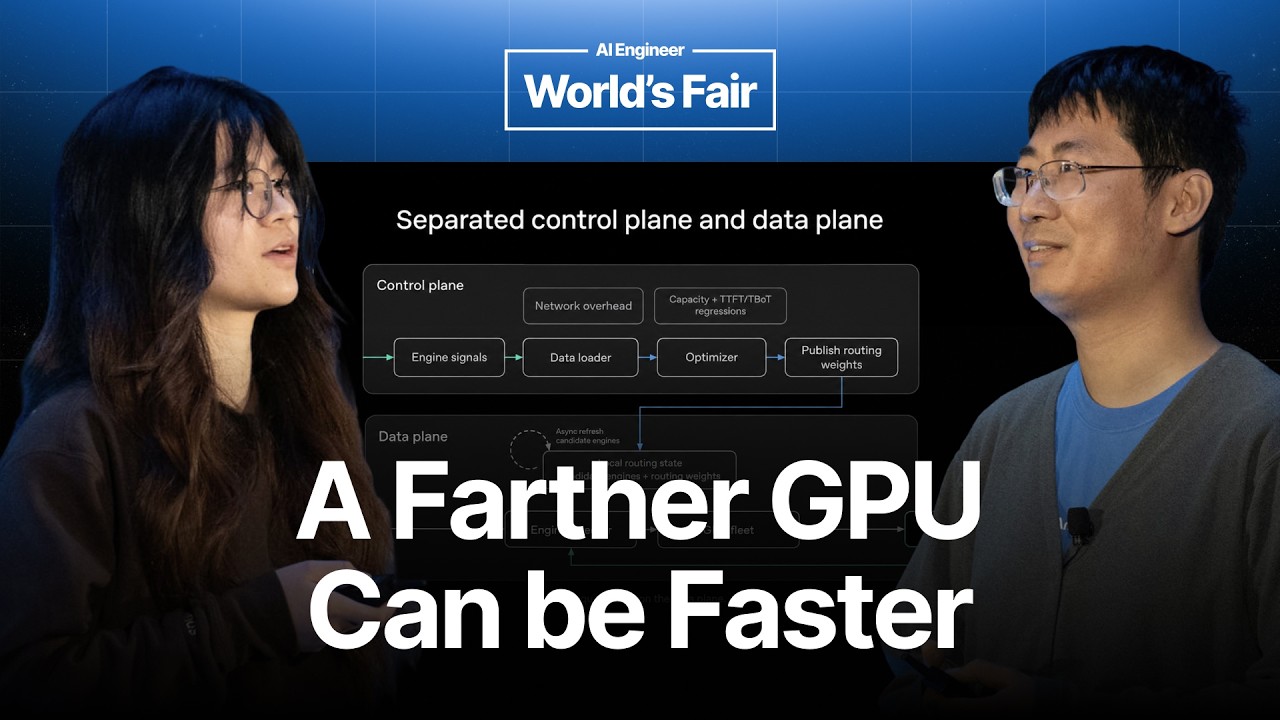
Routing LLM Inference in Production: From Engine Signals to Policy — Qianru Lao & Lu Zhang, OpenAI

Routing LLM Inference in Production: From Engine Signals to Policy — Qianru Lao & Lu Zhang, OpenAI

This talk outlines OpenAI's journey in building a robust inference load balancer. It details the transition from an initial feedback-loop-driven system, which suffered from explainability issues and disruptive oscillations, to a sophisticated control plane/data plane architecture. The new system leverages a global view to optimize end-to-end latency across all traffic, balancing network distance with engine-side queuing, and includes critical protection mechanisms like outlier penalties, dynamic retry budgets, and load shedding to ensure stability in production.

Building AI That Optimizes AI

Building AI That Optimizes AI

Wafer (S24) is a fast AI inference cloud that runs open-source models at industry-leading speeds by using AI agents to optimize GPUs across the entire stack. This unique approach allows them to deliver the low cost of open source with the latency of much smaller models. The company recently raised a $40 million Series A after achieving rapid growth by making GLM 5.2 run 2-3x faster than competitors, driving significant customer adoption due to speed, not just cost, which is crucial for latency-sensitive applications like voice agents.

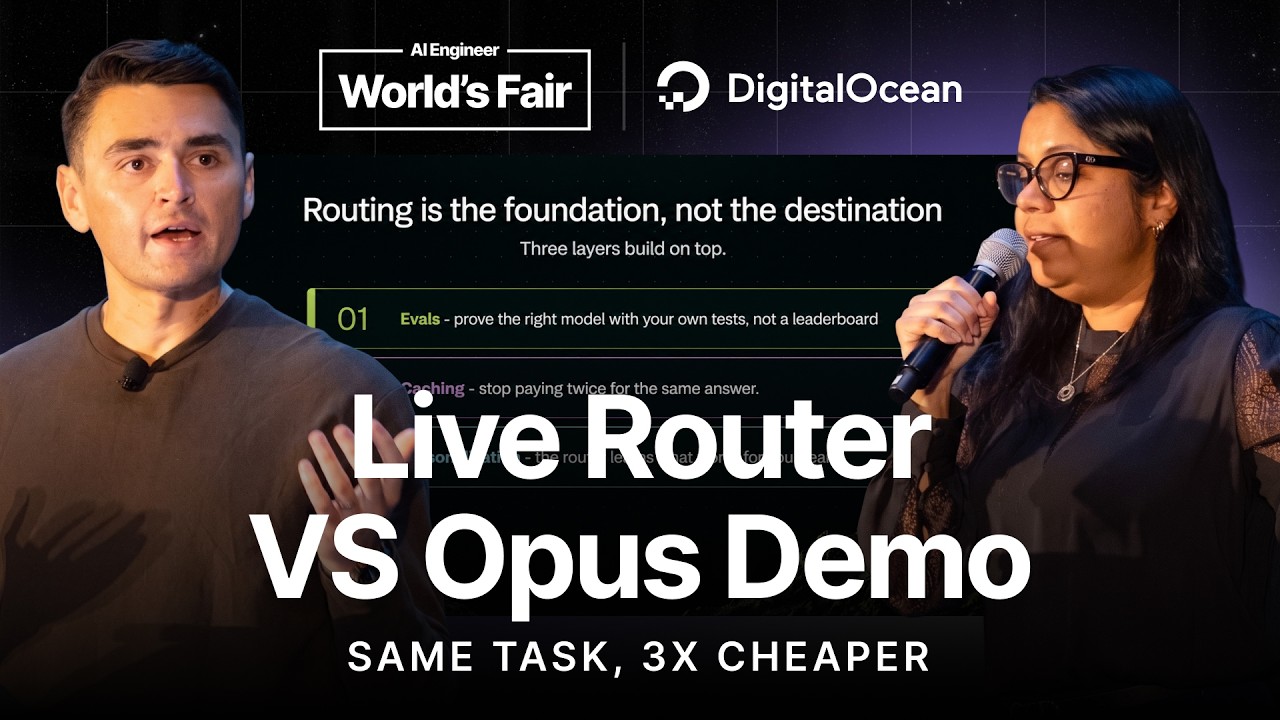
Preferences Over Benchmarks: Model Routing — Archana Kamath & Tyler Gillam, DigitalOcean

Preferences Over Benchmarks: Model Routing — Archana Kamath & Tyler Gillam, DigitalOcean

This talk argues against the common practice of picking LLMs based solely on leaderboards, emphasizing that there's no single best model, only the right one for a given request. It introduces Digital Ocean's Inference Router, a customizable, open-source solution that intelligently selects models based on user-defined preferences (cost, latency, task, quality) rather than benchmarks, demonstrating significant cost savings and performance improvements in live demos.

Decagon’s Playbook for Building Enterprise AI Applications

Decagon’s Playbook for Building Enterprise AI Applications

Jesse Zhang and Ashwin Sreenivas, co-founders of Decagon, discuss their company's transition to open-source models for enterprise AI, emphasizing how fine-tuned small models outperform frontier models on specific tasks. They delve into the role of application-layer companies in an AI-first world, their product-driven 'glass box' approach for enterprises, and the transformative power of their 'Duet Autopilot' agent, which builds other AI agents. The conversation also covers AI's impact on jobs, highlighting the Jevons Paradox in customer support.

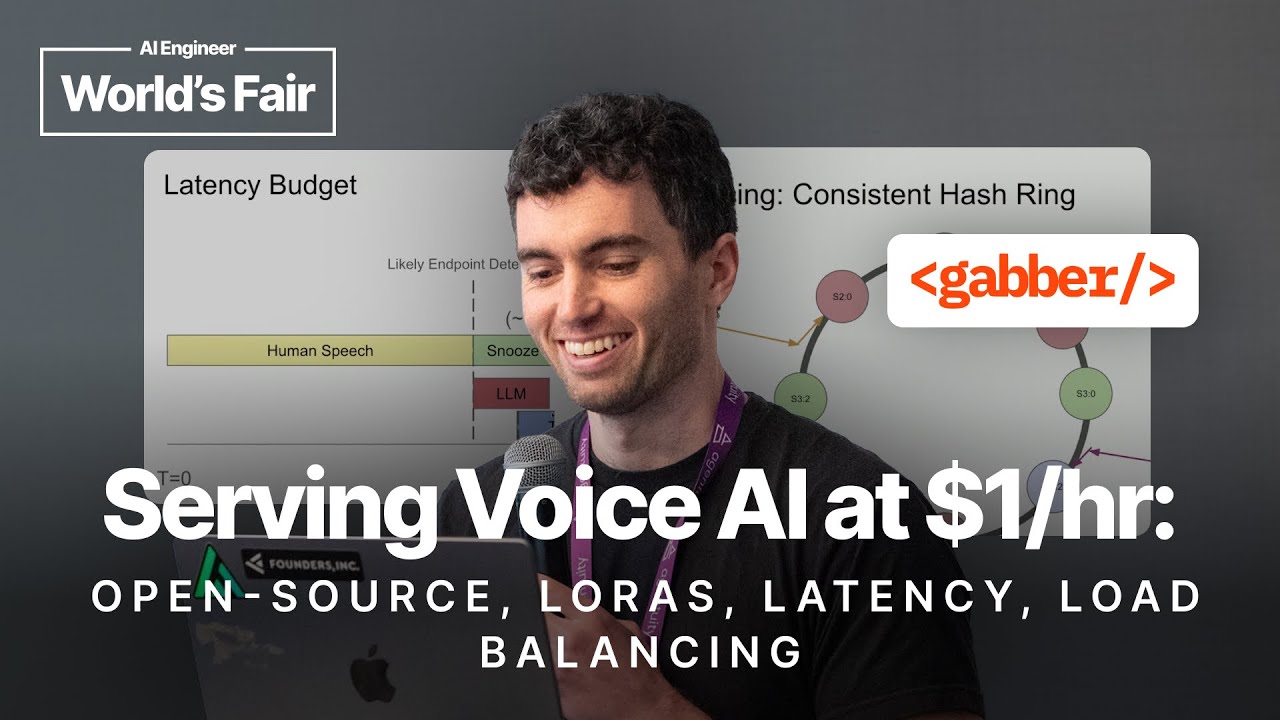
Serving Voice AI at $1/hr: Open-source, LoRAs, Latency, Load Balancing - Neil Dwyer, Gabber

Serving Voice AI at $1/hr: Open-source, LoRAs, Latency, Load Balancing - Neil Dwyer, Gabber

An in-depth look at Gabber's experience deploying the Orpheus text-to-speech model to production, covering latency optimization, high-fidelity LoRa-based voice cloning, and a cost-effective inference stack using vLLM and a consistent hash ring for load balancing.