Preferences Over Benchmarks: Model Routing — Archana Kamath & Tyler Gillam, DigitalOcean
This talk argues against the common practice of picking LLMs based solely on leaderboards, emphasizing that there's no single best model, only the right one for a given request. It introduces Digital Ocean's Inference Router, a customizable, open-source solution that intelligently selects models based on user-defined preferences (cost, latency, task, quality) rather than benchmarks, demonstrating significant cost savings and performance improvements in live demos.
Preferences Over Benchmarks: The Case for Intelligent LLM Routing
The presentation challenges the common industry practice of selecting Large Language Models (LLMs) based solely on public benchmarks or chasing “the top model.” Archa Kamath and Tyler Gillam from Digital Ocean argue that this “one model habit” is fundamentally flawed and increasingly unsustainable.
Why the “One Model” Approach is Failing
Three primary reasons are highlighted for the breaking of the single-model paradigm:
- Exploding Costs: Inference bills are escalating rapidly, forcing even large enterprises like Walmart and Microsoft to cap LLM usage. Relying on premium frontier models for all tasks is economically unsustainable.
- Suboptimal Fit: A single, high-capacity model is often overkill for many tasks. Smaller, more specialized, or open-source models can handle specific workloads effectively at a fraction of the cost.
- Increased Risk: Betting an entire product on a single model creates a critical single point of failure. Model degradation or outages leave no failover mechanism, jeopardizing production systems. The speaker notes that while cloud cost optimization took 15 years to mature, LLM orchestration cost optimization is happening in months.
The Myth of the “Single Best Model”
The core premise is that there is no single best model; rather, the right model depends entirely on the actual request. Examples illustrate this:
- Classification & Labeling: Small open models often suffice, offering significant cost savings.
- In-line Code Completion: Requires fast routing and potentially faster, larger models.
- Code Generation & Bug Fixing: Mid-weight open models can provide good results with cost optimization.
- Accuracy-Critical Tasks (e.g., Code Review, Security): These are where frontier models are genuinely necessary.
Defining the “Right” Model
The optimal model for a request is determined by a multifaceted mix that public leaderboards cannot encode:
- The Task Itself: What is the model trying to achieve?
- System Prompts & Tools: The surrounding methodology and context.
- Cost Willing to Spend: A crucial business constraint.
- Latency Needs: Varies widely by use case (e.g., real-time vs. batch).
- End-User Preference: Ultimately drives the application’s requirements.
Digital Ocean’s Inference Router: A Customizable Solution
Digital Ocean introduces an Inference Router designed to address these challenges. It aims to provide intelligent model selection without the “black box” problem of previous routing attempts.
Architecture and Features
- Open Proxy and Purpose-Built Routing Model: The system uses an open proxy and a specialized routing model, both open-source, ensuring no vendor lock-in.
- User Preferences: Users describe workload priorities (cost, latency, quality, preferred models, hard rules) in natural language or as decision tree rules.
- Performance: The routing model is exceptionally fast, making decisions in under 200 milliseconds per request, costs nothing extra, and has outperformed even frontier models at the routing task itself.
- Customization and Evaluation: The router allows users to customize, evaluate, and iteratively improve routing decisions, fostering a continuous feedback loop: Route, Evaluate, Adjust.
- Configuration: The UI allows defining multiple tasks (e.g., bug fixing, code generation, test writing), assigning model pools, and setting selection policies (e.g., manual ranking with failover, fastest model based on recent performance).
Live Demo Highlights
Tyler Gillam demonstrated the router’s capabilities through several scenarios:
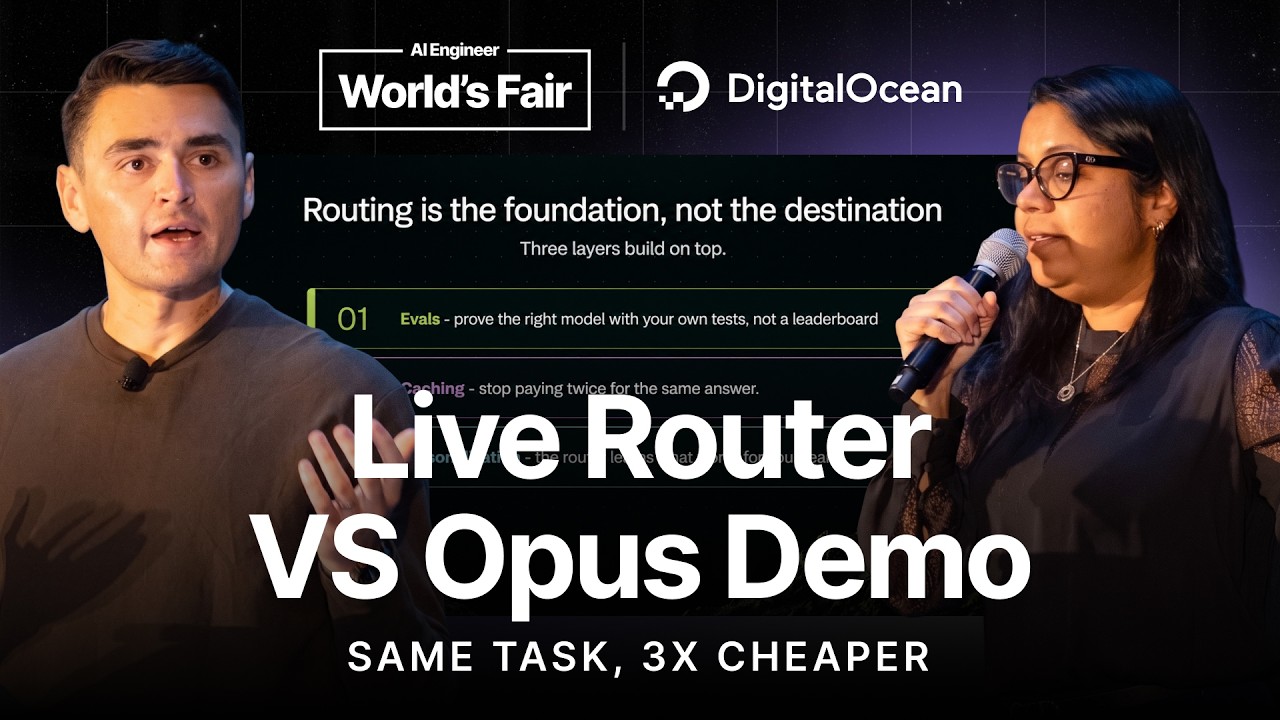
- Playground Comparison: A simple Fibonacci function prompt was sent to a single premium model (Opus) vs. the router. The router dynamically selected cheaper, faster models for tasks like code snippets, code optimization, and unit test generation, significantly reducing cost and latency.
- Coding Agent Workflow: Two terminals ran an open-code agent prompted to “build me a spinning wheel app.”
- Single Model (Opus): Every request went to Opus, leading to consistently high cost and latency.
- Router-Enabled Agent: The router dynamically selected models (e.g., GLM 5.2 for code generation, Claude 5 Sonnet for test writing) based on the task.
- Results: Both agents completed the initial task with comparable quality. However, the router’s session cost was 8 cents versus 25 cents for Opus (a 3x cost reduction). After subsequent tasks (unit tests, documentation), the gap widened to 14 cents for the router versus 44 cents for Opus, demonstrating significant cost savings over a session while maintaining similar quality and optimizing latency per step.
Key Facts and Future Directions
- Speed: Routing decisions in under 200ms using a custom Mixture-of-Experts (MoE) model.
- Integration: Requires zero application code changes for adoption.
- Cost: Free and included with Digital Ocean’s inference engine.
- Open Source: The entire routing model is open-sourced via Plano.
- Foundation Layer: Routing is presented as the foundation for further capabilities:
- Evaluation: To prove model effectiveness for specific use cases.
- Caching: To avoid re-paying for identical answers.
- Personalization: To allow the router to learn and adapt to team preferences over time, creating a continuous improvement loop.
Conclusion
The presentation concludes by reiterating that benchmarks offer only a partial view; user and application preferences are paramount. Digital Ocean’s router is built to honor these preferences while remaining open, preventing vendor lock-in, and enabling teams to build more efficient and resilient AI applications.