Diffusion models

Chai Discovery's Bitter Lesson: Drug Design Is Another Scaling Problem

Chai Discovery's Bitter Lesson: Drug Design Is Another Scaling Problem

Chai Discovery is revolutionizing drug discovery by treating biology as an engineering problem, leveraging AI—particularly diffusion models and the "bitter lesson" of scaling—to design molecules rather than merely discover them. Their approach has boosted antibody design hit rates from 0.1% to 16%, aiming for a "Molecular CAD" suite that collapses discovery timelines from months to days. They partner with pharma, building infrastructure and creating a data flywheel to develop higher-quality, more targeted medicines for previously undruggable diseases.

Causal Models Need Causal Data - Xaira’s X-Cell model (Bo Wang & Ci Chu)

Causal Models Need Causal Data - Xaira’s X-Cell model (Bo Wang & Ci Chu)

Bo Wang and Ci Chu of Xaira Therapeutics introduce X-Cell, a 4.9-billion-parameter diffusion language model designed to predict cellular responses to genetic perturbations. Trained on PISCES, the largest genome-wide CRISPRi Perturb-seq dataset (25.6 million single cells across 16 contexts), X-Cell overcomes limitations of previous observational models. The discussion highlights the critical role of high-quality, causal data, X-Cell's architecture advantages, and its demonstrated ability to generalize to unseen cell types and primary cells, marking a significant step towards truly predictive virtual cell models in drug discovery.

Convergence Analysis for Fast High-Order ODE Solvers in Diffusion Probabilistic Models

Convergence Analysis for Fast High-Order ODE Solvers in Diffusion Probabilistic Models

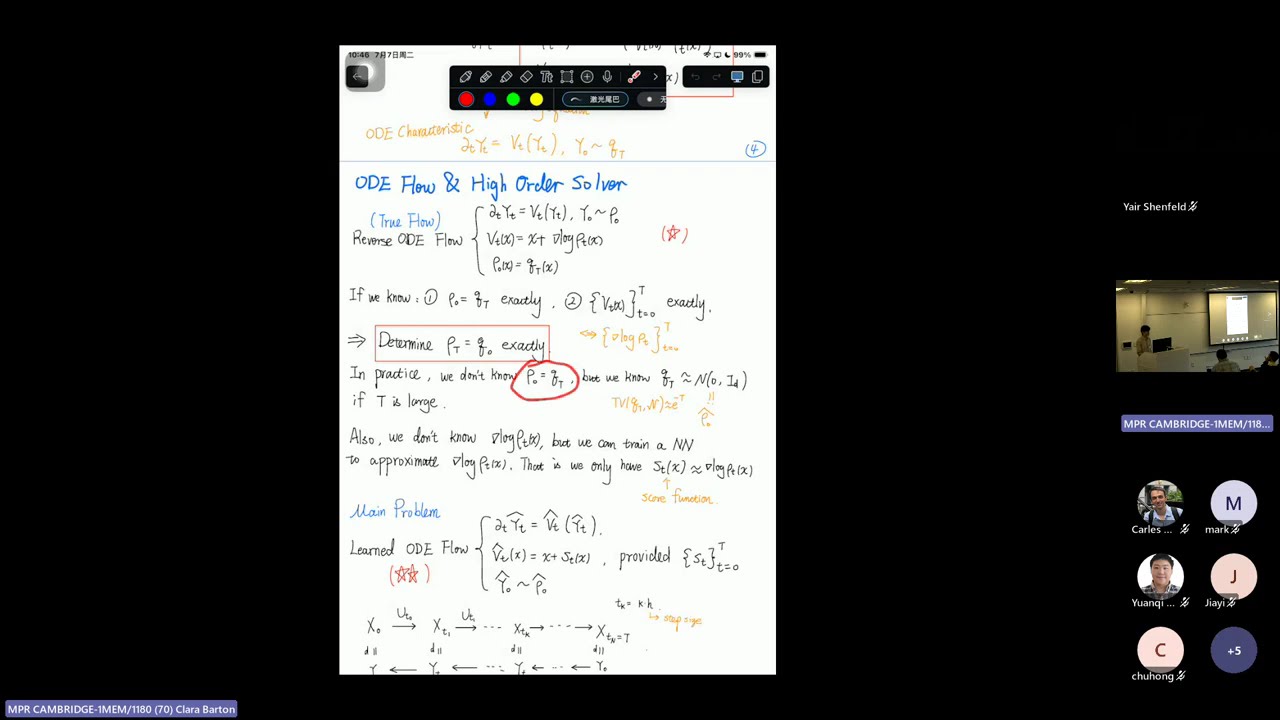
This talk presents a rigorous convergence analysis for fast, high-order ODE solvers in diffusion probabilistic models. It quantifies the interplay between the L2 score matching error (from neural network training) and the discretization error of Runge-Kutta integrators, establishing total variation distance bounds that only require C^2 regularity for the learned score functions. Numerical experiments validate the theoretical rates and the C^2 assumption on benchmark datasets. This work provides a solid theoretical foundation for designing efficient and accurate deterministic diffusion samplers.

Reinforce Adjoint Matching: Scaling Diffusion RL

Reinforce Adjoint Matching: Scaling Diffusion RL

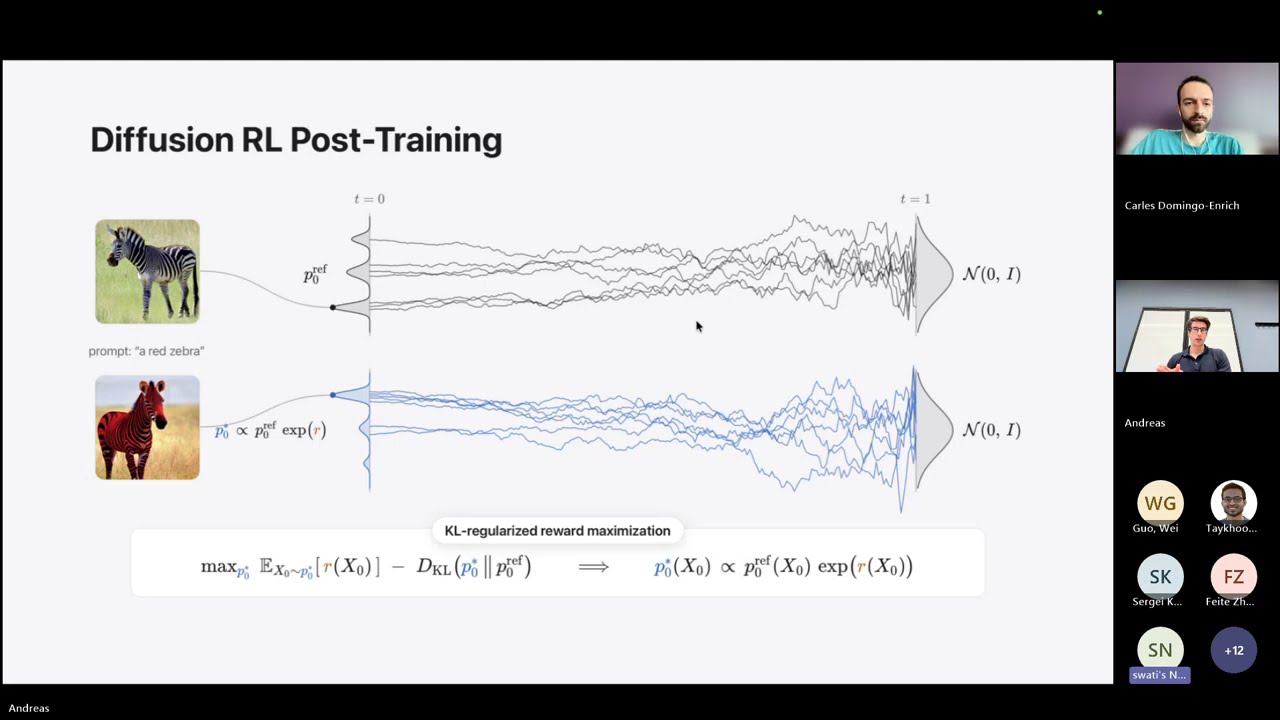
Andreas Bergmeister presents Reinforce Adjoint Matching (RAM), a novel method for scalable reinforcement learning post-training of diffusion models. RAM sidesteps the complexity of existing RL approaches by deriving a consistency loss that directly corrects the pre-training target with a reward signal, eliminating the need for costly SDE rollouts or reward gradients. This approach achieves superior performance and up to 50x faster convergence on challenging image generation tasks like complex composability, text rendering, and human preference alignment.

You Might Not Need 50 Diffusion Steps — Ziv Ilan, Nvidia

You Might Not Need 50 Diffusion Steps — Ziv Ilan, Nvidia

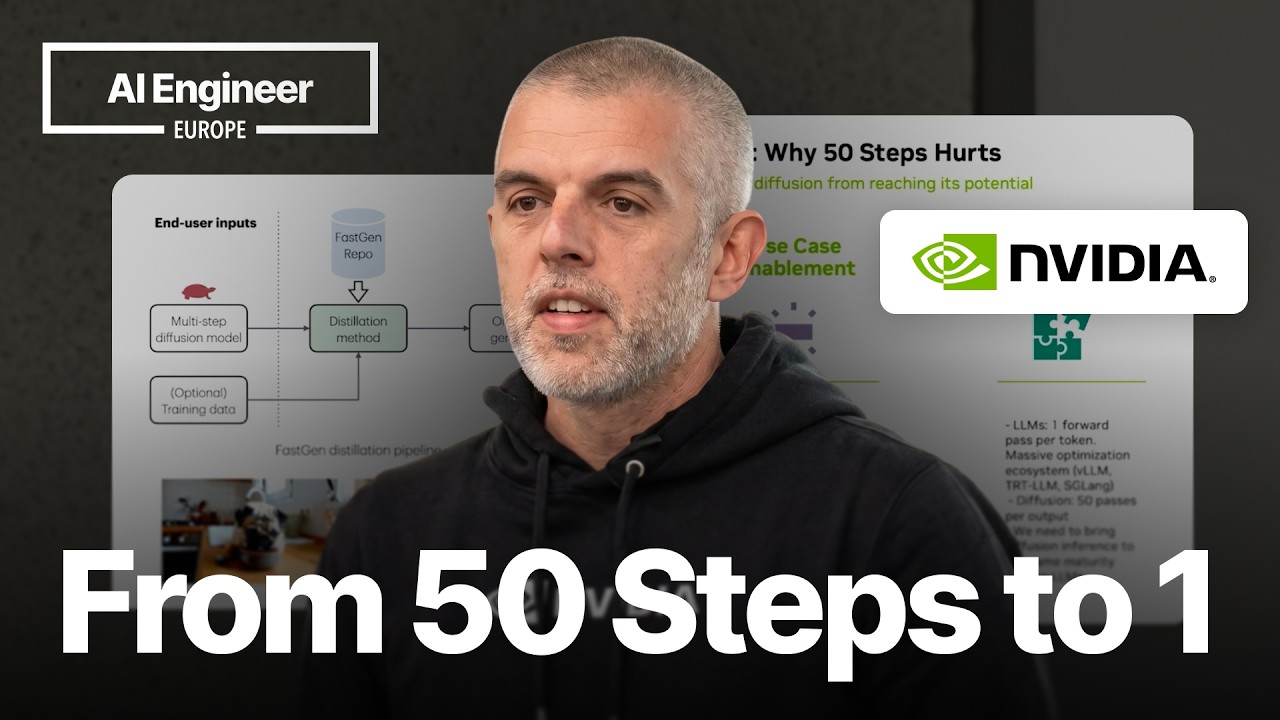
Ziv Ilan from NVIDIA details how latency in video diffusion models can be drastically reduced to achieve real-time generation. He presents a layered approach combining dynamic quantization for memory and speed, chunk-based caching to skip redundant denoising computations, and, most critically, step distillation—training models to achieve high-quality output in significantly fewer steps. These techniques, packaged in the open-source FastGen repository, offer additive performance gains, enabling real-time video on a single Blackwell B200 GPU.

Wavefunction Flows: Efficient Quantum Simulation of Continuous Flow Models

Wavefunction Flows: Efficient Quantum Simulation of Continuous Flow Models

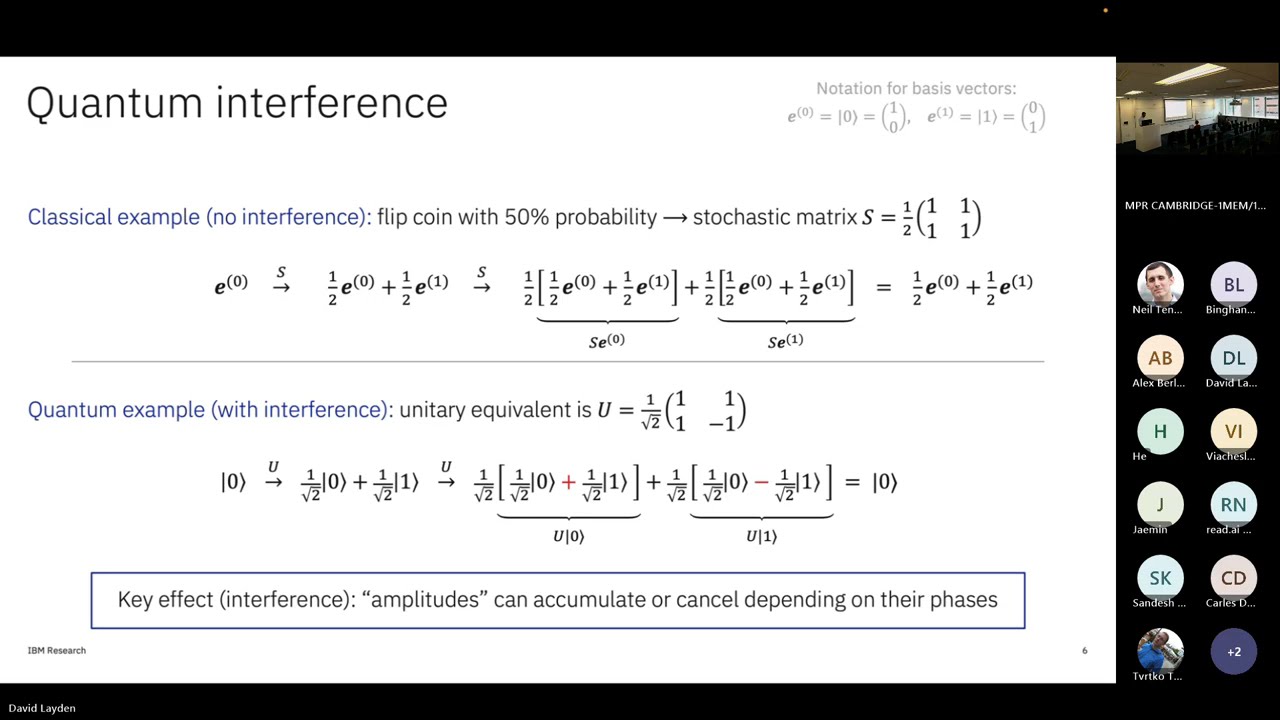
Continuous flow models map naturally to a Schrödinger equation, the fundamental equation of quantum mechanics. This discovery proves that a trained generative model can be efficiently simulated on a future quantum computer, enabling a new, more powerful type of access to its learned distribution for tasks like Monte Carlo estimation and structure discovery.