Convergence Analysis for Fast High-Order ODE Solvers in Diffusion Probabilistic Models
This talk presents a rigorous convergence analysis for fast, high-order ODE solvers in diffusion probabilistic models. It quantifies the interplay between the L2 score matching error (from neural network training) and the discretization error of Runge-Kutta integrators, establishing total variation distance bounds that only require C^2 regularity for the learned score functions. Numerical experiments validate the theoretical rates and the C^2 assumption on benchmark datasets. This work provides a solid theoretical foundation for designing efficient and accurate deterministic diffusion samplers.
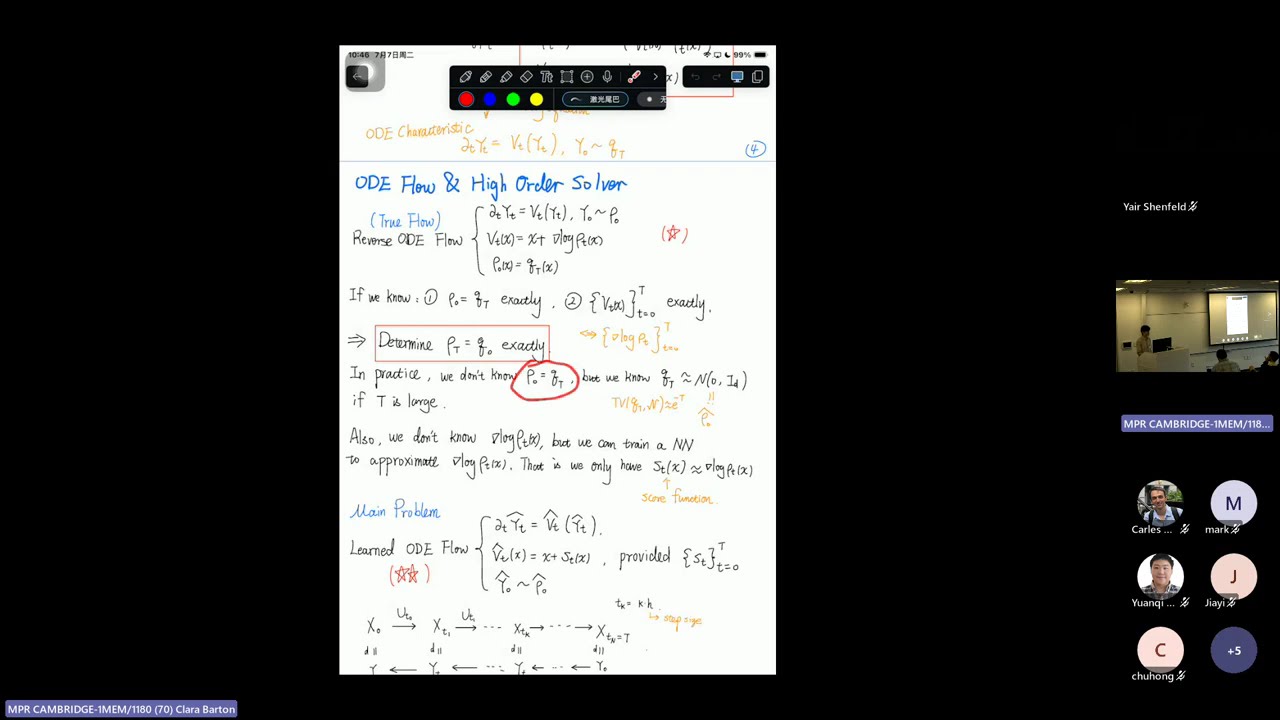
This talk by Zhengjiang Lin, a C.L.E. Moore Instructor at MIT, delves into the convergence analysis of fast, high-order ODE solvers used in diffusion probabilistic models (DPMs). The core problem addressed is the generation of high-fidelity samples from complex, high-dimensional data distributions, a task where DPMs have excelled.
Diffusion Models and Probability Flow ODEs
Lin begins by reviewing the mathematical framework of diffusion models. The forward process gradually transforms a data distribution (e.g., images of cats) into a pure Gaussian noise distribution using an Ornstein-Uhlenbeck process, described by a Stochastic Differential Equation (SDE) or a continuity equation (PDE). The key idea for efficient sampling lies in the reverse process, which aims to reconstruct the original data from noise. This reverse process can be described by a reverse SDE (leading to stochastic samplers like DDPM) or a Probability Flow Ordinary Differential Equation (ODE). The latter is the focus, as it enables faster, deterministic sampling akin to DDIM-style methods.
Challenges in Solving the Reverse ODE
In practice, two main challenges arise when solving the reverse ODE:
- Unknown Initial Data: The exact initial condition (a perfect Gaussian) for the reverse process is not perfectly known, as it’s typically approximated after the forward noise addition. However, as time
Tincreases, the noisy picture exponentially approaches a pure Gaussian, making this initial error small. - Unknown Exact Vector Field: The ODE’s vector field depends on the gradient of the log probability density (the “score function”) of the data distribution, which is unknown. Therefore, neural networks are trained to learn an approximate score function
s_θ(orV̂t) from data, leading to a learned ODE flow.
Numerical ODE Solvers and the Advantage of High-Order Methods
Lin explains how classical numerical ODE solvers, such as the Euler method (first-order) and Heun’s method (second-order Runge-Kutta), can be adapted to solve the diffusion ODE. He emphasizes that higher-order Runge-Kutta (RK) methods offer significant advantages:
- Higher Accuracy: They approximate the true solution more closely.
- Fewer Steps: They can achieve comparable or better accuracy with substantially fewer backward steps compared to first-order methods. This is crucial for fast sampling (e.g., DPM-Solver reducing steps from 100-10,000 to around 10). Lin highlights that even with the same number of function evaluations, a higher-order update structure yields greater accuracy.
Theoretical Challenges and Contributions
Despite the practical success of high-order ODE solvers in DPMs, their theoretical understanding regarding the interplay between score approximation error and discretization error has been limited. Lin identifies two key theoretical challenges:
- L2 vs. L-infinity Score Error: Classical ODE convergence theory typically requires point-wise (L-infinity) closeness of the approximate vector field to the true vector field. However, DPM training objectives primarily minimize an L2 score matching error (an expectation over the data distribution).
- Regularity of Learned Scores: Classical RK methods’
O(H^(p+1))error bounds rely on the assumedC^pregularity of the vector field. Neural network-learned score functions (V̂t) do not inherently guarantee such high regularity.
Lin’s work, presented in two papers, addresses these challenges by establishing rigorous convergence guarantees:
- Total Variation (TV) Distance Bound: The main result provides a bound on the TV distance between the generated distribution and the true target distribution. This bound decomposes into three terms:
- Initialization error (exponentially small,
O(exp(-T))). - Score approximation error:
O(d^(7/4) ε_score^(1/2)), directly relating to the L2 score matching errorε_score. - Discretization error:
O(d * (d H_max)^p), whereH_maxis the maximum step size andpis the order of the RK integrator.
- Initialization error (exponentially small,
- Relaxed Regularity Requirement: Crucially, the analysis relaxes the regularity assumption on the learned score
s_tfromC^pto onlyC^2(specifically, a weightedC^2norm is bounded). This makes the theory more applicable to neural network-based scores. - Iteration Complexity: The work yields an iteration complexity of
O(d^(1+1/p) ε^(-1/p))to achieveεTV accuracy.
Methodology and Verification
To overcome the regularity issue, Lin’s approach involves constructing a **