Cost optimization

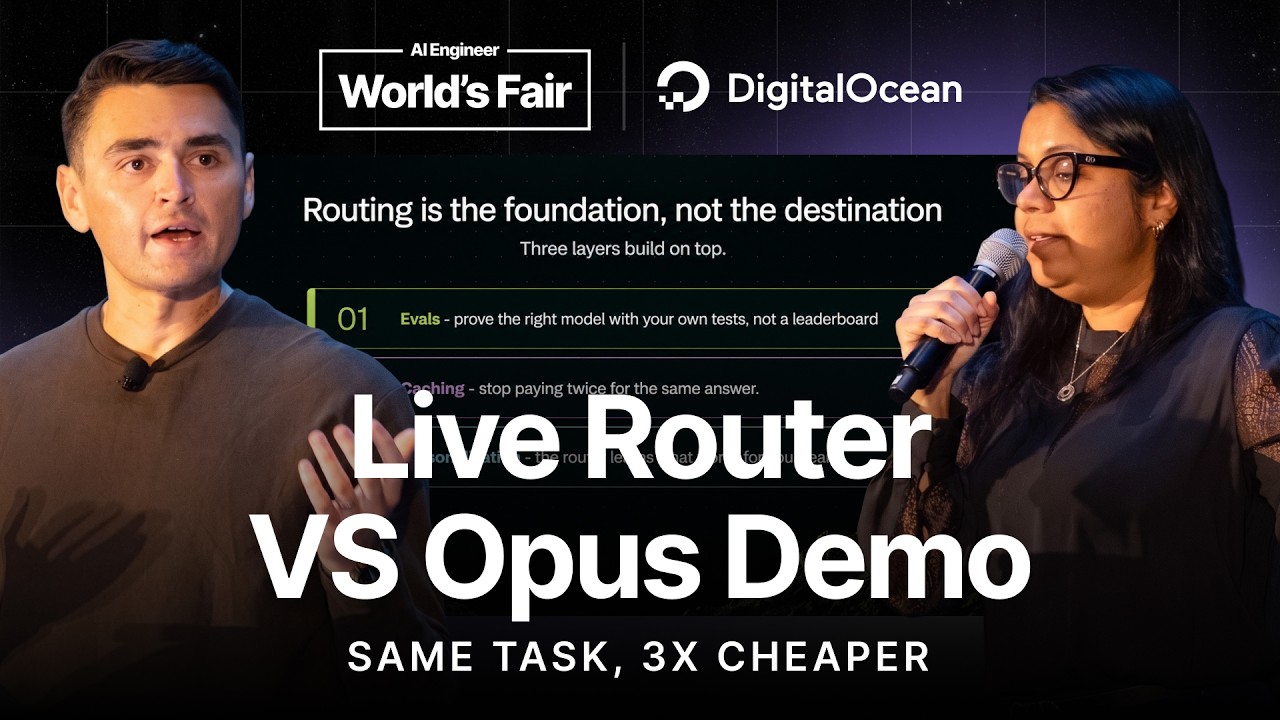
The State of Model Routing — NVIDIA, Cognition, OpenRouter

The State of Model Routing — NVIDIA, Cognition, OpenRouter

A deep dive into model routing strategies for AI/ML production, featuring experts from Cognition, OpenRouter, and NVIDIA. Key topics include optimizing costs with multi-model systems, delegating tasks between frontier and smaller models, managing context efficiently (sidekicks, compaction), and adapting to dynamic task complexities. The panel discusses the fragility of naive routing, the cost implications of in-distribution vs. out-of-distribution tasks, and the evolution of auto-routers driven by real-world usage patterns like OpenClaw's heartbeats. Insights also cover NVIDIA's Flex Run for dynamic model sizing, hallucination probes for detecting model limitations, and the future of hybrid local/cloud routing and model collaboration.

Build Hour: Valuemaxxing with GPT-5.6

Build Hour: Valuemaxxing with GPT-5.6

This Build Hour focuses on "value maxing" with GPT-5.6, shifting from simply tracking token usage to measuring the actual outcomes and efficiency gained from AI. It covers how to select the right GPT-5.6 model (Sol, Terra, Luna) based on intelligence, latency, and cost, and provides practical strategies for optimizing cost-performance. Key topics include leveraging programmatic tool calling, prompt caching, persistent reasoning, and context compaction for API users, along with CodeX-specific tips. A customer spotlight on Ploy demonstrates real-world application, showcasing their migration to GPT-5.6 Sol, which resulted in 2.2x faster builds at 27% lower cost through advanced caching and tool optimization techniques.

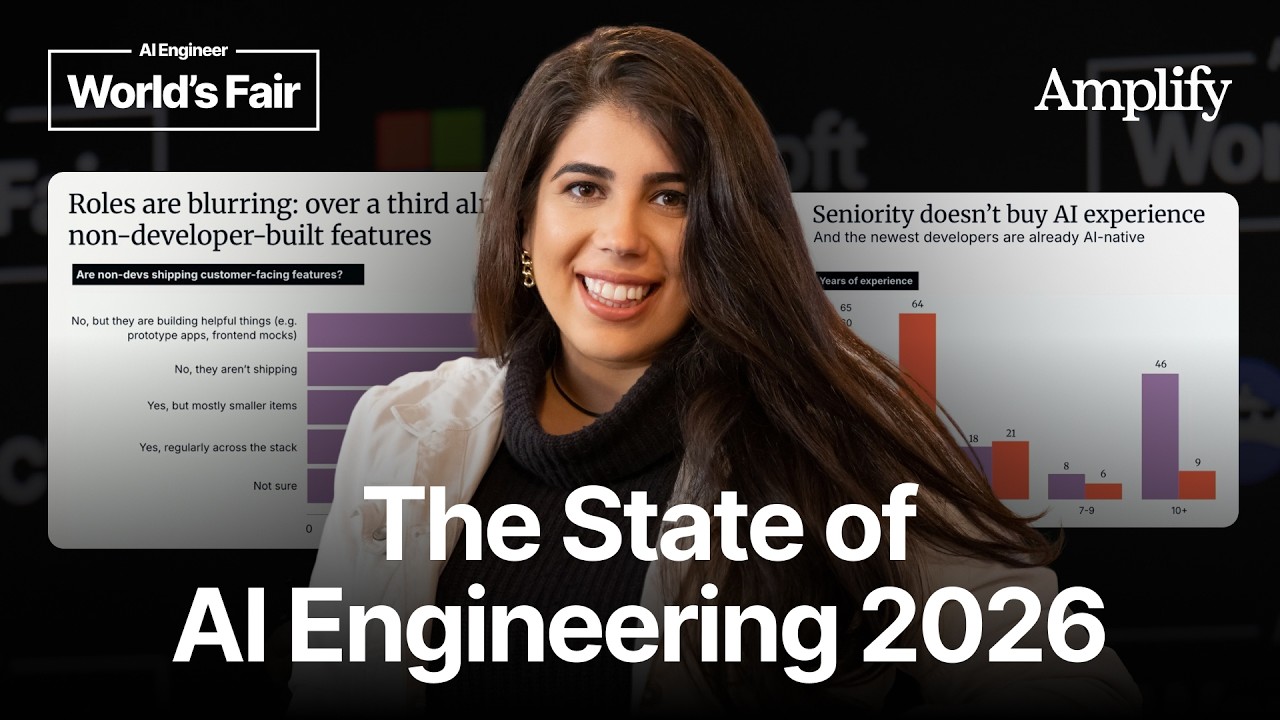
2026 State of AI Engineering — Barr Yaron, Amplify Partners

2026 State of AI Engineering — Barr Yaron, Amplify Partners

Barr Yaron's 2026 AI engineering survey reveals key trends: audio and image generation are rapidly gaining traction, while cost is now a primary engineering constraint. Agents are evolving to take actions within systems, but control mechanisms remain primitive. Evaluation (eval) is still the top infrastructure challenge. AI positively impacts job satisfaction and experimentation but also raises concerns about technical skill erosion and non-developers shipping code, fundamentally changing engineering culture. Predictions include a likely AGI declaration within five years and a shift away from Transformers as state-of-the-art.

Fable 5 as Advisor: Anthropic's Two-Model Pattern for Smarter, Cheaper Agents (Ep. 1010)

Fable 5 as Advisor: Anthropic's Two-Model Pattern for Smarter, Cheaper Agents (Ep. 1010)

The episode explores Anthropic's "advisor strategy," a novel AI agent pattern that combines a fast, cheap "executor" model with a frontier-class "advisor" model. This allows for mid-task consultation within a single API call, resolving the tension between cost and capability. Benchmarks show simultaneous improvements in quality and cost reduction, demonstrating that AI progress is shifting towards intelligent model composition rather than just larger models.

Frontier results, on device - RL Nabors, Arize

Frontier results, on device - RL Nabors, Arize

RL Nabors discusses the significant costs associated with using frontier AI models, covering security, latency, and financial implications. She introduces a framework for right-sizing AI solutions by leveraging smaller, task-specific models and Small Language Models (SLMs). The framework details how to prove task feasibility, establish success criteria with golden datasets, conduct capability evaluations (using tools like Phoenix), and select the most appropriate "Small And Good Enough" (SAGE) model. Nabors further demonstrates how prompt engineering, particularly few-shot prompting, and post-processing can close performance gaps with larger models, while advocating for continuous regression evaluations to maintain performance integrity. The overarching message is to "prototype big, deploy small" to optimize AI deployments.

Scaling the Next Paradigm of Heterogeneous Intelligence — Adrian Bertagnoli, Callosum

Scaling the Next Paradigm of Heterogeneous Intelligence — Adrian Bertagnoli, Callosum

Adrian Bertagnoli from Callosum argues that the era of scaling monolithic models on homogeneous GPU clusters is ending. He introduces "heterogeneous intelligence," a new paradigm where model architectures, chip types, and workflows are optimized together. By routing subtasks to the most efficient model and hardware, this approach achieves significant performance gains, as demonstrated by two key results: a 7x cost reduction in recursive reasoning tasks using Cerebras, and state-of-the-art performance on the Video Web Arena benchmark, outperforming leading GPT and Gemini models at a fraction of the cost and time.