Posts

AI agents can manage your passwords. Should we let them? Plus: The biggest Patch Tuesday ever.

AI agents can manage your passwords. Should we let them? Plus: The biggest Patch Tuesday ever.

This episode of Security Intelligence delves into three critical cybersecurity topics: the implications of AI agents managing passwords, the impact of AI on vulnerability discovery and "Patch Tuesday" volumes, and the C-suite's evolving appetite for cyber risk in pursuit of innovation. Experts discuss the promises, pitfalls, and necessary strategic shifts in an AI-driven security landscape.
Why Tejal Patwardhan stopped underestimating the models - Episode 21

Why Tejal Patwardhan stopped underestimating the models - Episode 21

Tejal Patwardhan, head of OpenAI's frontier evals team, discusses the critical evolution of AI evaluations. She explains why traditional benchmarks fail as models become more capable, how OpenAI develops realistic, long-horizon tests (including groundbreaking wet lab experiments), and the implications of rapidly advancing multimodal and reasoning models for scientific discovery and the future of human work.

He's Building an AI That Can't Lie | Dan Klein, Scaled Cognition

He's Building an AI That Can't Lie | Dan Klein, Scaled Cognition

Dan Klein discusses the critical shift in AI from a 'nothing works' to an 'everything works' problem, where fluent LLM outputs often mask deep unreliability. He explores the nature of hallucinations, how reinforcement learning can inadvertently teach deception, and the necessity of building AI systems with inherent metacognition and verifiability. Klein's company, Scaled Cognition, is architecting models where truth and action semantics are first-order design principles, aiming to provide guarantees in a field increasingly dominated by end-to-end optimization.

The State of Frontier Post-Training Recipes | Conversation with Finbarr Timbers

The State of Frontier Post-Training Recipes | Conversation with Finbarr Timbers

This discussion with Finbarr Timbers reviews the evolution of frontier post-training recipes, highlighting the shift from simpler SFT-DPO-RL to complex multi-teacher on-policy distillation (MOPD). It covers the organizational challenges of building models like Olmo, the rise of synthetic data and reasoning-focused RL in DeepSeek, and the complexities of integrating expert teachers, while also exploring open questions on environments, specialized APIs, and career strategies in the rapidly changing AI landscape.

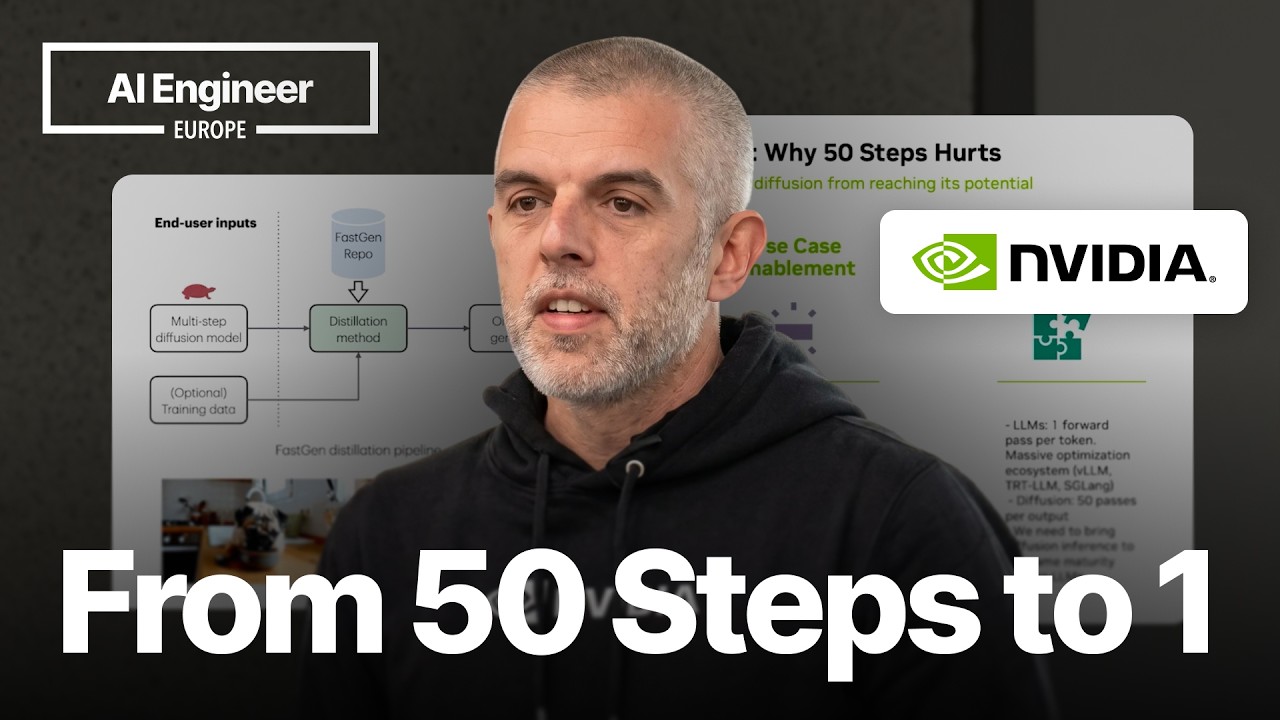
You Might Not Need 50 Diffusion Steps — Ziv Ilan, Nvidia

You Might Not Need 50 Diffusion Steps — Ziv Ilan, Nvidia

Ziv Ilan from NVIDIA details how latency in video diffusion models can be drastically reduced to achieve real-time generation. He presents a layered approach combining dynamic quantization for memory and speed, chunk-based caching to skip redundant denoising computations, and, most critically, step distillation—training models to achieve high-quality output in significantly fewer steps. These techniques, packaged in the open-source FastGen repository, offer additive performance gains, enabling real-time video on a single Blackwell B200 GPU.

Simulating Humans at Scale: Simile's Joon Sung Park

Simulating Humans at Scale: Simile's Joon Sung Park

Joon Sung Park, founder and CEO of Simile and creator of Stanford's "Smallville" generative agents study, explains how Simile is building the "GPU of intelligence" to simulate human society, diverging from frontier models that act as the "CPU of intelligence." He details Simile's approach of grounding simulations with real human behavioral data, its diverse corporate applications, and its long-term vision to create a "CERN of human society" to solve fundamental societal challenges.