Posts

The C4 Model: Visualizing Software Architecture • Simon Brown & Susanne Kaiser • GOTO 2026

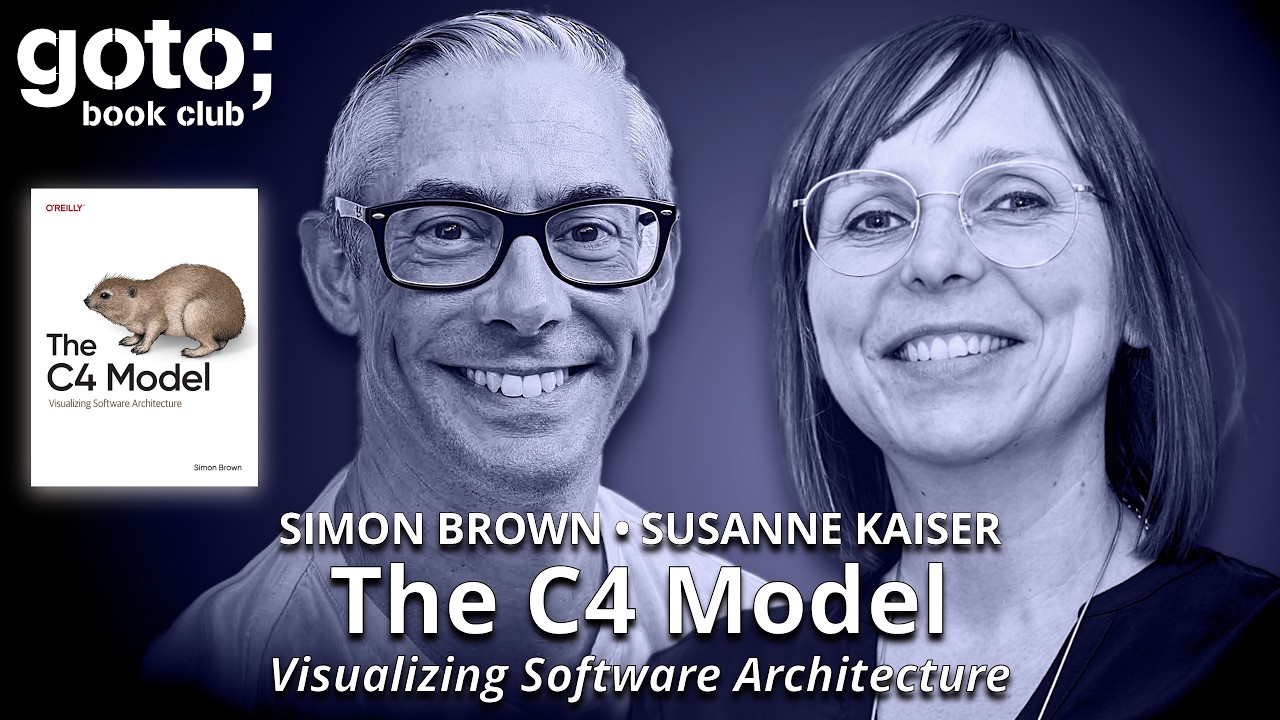
The C4 Model: Visualizing Software Architecture • Simon Brown & Susanne Kaiser • GOTO 2026

Simon Brown, creator of the C4 Model, discusses its origin as a practical solution to clarify messy software diagrams. He explains the four hierarchical levels (context, container, component, code), emphasizing that most teams only need the top two for significant value. The discussion highlights the importance of including technology in diagrams, C4's collaborative nature, and practical advice on modeling microservices and bounded contexts, all while advocating for a lightweight, accessible approach to architectural visualization.

Re-engineering the Semiconductor Supply Chain with Intel CEO Lip Bu Tan

Re-engineering the Semiconductor Supply Chain with Intel CEO Lip Bu Tan

Intel CEO Lip Bu Tan shares his strategic vision for turning around the tech giant, focusing on cultural transformation, strengthening the balance sheet with key investments (including the US government and Nvidia), and driving innovation in foundry, advanced packaging, and new materials. He discusses collaborations like Terafab with Elon Musk, the profound impact of AI on the semiconductor supply chain, and his investment philosophy for the evolving industry, aiming to position Intel for agentic and physical AI at the edge and client, not just centralized compute.

🔬 The Limits of AI in Science - Why We Need Self-Driving Labs — Joseph Krause, Radical AI

🔬 The Limits of AI in Science - Why We Need Self-Driving Labs — Joseph Krause, Radical AI

Joseph Krause, CEO of Radical AI, details how his company uses Self-Driving Labs (SDLs) and AI scientists to overcome the experimental bottleneck in materials science. By automating the full loop of hypothesis generation, synthesis, characterization, and testing, Radical AI is accelerating the discovery of novel alloys for aerospace, defense, and semiconductor applications, achieving 10x the pace of traditional methods. Krause explains why materials science is uniquely challenging for AI, how human intuition trains the AI, and why experimental data, not models, forms the core competitive advantage in this rapidly evolving, geopolitically significant field.

Women in AI | The Founders & Builders Flipping the Script | Event | Creator's Cut | Mar 2026 | 4K

Women in AI | The Founders & Builders Flipping the Script | Event | Creator's Cut | Mar 2026 | 4K

This Creator's Cut of The AI Space Podcast features women leaders across motorsports, tech staffing, AI design, and MedTech. They discuss actionable strategies for 2026, emphasizing why AI adoption hinges on fitting user workflows, the irreplaceable value of authentic human voice, and the necessity of robust processes for scaling businesses. The panel explores AI's impact on job markets, healthcare, creative industries, and ethical development, offering practical advice for founders and professionals.

How To Pick A Startup Idea

How To Pick A Startup Idea

Jon Xu, a YC General Partner, argues against the "perfect idea" trap and juggling multiple startup concepts. He advocates for founders to commit deeply to a single idea, immersing themselves in customer problems to the point of understanding their business intimately. This approach, especially vital in the AI era, involves building at the frontier of technology, verticalizing to own outcomes, and aiming for the most ambitious version of a solution, ultimately yielding invaluable insights and potential for pivot, even if the initial idea doesn't succeed.

Growing & Thriving in a Multi-model World • Alberto Brandolini • GOTO 2025

Growing & Thriving in a Multi-model World • Alberto Brandolini • GOTO 2025

Alberto Brandolini delivers a compelling talk on how to combat software model decay and avoid the "Big Ball of Mud" by strategically applying Domain-Driven Design principles, especially Bounded Contexts. He emphasizes the critical role of visual thinking, structured architectural discussions, and organizational habits in maintaining clean, evolvable systems, particularly when scaling across teams and international markets. The talk highlights the need for continuous design effort, disciplined decision-making, and proactive identification of model boundaries to build resilient software in complex socio-technical landscapes.