Posts

Using Spec-Driven Development for Production Workflows - Erik Hanchett, AWS

Using Spec-Driven Development for Production Workflows - Erik Hanchett, AWS

Erik Hanchett discusses spec-driven development (SDD) as a structured approach to building complex software features with AI coding assistants. He explains how to guide AI "interns" through distinct phases of requirements, design, and implementation, emphasizing context management, the use of "skills," and the crucial role of the human in the loop for review. Hanchett highlights AWS's Kiro tool, which automates much of this process, and the Model Context Protocol (MCP) for integrating external data sources, offering a pathway to higher-quality code and more effective AI collaboration.

The 100-Tool Agent Is a Trap - Sohail Shaikh & Ankush Rastogi, Prosodica

The 100-Tool Agent Is a Trap - Sohail Shaikh & Ankush Rastogi, Prosodica

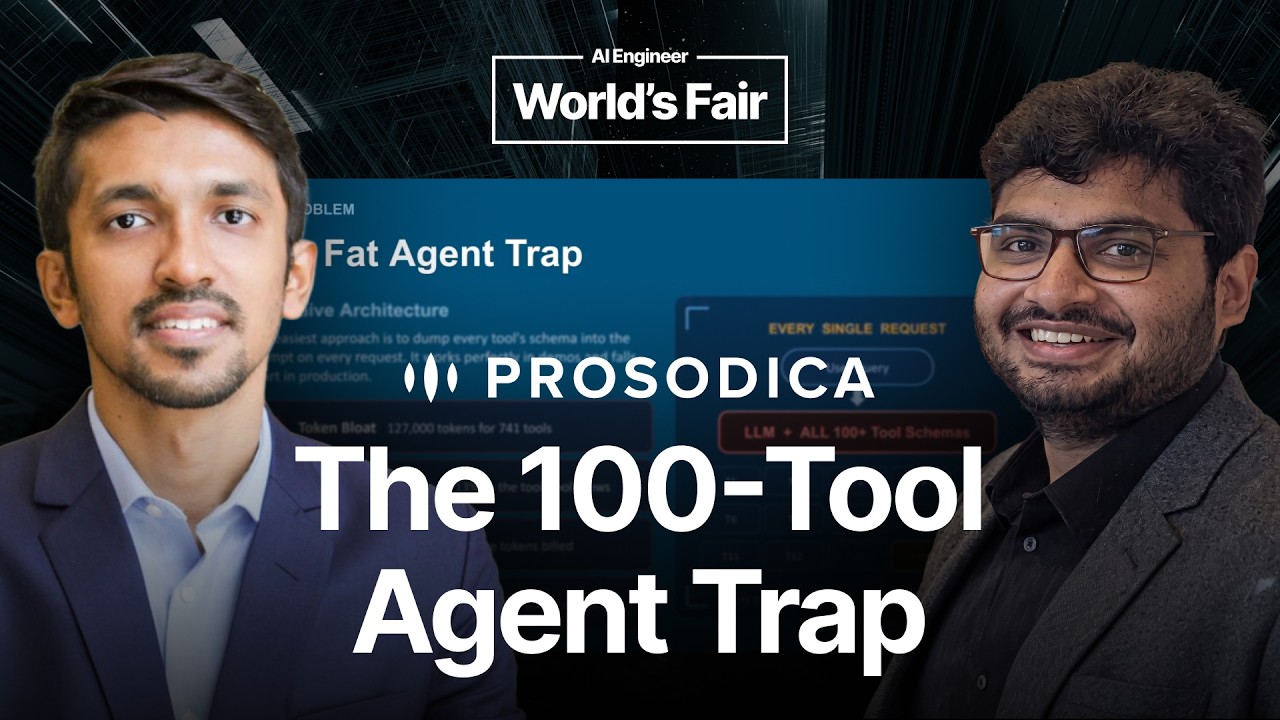
This session unveils the "Fat Agent" trap in LLM agent architectures, where loading an entire tool catalog into the system prompt causes severe latency, cost, and accuracy problems. It presents the Semantic Tool Router pattern, a practical solution leveraging Just-in-Time Context Injection and vector search (RAG for tools) to dynamically provide only relevant tools, dramatically reducing prompt size, enhancing performance, and improving reliability across frontier models like GPT-4o and Gemini 2.0.

OpenAI Codex lead on the new shape of product work | Andrew Ambrosino

OpenAI Codex lead on the new shape of product work | Andrew Ambrosino

Andrew Ambrosino, Product and Engineering Lead for the Codex app at OpenAI, details how AI is transforming product development, shifting focus from implementation to curation and the crucial role of "taste." He discusses AI's current limitations in design, the evolving nature of product roles, and OpenAI's "zone defense" approach to product management. Ambrosino shares his personal workflow with Codex and outlines the vision for it as an intelligent "home base" that orchestrates work across various applications, exemplified by a story of Codex building a Premiere Pro extension.

The Promptware Kill Chain: How Prompt Injection Becomes AI Malware

The Promptware Kill Chain: How Prompt Injection Becomes AI Malware

Promptware introduces a new class of AI malware leveraging prompt injections to exploit architectural flaws in LLMs. This summary details The Promptware Kill Chain, covering stages from initial access and jailbreaking to persistence, lateral movement, and real-world impact. It emphasizes the critical need for a Zero Trust approach, treating AI agents as hostile runtimes to defend against these sophisticated AI-native threats.

India Can Create The Largest AI Companies

India Can Create The Largest AI Companies

This panel from Startup School India explores why India's technical talent is poised to lead the global AI wave, challenging traditional career advice. It highlights Y Combinator's focus on young, high-agency founders who leverage AI for rapid prototyping and embrace 'second mover advantage' to build global companies, emphasizing customer obsession and relentless resourcefulness.

Builders Unscripted: Ep. 4 - Pietro Schirano

Builders Unscripted: Ep. 4 - Pietro Schirano

Pietro Schirano, Founder & CEO of MagicPath, discusses his pioneering work with GPT-5.5 and Codex, transforming creative ideas into software and hardware solutions. He details using advanced AI for image-to-sound conversion, multi-agent workflows, resurrecting obsolete tech with new functionalities, and building his company, MagicPath, on the principle of humans directing AI agents. This interview provides deep insights into the creative potential and practical applications of cutting-edge AI for developers and entrepreneurs.