How Nuclear Will Unlock Energy Abundance with Valar Atomics Founder Isaiah Taylor
Valar Atomics founder Isaiah Taylor discusses how his company is rapidly advancing nuclear energy through hardware iteration, manufacturing, and a unique regulatory pathway. He explains their intrinsic safety philosophy, the strategic importance of vertical integration for speed and cost reduction, and their venture-backed approach to building gigasites. Taylor highlights how the demand for AI compute is a major driver for nuclear, showcasing their direct powering of an NVIDIA Blackwell chip, and casts a compelling vision for a future of "hyper-technoindustrialism" enabled by abundant, cheap atomic energy.
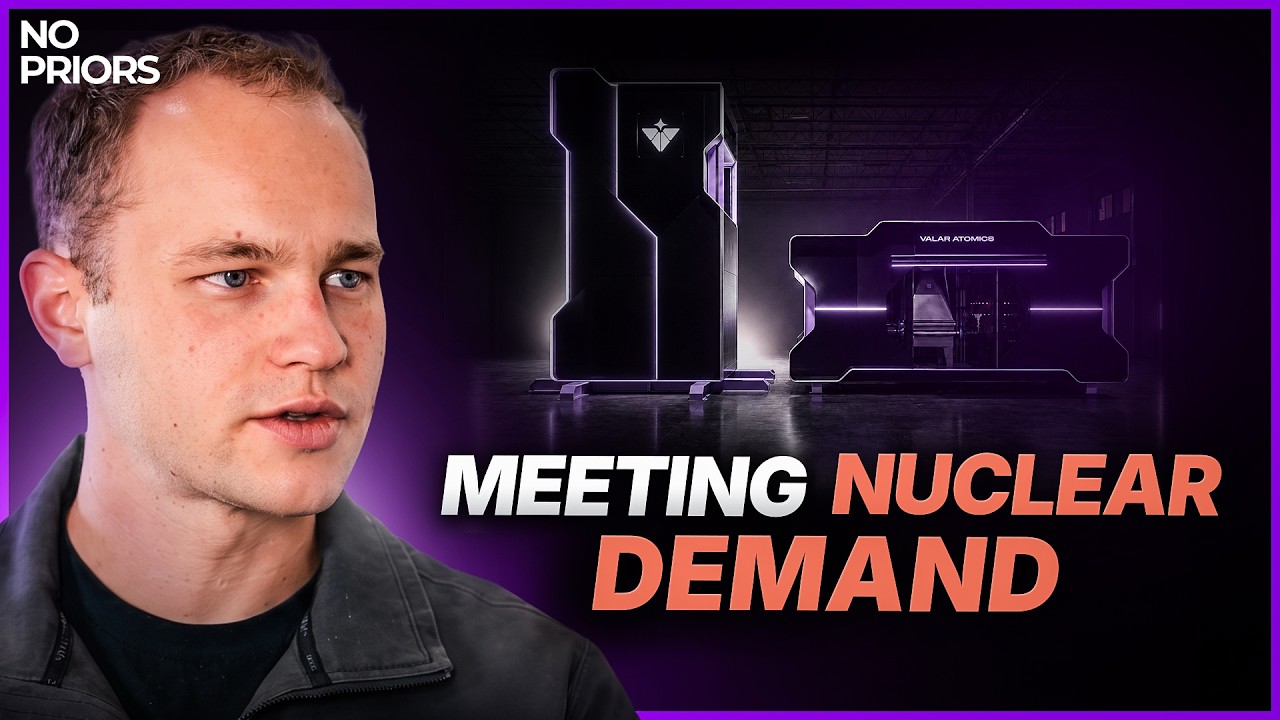
Isaiah Taylor, founder and CEO of Valar Atomics, outlines the company’s mission to revolutionize nuclear energy by focusing on hardware iteration, manufacturing, and scale to make energy ten times cheaper for humanity. Valar Atomics, unlike most of the nuclear industry which relies on modeling and simulation, believes nuclear is fundamentally a hardware execution problem.
The Stalled Nuclear Industry and Valar’s Solution
Taylor explains that nuclear development in the US stalled after the Three Mile Island incident in the 1970s, leading to a public perception of danger despite nuclear energy being empirically the safest form of energy. He notes that the US also shifted from excelling at large-scale civil infrastructure to advanced manufacturing. Valar’s approach acknowledges this shift by building manufactured, small modular reactors (SMRs) through continuous hardware iteration, rather than traditional large-scale construction or solely theoretical design.
A Novel Regulatory Pathway
Valar circumvented the traditional, slow Nuclear Regulatory Commission (NRC) commercial pathway by utilizing a lesser-known Department of Energy (DoE) testing pathway. This pathway, originally designed for R&D and revived by Trump Administration’s Executive Order 14301, allowed Valar to rapidly develop and operate their reactor. Their “Ward 250” reactor is the first advanced reactor built outside a national laboratory and the first to make power by a startup, operating under DoE authority.
Intrinsic Safety and Operational Simplicity
Valar’s safety philosophy prioritizes reducing the consequence of an incident over merely reducing the odds of it occurring. Their reactors are designed for intrinsic and inherent safety, meaning they won’t melt down even if all active safety systems fail. This is demonstrated by their ability to scram a reactor and then turn off all electrical supply, relying on passive cooling mechanisms (like the RCCS panels in passive circulation mode) to safely remove decay heat. This approach, using Trico-fueled, graphite-moderated, helium-cooled designs, allows for greater scale and speed in deployment, as the physics of the plant inherently prevent meltdown.
Speed Through Hardware Execution and Vertical Integration
Taylor emphasizes that the primary challenge in nuclear is not design, but the ability to build, operate, and scale reactors rapidly and affordably. Valar measures its progress by “tick rate”—the time between bringing new reactors online—aiming to reduce this from months to minutes. This focus on speed and scale drives their strategy, including extensive vertical integration. They are willing to build any component in-house that obstructs their pace, exemplified by developing their own pre-cast concrete “Modular Citadel” for shielding (assembled in 42 hours instead of 3 months) and creating their own Reactor Protection System (RPS) for $400,000 in six weeks, compared to a $5 million, two-and-a-half-year vendor quote. This internal capability allows them to bypass inflated costs and slow timelines prevalent in the legacy nuclear industry.
Venture-Backed Nuclear and Gigasite Strategy
Valar leverages venture capital to fund reactor development on equity balance sheets, accepting technical risk where traditional debt financing is hesitant. This approach enables them to build and iterate much faster than competitors reliant on project finance. Their “gigasite” strategy involves independently building large-scale nuclear power infrastructure, confident that demand (especially from AI compute) will follow, rather than waiting for customer deals.
AI Drives Demand and NVIDIA Blackwell Integration
Growing demand for AI compute significantly increases the need for power. Taylor asserts that energy is a commodity, and making it cheaper inherently creates more demand. Valar demonstrated this by powering an NVIDIA Blackwell AI chip directly with their reactor, hosting the world’s first nuclear-powered website (nuclearbyte.com). The site even shows how many uranium atoms are split to deliver each webpage, symbolizing the direct link between their nuclear power and advanced technology.
Vision: Abundant Energy and Hyper-Technoindustrialism
Taylor envisions a future of