The Media Game Has Changed
The conversation explores the shift from legacy media to creator-led platforms, why authenticity has become a competitive advantage, and how founders can build audiences by communicating directly with customers, employees, and the public. They discuss podcasts, social media, storytelling, corporate communications, and the changing relationship between companies, journalists, and audiences. Along the way, they examine how founders can develop a public voice, why some leaders become influential communicators, and what it means to build a brand in a world where distribution is increasingly decentralized.
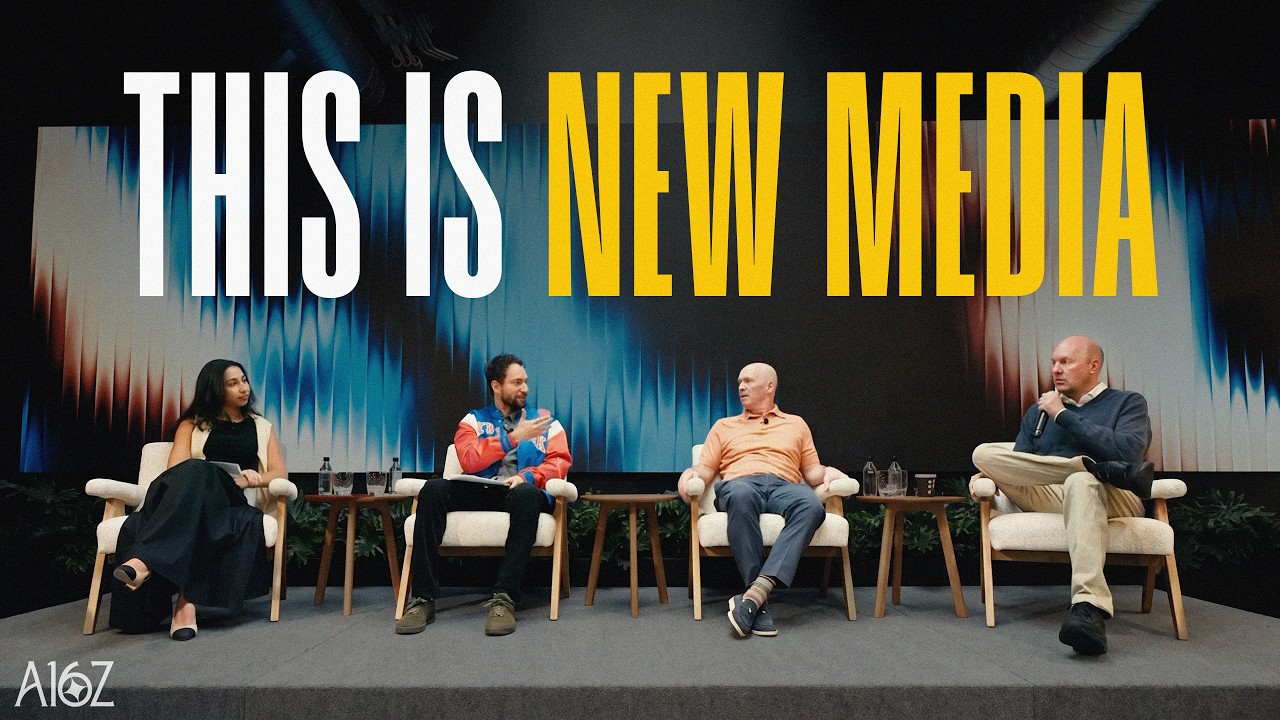
In a deep dive into the evolving landscape of media and communication, Marc Andreessen, Ben Horowitz, Erik Torenberg, and Gaby Goldberg dissect the fundamental shifts from traditional media to a new, creator-led paradigm. The discussion emphasizes why authenticity and direct communication have become paramount for founders and companies looking to build influence and connect with their audiences.
The Demise of Old Media and the Rise of Direct Communication
The panelists assert that the era of relying on traditional, legacy media for company messaging is effectively over. Marc Andreessen recounts a shift around 2017 where the press, once largely cooperative and interested in explaining tech, became primarily “agenda-driven” and “adversarial”.
- Old Media Characteristics: Characterized by “restricted channels with very restricted formats” and a defensive posture. The primary rule was “don’t be interesting” to avoid controversy. Success was measured by “minimum controversy.” This often led to public figures appearing “plastic” or “fake.” While historically claiming “impartial journalism” and to “speak truth to power,” Andreessen argues this devolved into activism, making it nearly impossible to get a favorable story through traditional channels.
- New Media Characteristics: Offers “unlimited formats, unlimited channels” and demands authenticity and interest. It’s “offense-oriented,” allowing companies to directly tell their story and control their narrative. The rise of long-form podcasts, Substack, and direct social media presence signifies a return to “interesting people having interesting conversations,” replacing the narrow scope of old media. Ben Horowitz notes the superior quality and availability of in-depth content today compared to past eras.
Authenticity as a Competitive Advantage
The conversation highlights authenticity as a critical component of new media success, directly contrasting it with the perceived “plastic” and “fake” outcomes of traditional media training.
- Media Training Horror Story: Marc Andreessen vividly describes his formative experience with old-school media training, which focused on rote answers, avoiding “bad questions,” and minimizing controversy. The painful process of watching oneself be critiqued for appearing awkward or uninteresting often resulted in a desire to avoid public speaking altogether.
- The “Friend at Lunch” Approach: A groundbreaking media trainer advised Marc to speak as if having lunch with a friend – naturally and genuinely. The core principle: if you don’t know a topic intimately, you shouldn’t be talking about it. When you do, you should be able to convey it in a “viscerally interesting way” that truly reflects your thoughts.
- The “Jedi Knight” Pivot: A tactical extension of this approach involves refusing to answer “bad questions” and artfully substituting them with “good questions” that align with your desired message, even if it feels unnatural initially.
- Impact of Authenticity: Real people like Palmer Luckey, Alex Karp, Elon Musk, and Jensen Huang exemplify this direct, authentic approach. It allows the audience to feel they are “meeting the real person,” fostering trust and genuine connection beyond a media-trained facade. This is seen as critical for conveying not just information, but understanding.
The Founder as the Brand: “Going Direct”
A central tenet of the new media landscape is that the “brand is now the person,” not just the company, necessitating a “go direct” strategy.
- Historical Parallel: Ben Horowitz traces this back to early industrialists (e.g., Henry Ford, Thomas Edison), whose companies bore their names. The rise of abstract corporate brands (e.g., IBM, General Motors) coincided with the centralization of media in the 1930s-1940s. With limited channels (e.g., three TV networks), messages had to be distilled into “atomic units” to pass through these narrow “straws.” As media decentralizes again, the personal brand of the founder or a key leader becomes paramount.
- The “Joe Rogan Test”: The ability to engage in a three-hour, unscripted, and wide-ranging conversation on a platform like Joe Rogan’s podcast is presented as the new benchmark for public figures, including political candidates and founders. This demands authenticity, deep knowledge, and the ability to be genuinely interesting.
- Leadership in the Spotlight: Founders like Elon Musk (SpaceX) or Alex Karp (Palantir) become the public face, often absorbing both praise and criticism directed at their companies. While not every CEO must be the brand, a “permanent fixture” leader needs to fulfill this role, demonstrating consistent presence and a clear voice.
Picking Your Battles and Embracing Polarization
The discussion delves into how to navigate criticism and leverage conflict effectively in the new media environment.
- Strategic Response to Attacks: While the instinct is to respond to all negative feedback, it’s crucial to discern whether a response will “improve your position” or merely amplify “stupid opinions” from low-follower accounts (e.g., on X/Twitter).
- Brand Building Through Conflict: Ben Horowitz argues that responding to impactful attacks can be a “real opportunity to boost the brand.” He cites a past controversy with Instagram and the New York Times as an example where a forceful response galvanized supporters, demonstrating that “everybody loves a fight,” and “fights are good for brand building” if the right battles are chosen.
- The Value of Being Polarizing: Being “neutral” or “lukewarm” makes you “uninteresting.” The goal is to have people “hate you and love you” because it signifies doing something important and making a mark. Marc Andreessen notes that “nobody writes a puff piece on like Rupert Murdoch or Elon Musk… when you get to a certain size people hate you. And that’s good because that means you did it.” This “right enemies” approach can galvanize supporters and clarify your position.
Building a New Media Team
Effective communication in the new landscape requires a specific kind of team, distinct from traditional PR structures.
- Beware of Old Media Expertise: Experience in traditional media can often be a “hindrance” as the rules and “laws of physics” are entirely different. New media demands a distinct “skill set” focused on direct engagement and content creation.
- Prioritize Storytelling and Audience Building: The ideal team members are those who have “done it” – built their own brand or audience. They should be world-class storytellers who can craft narratives with “tension, with a beginning and an end,” and be obsessed with discourse.
- Beyond “Propaganda”: The panel challenges the old media view that direct communication is mere “propaganda” or “just marketing.” Instead, it’s about honestly explaining “what’s actually happening,” providing context, and demystifying complex topics. This is framed as a responsibility for tech leaders to articulate profound technological changes (e.g., AI/ML, space exploration) that are otherwise difficult for the public to understand amidst noise.
Founder Messaging Mistakes and the “Outside-In” Playbook
Gaby Goldberg outlines common founder mistakes and offers the “outside-in” approach as a powerful alternative for effective communication.
- Mistake 1: Distribution Before Message: Founders often “overindex on distribution and tactics before actually getting the message right.” Distribution is a “multiplier on the message,” so an uninteresting or irrelevant message amplified widely is detrimental.
- Mistake 2: Inputs Over Outcomes: Focusing on “all the interesting things you could say” about your company (internal inputs) instead of the desired “outcomes” or audience understanding. The message should be tailored to achieve specific goals, such as recruiting engineers, attracting customers, or influencing specific stakeholders.
- The “Outside-In” Playbook: Instead of thinking “inside out” (me, my company, my product), founders should think “outside in.” This involves identifying “the most interesting things happening in the world” and then connecting their company’s story to those broader trends. This makes the company relevant to a larger, more compelling narrative.
- Alex Karp (Palantir) Example: Karp rarely talks about Palantir’s specific software features but consistently frames his discussions around “the future of the US military,” “super-intelligence,” “neurodivergence,” or “geopolitics.” Palantir becomes implicitly linked to these large, interesting topics, positioning Karp as the “first phone call” when such issues arise.
- Ryan Peterson (Flexport) Example: Similarly, Peterson talks about “global supply chain” and its collapse during COVID, not just “freight,” positioning Flexport as a solution to a world-altering problem. This approach makes a company important enough to engage with high-level decision-makers.
- Developable Skill: This ability to connect deeply with broader narratives and communicate authentically is a skill that can be developed and cultivated over time, as evidenced by figures like Alex Karp and even Donald Trump’s evolution in public communication. The enormous effort often put into unread S1/K1 documents for investors contrasts sharply with the reach and impact of a well-articulated, public narrative.