Collaborative AI Engineering — Maggie Appleton, GitHub Next
Maggie Appleton from GitHub Next argues that current agentic tools are flawed by focusing on individual productivity, ignoring the collaborative nature of software development. She introduces ACE (Agent Collaboration Environment), a multiplayer platform designed to solve team alignment issues by integrating planning, development, and shared context in a real-time, sandboxed environment.
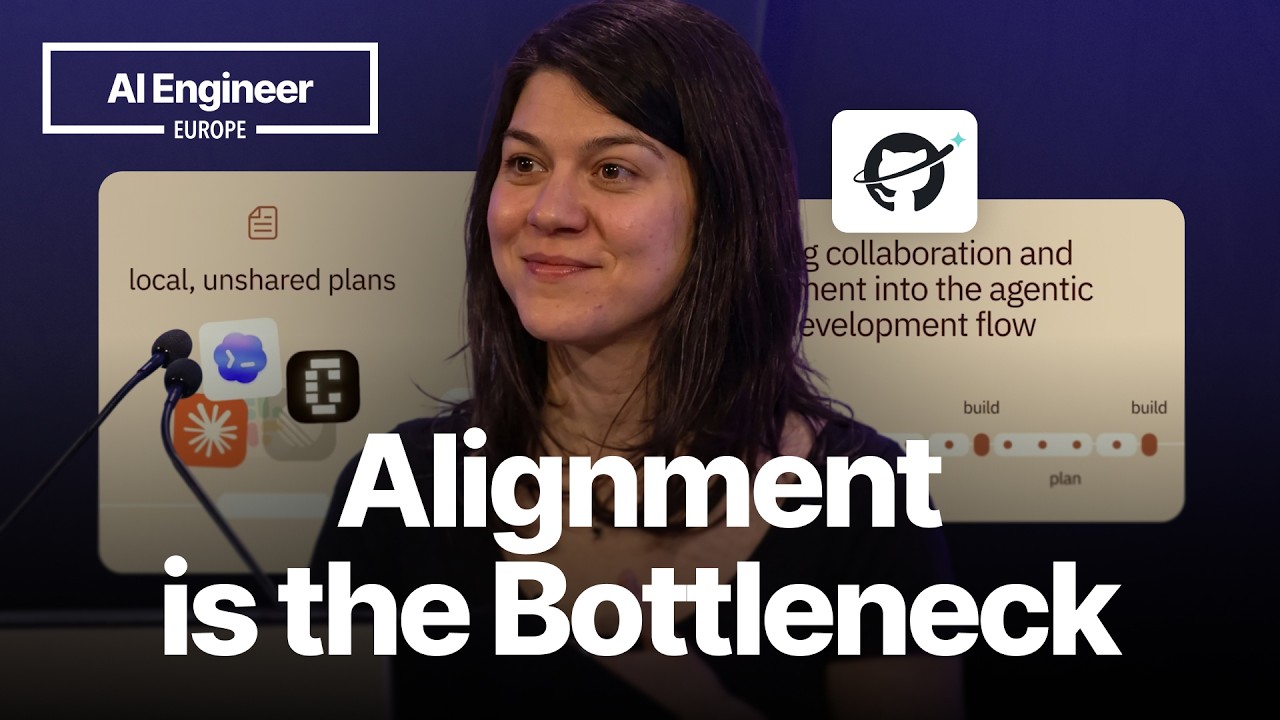
The current generation of agentic developer tools operates on a flawed premise: that software development is a solo endeavor. This “one developer, two dozen agents” model focuses on scaling individual output, but fails to address the core challenge of modern software engineering: team alignment. Software is a team sport, and increasing individual speed without coordination only exacerbates problems like duplicated work, merge conflicts, and building features no one agreed upon.
The hard question is no longer how to build it. It’s should we build it. Agreeing on what to build is the new bottleneck. When production is cheap, opportunity cost becomes the real cost.
The Collapse of the Alignment Window
Traditionally, the software development lifecycle had distinct phases for planning, building, and review, with numerous touchpoints for alignment through meetings, comments, and draft PRs. The speed of agentic coding has collapsed this implementation window. The time between logging an issue and an agent opening a PR can be mere minutes.
This compression eliminates crucial early alignment conversations. The entire weight of team alignment, architectural review, and product discussion is now unhelpfully shifted to the pull request—a mechanism that was never designed for this purpose and is positioned too late in the process to be effective. We are funneling a massive volume of agentic output into coordination platforms like GitHub, Slack, and Jira, which were designed for a much slower, human-driven era of development.
ACE: An Agent Collaboration Environment
To solve this, the GitHub Next team is developing a research prototype called ACE (Agent Collaboration Environment). ACE is a multiplayer tool that brings planning, context gathering, and development under one roof, creating a shared space for teams to think critically and work with agents collectively.
Core Features of ACE:
- Multiplayer Sessions: Each task or feature is handled in a “session,” which functions like a multiplayer chat channel (akin to Slack). Teammates and coding agents all exist within this shared space. The agent uses the entire human conversation as context for its work.
- Sandboxed MicroVMs: Every session is backed by a sandboxed microVM in the cloud, running on its own git branch. This isolates work, allowing for parallel development without local environment conflicts. A team member can jump into another’s session with a single click, seeing their full prompt history and environment state without needing to
git stashor pull a new branch. - Shared Execution Environment: Everyone in a session shares the same computer. They can run terminal commands, see the same output, and view the same live preview of the application. This eliminates the “it works on my machine” problem. Multiple team members can prompt the agent in the same session.
- Integrated Collaborative Planning: Teams can ask the agent to generate a plan, which appears as a collaborative document. Everyone can edit the plan together, discuss its merits, and update requirements in real-time before instructing the agent to proceed with the implementation.
- Proactive Summarization & Dashboards: To combat the noise from increased development velocity, ACE features a dashboard that provides a “Team Pulse”—a summary of what colleagues have been working on. It helps team members stay oriented and can proactively notify them about relevant conversations or decisions.
Reclaiming Time for Quality and Craft
The ultimate goal of tools like ACE is not just to build software faster, but to build better software. By automating the toil of implementation, we are gifted back time and energy. This time can be reinvested into activities that truly create value:
- More rigorous critical thinking and planning.
- Deeper user research and design exploration.
- Thoughtful architectural decisions.
In a world where software production is fast and cheap, quality becomes the new differentiator. Craftsmanship is what will set exceptional products apart from a sea of “vibecoded slop.” To achieve this level of craft, teams need strong alignment to focus on doing fewer things better. Agentic tools should not just be about scaling output; they should be environments that help teams get aligned, think rigorously together, and build exceptional things.