Simple AI Upsells 30% Better Than Trained Reps
Founders of Simple AI, Catheryn Li & Zach Kamran, discuss their journey from building consumer apps to creating an AI sales agent that handles inbound calls for major brands. They cover their pivot, the technical challenges of integrating with legacy systems, and how their AI outperforms human reps by leveraging hyper-personalization and rapid A/B testing.
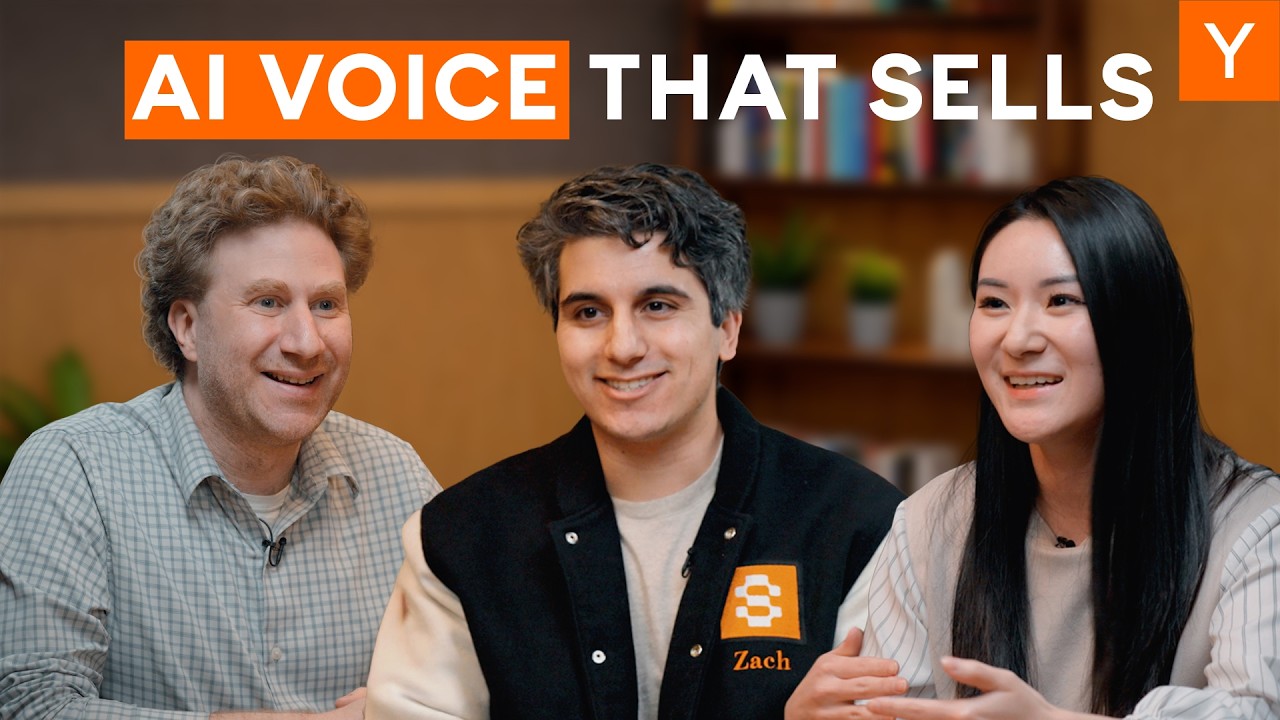
Simple AI is building AI voice agents that handle end-to-end sales processes over the phone for major brands, selling everything from steak and self-storage to home insurance. The AI is designed to sound natural, explain products, answer complex questions, and take billing and shipping information without human intervention.
The Founders’ Journey: From YC to a Triple Pivot
The founders, Catheryn Li and Zach Kamran, met while working on the internal software team at Y Combinator (YC). Surrounded by the startup ecosystem and with early access to innovations from companies like OpenAI (which began as YC Research), they were inspired to start their own company.
Their path to the current product involved three major iterations:
- A Better Siri: Their first idea was a broad consumer AI assistant that could perform tasks like calling an Uber or ordering food. This proved too confusing for users, who couldn’t determine the app’s limits.
- Outbound Calling AI: They narrowed their focus to an AI that made outbound calls on a user’s behalf for tasks like making reservations or negotiating purchases. The app went viral, with users leveraging it for everything from buying a car at the best price across multiple dealerships to getting a refund from an airline. However, despite its novelty, the use case was too infrequent to build a sustainable business, leading to poor retention.
- Inbound Sales AI: The turning point came from the consumer app’s users. Businesses, intrigued by the technology’s quality, started reaching out with inbound requests. The most notable was the CEO of Omaha Steaks, who used the consumer app to prank-call his COO and immediately saw its potential for his business. This led to the final pivot, guided by the YC principle:
It’s not make something people want that no one else is making in case you can’t do it better. It’s just make something people want.
Case Study: Solving a “Hair on Fire” Problem for Omaha Steaks
Omaha Steaks faced a massive seasonal challenge: they needed to 15x their workforce with temporary staff for the holiday season. These temporary workers were often unreliable, poorly trained, and struggled with the company’s software, resulting in significant lost revenue.
Simple AI’s solution involved a deep, hands-on integration process:
- On-site Immersion: The founders spent two weeks in Omaha, Nebraska, working directly with every team—from engineering and IT to marketing and sales—to understand the business’s intricate complexities.
- Legacy System Integration: They had to integrate with Omaha Steaks’ on-premise, 1990s-era AS/400 terminal systems. This required the client to dedicate two full-time developers to build the necessary APIs for fetching customer data and placing orders.
- Complex Product Logic: The AI had to be taught a complex catalog with thousands of SKUs, combination items, and dynamic promotions that varied by region.
The AI Agent: Performance, Personalization, and Technical Moat
Simple AI’s core value proposition is not just cost savings but revenue generation and a superior customer experience. Their AI agent consistently outperforms human agents.
- Superior Sales Performance: The AI is 30% better at upselling than the company’s best-trained, year-round live reps. By training on the performance of the top human agents, the AI ensures every call is handled by a “superstar” performer.
- Hyper-Personalization at Scale: The system leverages customer data to create a magical, personalized experience.
- It uses the caller’s phone number to access past purchase history, successful and unsuccessful upsell attempts, and even notes from previous conversations.
- It can A/B test different voices (male vs. female) and accents (New York vs. Texas) based on the caller’s area code to build rapport.
- The AI remembers details from past conversations. If a customer mentioned their husband doesn’t eat chicken, the agent will remember that on a call a year later and suggest a different product, creating a “10x user experience.”
- Rapid Experimentation: Unlike a traditional call center where new scripts take weeks to propagate, Simple AI allows for instant A/B testing of sales tactics. A simple prompt change like adding “Lock in your savings today” was tested and proven to be highly effective at selling subscriptions.
The Engineering Challenges and Defensibility
Building a production-grade voice agent goes far beyond a simple wrapper on an LLM API. The defensibility lies in solving complex, long-tail engineering problems:
- Low Latency: The team targets a sub-600 millisecond response time to ensure conversations feel natural.
- Custom Fine-Tuned Models: To achieve the required speed and accuracy, they build and fine-tune their own models for specific tasks, moving beyond general-purpose APIs.
- Inference Models: They use RL and fine-tuning to create models trained for each customer’s specific use case, reducing response times to ~100ms.
- Task-Specific Models: They train specialized models to solve persistent problems where generic models fail, such as accurately transcribing addresses.
- End-of-Turn Detection: They fine-tune a unique model for each customer to accurately predict when a speaker has finished talking, accounting for varying demographics and speech patterns.
- Agent Orchestration and Guardrails: For a fully autonomous agent handling payments and placing orders, reliability is paramount. A huge amount of in-house software is dedicated to orchestrating the agent’s actions and implementing strict guardrails to prevent errors and hallucinations, ensuring it works perfectly.