Motion: Redefining How Work Gets Done
The founders of Motion discuss their journey from lucrative seven-figure trading jobs to building a work management platform. They detail a critical pivot away from a successful $20M ARR consumer product to a B2B suite, and their current strategy of embedding "AI employees" directly into workflows, leveraging proprietary data and a unified human-AI task management system.
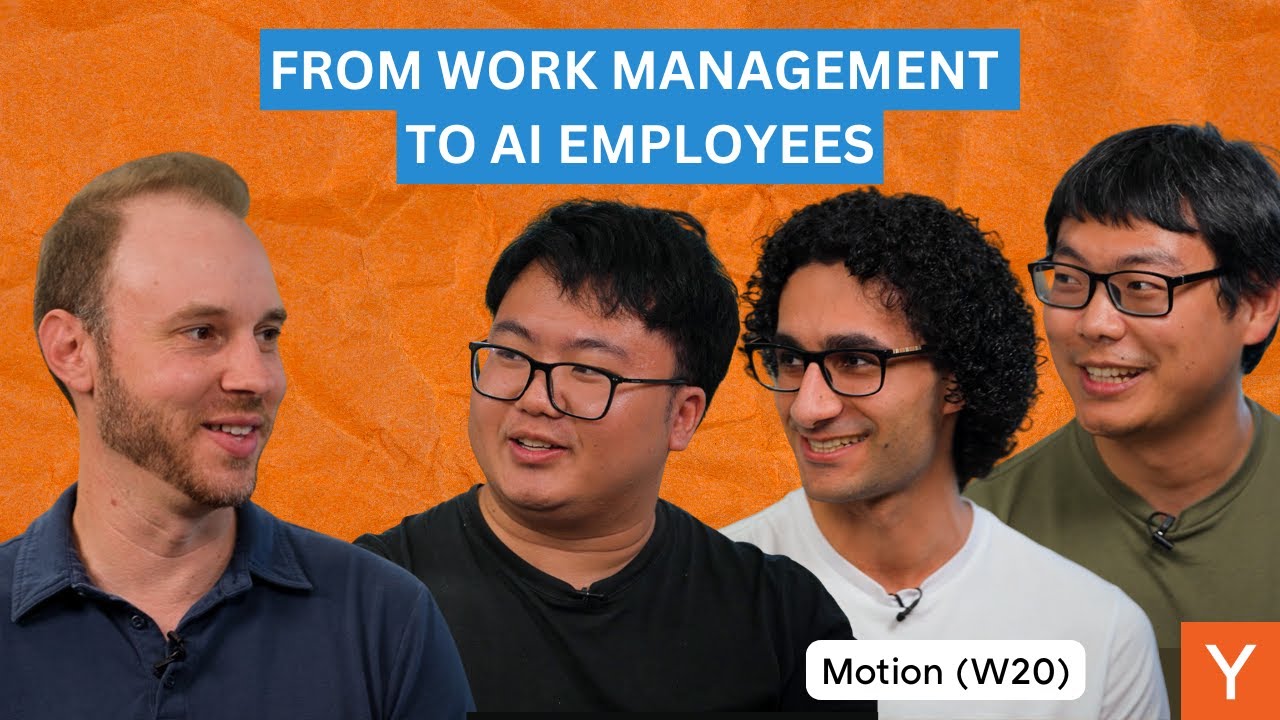
The journey of Motion began with its founders—two high school math olympiad friends and a college friend—leaving behind seven-figure salaries as quantitative traders. They were driven by a desire to build something with a compounding purpose, a stark contrast to the daily reset of the trading world. This ambition led them to Y Combinator (W20 batch) and a series of foundational pivots that shaped their current trajectory.
The First Breakthrough: Smart Calendaring
After an initial, short-lived idea in sports betting, the team found its first product-market fit with an AI-powered smart calendaring application. The tool automatically scheduled a user’s entire day, a novel concept at the time. This product resonated strongly and scaled rapidly.
- Within two months of launch, it grew from near-zero to $1 million in Annual Recurring Revenue (ARR).
- It continued to grow over two years, reaching nearly $20 million in ARR.
The Strategic Pivot from a $20M ARR Product
Despite this significant success, a pivotal conversation with YC partner Michael Seibel led to a difficult realization. The founders concluded that their consumer/prosumer calendaring tool, while profitable, had a ceiling.
You can become a very profitable 20 million a year… but you are never going to make a billion of ARR.
The core limitations identified were:
- “Nice-to-Have” vs. “Must-Have”: For most users, the tool was a convenience, not a critical dependency for their life or business.
- Retention Ceiling: Consumer productivity tools rarely achieve the near-100% net dollar retention common in essential B2B software.
- Scalability: The path from a $20M ARR consumer tool to a billion-dollar enterprise was unclear.
Recognizing this, the team made the challenging decision to pivot. They shifted focus to building a comprehensive B2B work management platform for Small and Medium-sized Businesses (SMBs)—a segment that many of their prosumer customers belonged to. This meant essentially starting over, building for feature parity with established players like Asana and Jira while also developing a unique, 10x value proposition.
The Future of Work: Embedding AI Employees
Motion’s current and future direction is centered on integrating AI agents, which they term “AI employees,” directly into their work management suite. This goes beyond simply managing work to actively doing work. The platform is designed to manage projects, documents, and knowledge, and now, to delegate tasks directly to AI.
This integrated approach provides two core strategic advantages:
-
Unified Human-AI Workflow: The platform avoids the friction of managing human and AI tasks in separate systems. Because Motion is already the system of record for projects and tasks, it can seamlessly handle handoffs. An AI agent can complete a sub-task, and the system can immediately assign the next step to a human team member within the same workflow.
-
Context is the Moat: The effectiveness of AI agents is highly dependent on the quality and depth of their context. By operating within an all-in-one work suite, Motion’s agents have access to a rich, proprietary dataset for each customer.
We basically have a lot of context about their business… their internal knowledge base, their projects, their tasks, their time, like everything. And that enables us to basically be able to build the best agent in the market for these small and medium businesses.
This deep contextual understanding allows their agents to perform significantly better than standalone solutions that lack access to the underlying platform data. The initial results of this strategy have been explosive, with the AI agent product growing from zero to over $10 million in ARR within a few months of its launch in early 2024. This success has been a key driver in the company’s recent Series B and C funding rounds at a $550 million valuation.