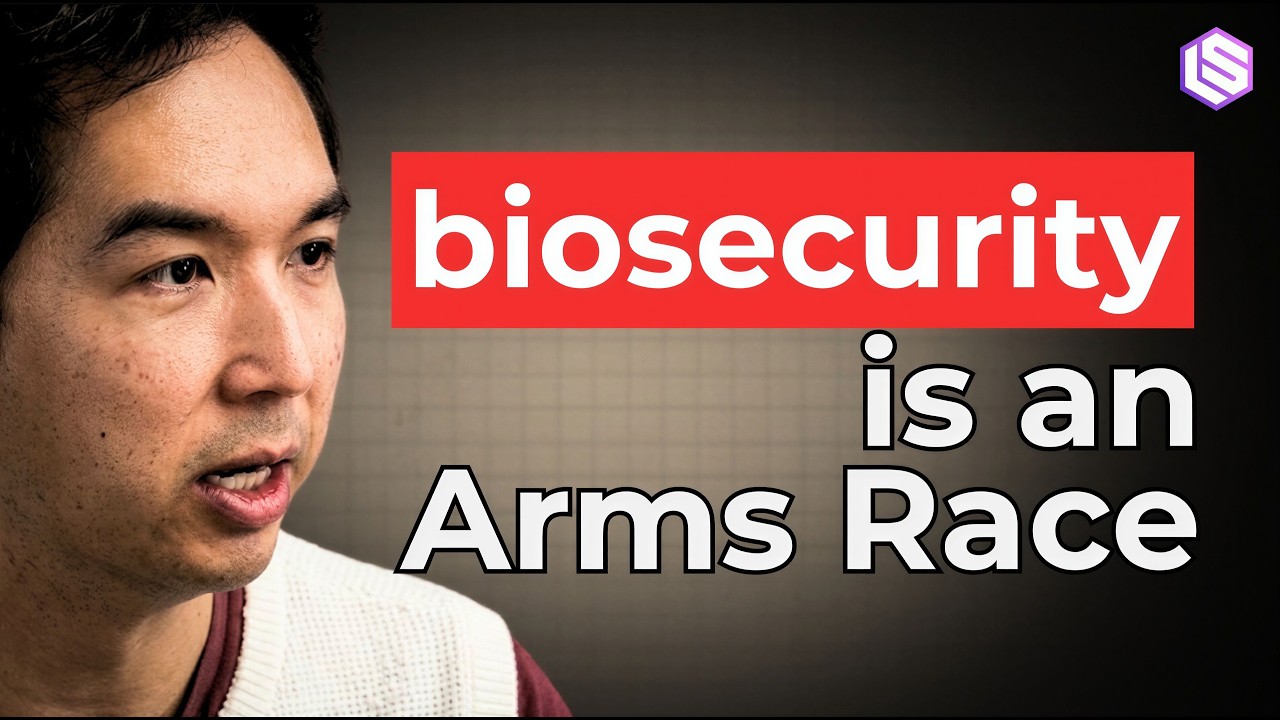
🔬Bio-security is an AI Arms Race - Eric Nguyen (CEO, Radical Numerics)

Eric Nguyen, CEO of Radical Numerics, details the journey from early genome language models to Omni, a system that excels in DNA reading, writing, and reasoning. Omni outperforms specialized models in disease-variant prediction, particularly in previously challenging non-coding regions. The discussion also covers the critical need for AI-native biosecurity defenses, addressing how models can design biological sequences that evade current detection systems, and the broader vision for General Biological Intelligence.
2 min read
🔬Bio-security is an AI Arms Race - Eric Nguyen (CEO, Radical Numerics)
source: https://www.youtube.com/watch?v=B7DdNj_VjcU

Eric Nguyen, CEO and co-founder of Radical Numerics, discusses the evolution of genome language models from reading DNA to actively designing it, culminating in their latest model, Omni. He emphasizes Radical Numerics’ dual mandate: pushing biological design capabilities while simultaneously building robust biosecurity defenses.

The Evolution of Genome Language Models

  • Hyena DNA: The journey began with Hyena DNA, a large language model utilizing convolutions instead of attention. This architecture allowed processing significantly longer DNA sequences (up to a million base pairs), exceeding previous context windows. Its primary function was to read DNA and predict regulatory functions, particularly for non-coding regions and long-range interactions, addressing the

Share post

Stay In The Loop! Subscribe to Our Newsletter.

Get updates straight to your inbox. No spam, just useful content.

Recommended for You

SOTA Generative Media Panel — Dumitru Erhan, Shane Gu & Nicole Brichtova, Google DeepMind

SOTA Generative Media Panel — Dumitru Erhan, Shane Gu & Nicole Brichtova, Google DeepMind

This detailed discussion with Google AI researchers highlights the latest generative video models (NanoBanana 2 Lite, Gemini Omni Flash APIs) and their applications, including video editing, education, and localization. The conversation critically examines whether language is an adequate intermediate representation for AI, especially for sensory experiences like audio and taste, where human vocabulary is limited. It exposes the unreliability of human preferences in evaluating AI-generated content, citing the "Instagram filter effect" and "wedding ring" reward hacking as examples. The researchers emphasize the importance of high-quality, real-world data and the critical role of forward-deployed engineers in bridging the gap between cutting-edge research and practical applications.

Chai Discovery's Bitter Lesson: Drug Design Is Another Scaling Problem

Chai Discovery's Bitter Lesson: Drug Design Is Another Scaling Problem

Chai Discovery is revolutionizing drug discovery by treating biology as an engineering problem, leveraging AI—particularly diffusion models and the "bitter lesson" of scaling—to design molecules rather than merely discover them. Their approach has boosted antibody design hit rates from 0.1% to 16%, aiming for a "Molecular CAD" suite that collapses discovery timelines from months to days. They partner with pharma, building infrastructure and creating a data flywheel to develop higher-quality, more targeted medicines for previously undruggable diseases.