Post‑Quantum Security: How Lattice Cryptography Keeps Data Safe
This video explains the imminent threat quantum computers pose to current cryptographic standards like RSA. It introduces lattice-based cryptography as a leading quantum-safe solution, using analogies to demystify how high-dimensional spaces and 'noise' create math problems that are intractable even for quantum machines. The summary provides a clear action plan for organizations, emphasizing the need for 'crypto-agility' and the urgency driven by the 'Harvest Now, Decrypt Later' attack strategy.
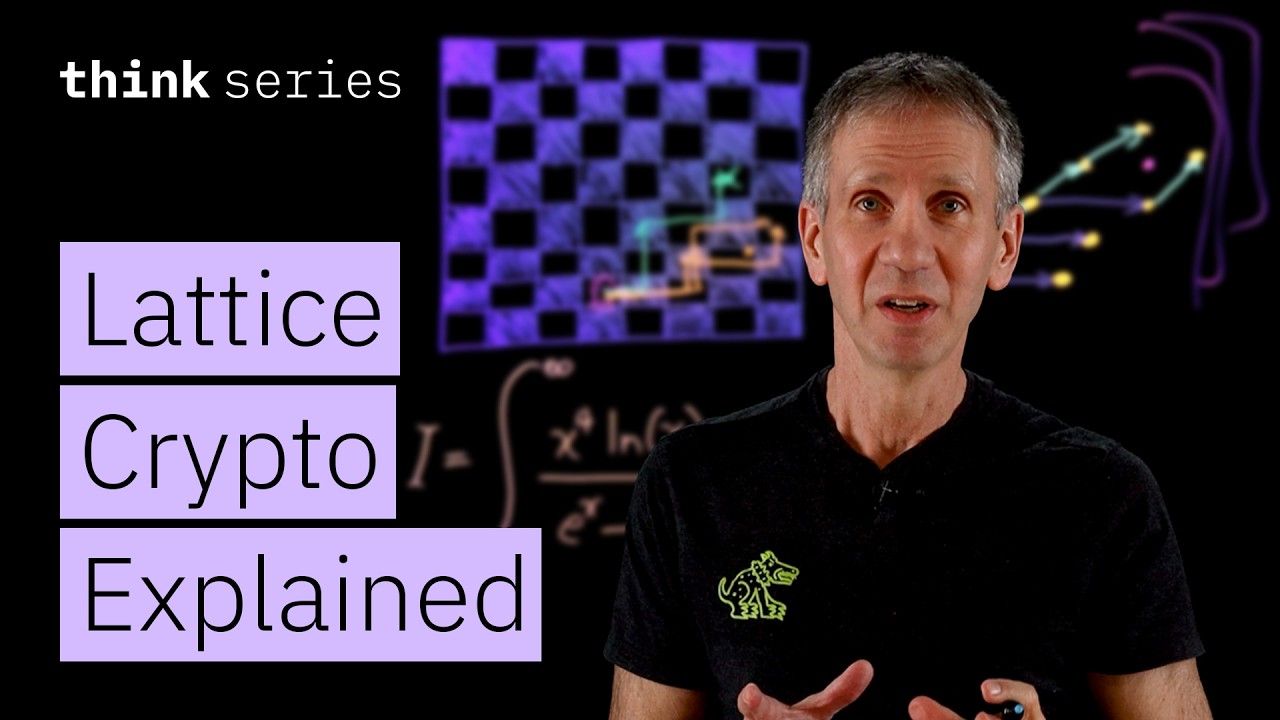
Modern cryptography, the foundation of our digital security, relies on hard math problems to protect sensitive data. A primary example is the RSA algorithm, which is secure because factoring a large number into its two prime components is computationally infeasible for classical computers. A 600-digit number, for instance, would take a supercomputer thousands of years to factor.
The Quantum Threat
The security landscape is changing with the advent of quantum computing. A sufficiently powerful quantum computer could solve this prime factorization problem in a matter of hours, rendering much of our current encryption obsolete. This potential event is often referred to as “Q-Day.” This would break the secrecy of everything from personal information to intellectual property, effectively dismantling the internet as we know it.
The Solution: Post-Quantum Cryptography
To counter this threat, cryptographers have developed what is known as post-quantum cryptography (PQC) or quantum-safe algorithms. A leading approach is lattice-based cryptography, which is built on math problems that are significantly harder to solve than prime factorization, even for quantum computers.
Understanding Lattice Cryptography
The core concept can be understood through an analogy. Imagine a chessboard where a knight has specific moves. The problem becomes complex if you try to land on a point that is not an exact destination square, forcing an approximation. Lattice cryptography formalizes and massively scales this complexity:
- Lattices and Vectors: A lattice is a grid of points in space created by linear combinations of a set of basis vectors. The problem is to find the closest point in this lattice to a target point that is intentionally placed off the lattice.
- Adding Complexity: The problem’s difficulty is amplified by:
- High Dimensions: Instead of a 2D or 3D space, these lattices exist in thousands of dimensions, making them impossible to visualize and computationally intractable to navigate.
- Noise: The introduction of a target point that is not on the lattice (the “noise”) means an exact solution isn’t possible, forcing a search for the best approximation. This is related to the “Learning with Errors” (LWE) problem.
This multi-dimensional, noise-infused problem forces any attacker, whether using a classical or quantum computer, to resort to a brute-force search. The number of possibilities is so vast that it remains secure.
The Action Plan for a Quantum-Safe Future
The good news is that these quantum-safe algorithms, standardized by institutions like the U.S. National Institute of Standards and Technology (NIST), are available today and run on classical computers. Organizations must begin the transition now.
The recommended steps are:
- Discovery: Identify all uses of cryptography across the enterprise.
- Inventory: Create a “Crypto Bill of Materials” (C-BOM) to catalog all cryptographic assets.
- Prioritization: Evaluate the inventory for vulnerabilities and prioritize remediation based on the sensitivity of the data being protected.
- Remediation: Execute a phased plan to replace vulnerable algorithms with their quantum-safe counterparts.
The ultimate objective is to achieve crypto-agility: the capability to easily swap out cryptographic algorithms if a new weakness is discovered in the future.
The Urgency: Harvest Now, Decrypt Later
Action is required immediately due to the “Harvest Now, Decrypt Later” threat. Adversaries are already capturing and storing encrypted data today. They are waiting for the arrival of a capable quantum computer to decrypt this data retroactively. Unless data is protected with PQC now, secrets from today and yesterday will be exposed tomorrow.