Post quantum cryptography

Q‑Day Explained: How Quantum Computing Threatens Today’s Cryptography

Q‑Day Explained: How Quantum Computing Threatens Today’s Cryptography

Q-Day, the day a quantum computer will be powerful enough to break current encryption standards, is an inevitable threat. This summary explains how quantum algorithms like Shor’s and Grover’s will compromise both asymmetric and symmetric cryptography, the severe consequences for data confidentiality and digital trust, and why the "Harvest Now, Decrypt Later" attack vector makes immediate migration to post-quantum cryptography a critical priority for all organizations.

Post‑Quantum Security: How Lattice Cryptography Keeps Data Safe

Post‑Quantum Security: How Lattice Cryptography Keeps Data Safe

This video explains the imminent threat quantum computers pose to current cryptographic standards like RSA. It introduces lattice-based cryptography as a leading quantum-safe solution, using analogies to demystify how high-dimensional spaces and 'noise' create math problems that are intractable even for quantum machines. The summary provides a clear action plan for organizations, emphasizing the need for 'crypto-agility' and the urgency driven by the 'Harvest Now, Decrypt Later' attack strategy.

Hardware Realization and Implementation Security Evaluation of HQC, A NIST PQC Standard

Hardware Realization and Implementation Security Evaluation of HQC, A NIST PQC Standard

This talk by Sanjay Deshpande from Northwestern University explores the critical transition to Post-Quantum Cryptography (PQC) in response to the threat quantum computers pose to current public-key algorithms. It provides a deep dive into the Hamming Quasi-Cyclic (HQC) algorithm, a code-based candidate for NIST standardization. The session focuses on the challenges and innovations in creating efficient and secure hardware implementations of HQC, covering performance optimization for polynomial multiplication and countermeasures against side-channel attacks.

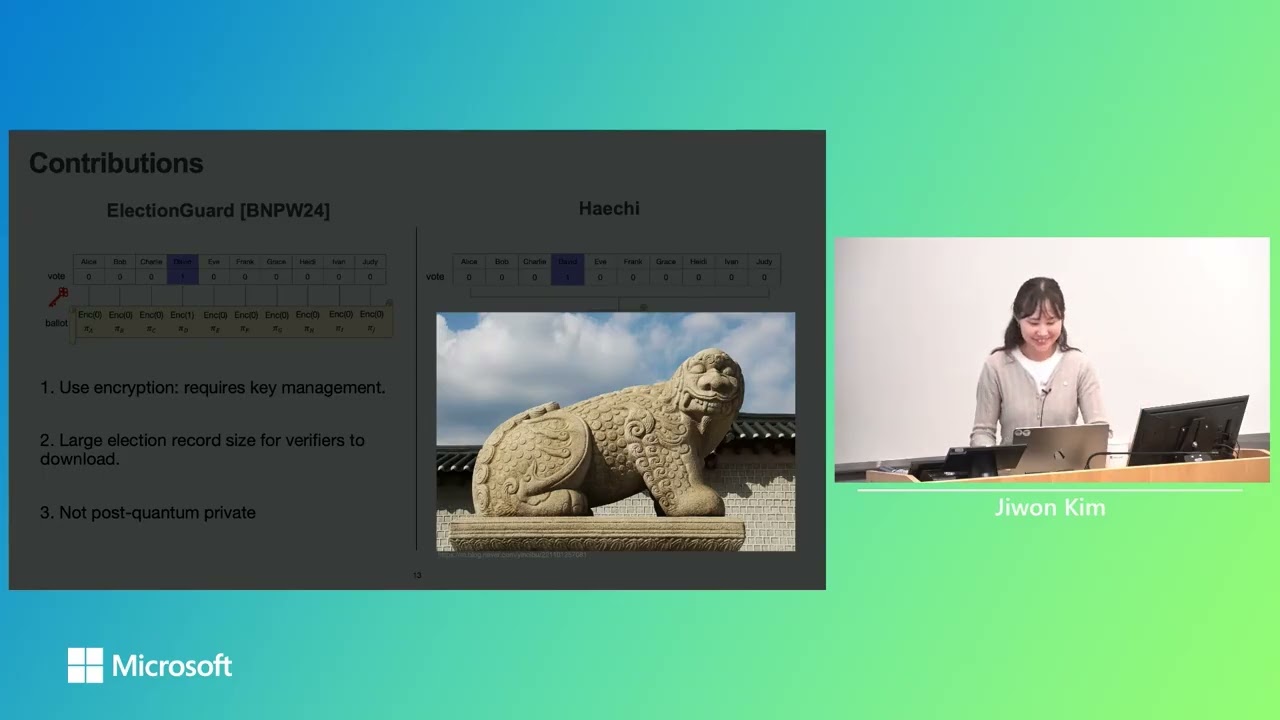
Efficient Homomorphic Integer Computer from CKKS

Efficient Homomorphic Integer Computer from CKKS

A deep dive into the hardware design and implementation of HQC, a post-quantum cryptography scheme. The talk covers performance and security bottlenecks, detailing novel solutions for efficient polynomial multiplication by leveraging sparsity and constant-time methods for generating fixed-weight vectors to thwart side-channel attacks.

Cybersecurity Trends in 2026: Shadow AI, Quantum & Deepfakes

Cybersecurity Trends in 2026: Shadow AI, Quantum & Deepfakes

Explore Jeff Crume's cybersecurity predictions for 2026 and beyond, detailing the dual impact of AI in security, the rise of autonomous AI agents, the futility of deepfake detection, and the critical importance of post-quantum cryptography and passkeys for future defense.

Lattice-Based Accumulator and Application to Anonymous Credential Revocation

Lattice-Based Accumulator and Application to Anonymous Credential Revocation

Victor Youdom Kemmoe from Brown University presents a novel, communication-efficient cryptographic accumulator based on the Module-SIS assumption. This construction is designed for applications like anonymous credential revocation, where elements can be added without needing to update existing membership witnesses, a significant improvement over previous post-quantum schemes.