Inside Perplexity Computer’s agent platform
Experts on the Mixture of Experts podcast analyze Perplexity Computer's pivot to agent orchestration and debate its closed-system approach versus open alternatives like OpenClaw. They also discuss Anthropic's new memory import feature for Claude, questioning if memory is still a competitive moat, and explore NullClaw, a minimalist agent framework that sparks a conversation about the future of edge-based agent swarms. Finally, they tackle the controversial debut of Tilly Norwood, the world's first AI actor, and debate the implications for the entertainment industry and the personification of AI.
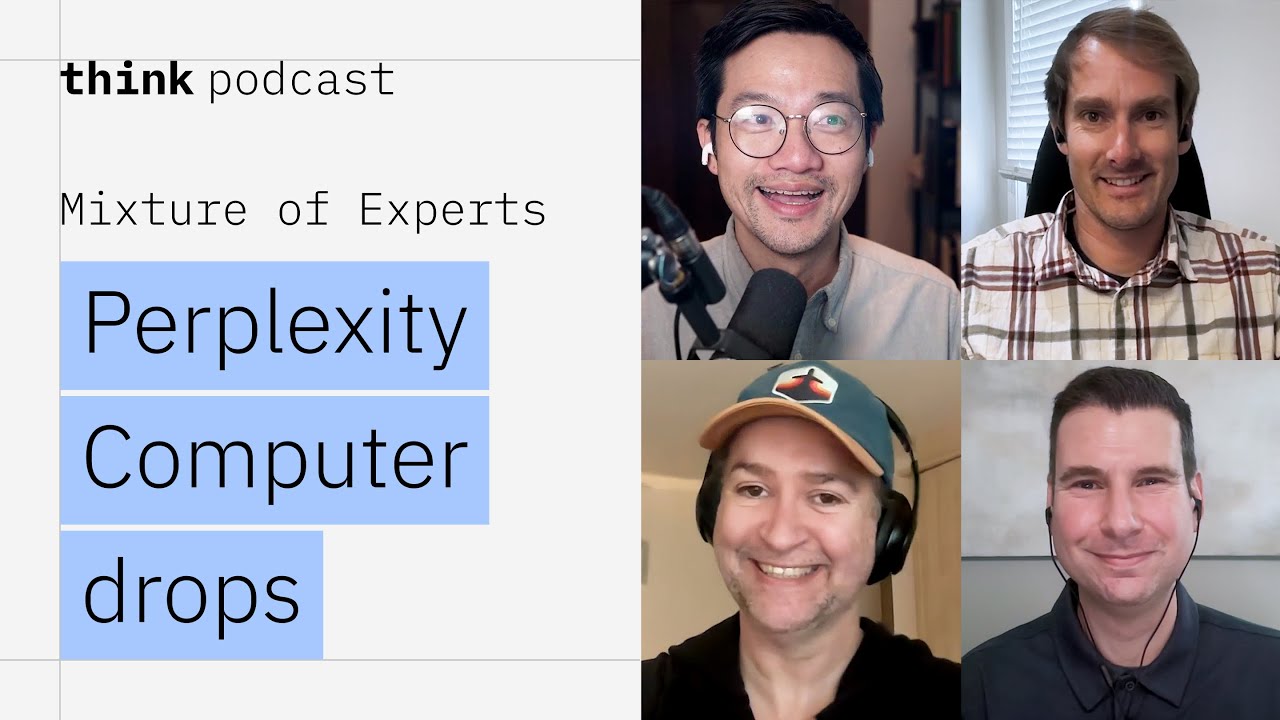
Perplexity Computer: A Shift from Search to Agent Orchestration
Perplexity is expanding beyond its search-centric roots with Perplexity Computer, a new feature designed to orchestrate multiple AI agents to perform complex, long-running tasks. This move places Perplexity in the competitive landscape of agentic platforms, alongside open-source frameworks like OpenClaw, LangGraph, and AutoGPT.
Open vs. Closed Ecosystems A key part of Perplexity’s strategy is emphasizing security by running agents in the cloud with a curated list of integrations, contrasting with open-source tools that run locally. However, the panel debated the effectiveness of this approach:
- Chain of Trust: The core issue isn’t whether a system is open or closed, but about establishing a “chain of trust.” Both ecosystems face similar security challenges.
- Security Risks: The primary risks associated with AI agents were broken down into three categories:
- Unfettered Computer Access: Mitigated by sandboxing, which is available in both closed systems and open ones (e.g., running OpenClaw in a Docker container).
- Destructive Permissions: If an agent is given delete access to a service like Gmail, it can make a mistake regardless of whether it’s running locally or in the cloud. This risk is not inherently mitigated by a closed system.
- Prompt Injection: This remains a significant vulnerability from two vectors: the community of skills (which Perplexity curates) and raw content scraped from the web. The open-source community is already addressing skill security with rating systems, but protecting against prompt injection hidden in web metadata is a complex challenge that no system has fully solved yet.
Market Position and Cost The panel questioned Perplexity’s value proposition, noting its high price point of around $200/month for the max tier, which may alienate the average user. While acknowledging the real academic research behind agent selection and management, the experts see a crowded market with various tools filling specific niches:
- Claude Co-worker: For deep reasoning tasks.
- OpenClaw: A personal autonomous agent.
- LangGraph: For building custom, graph-based agent workflows.
- AutoGPT: For autonomous task execution.
Is AI Memory a Competitive Moat?
Anthropic’s announcement that users can now import memory into Claude challenges the long-held belief that a user’s history and preferences would be a powerful moat for chatbot providers. The panel was largely skeptical that this feature fundamentally changes the competitive dynamics.
- Chat History vs. Curated Memory: For technical users, the full, searchable chat history is often more valuable than a curated set of “memories” about personal preferences. Recalling a specific solution from a six-month-old conversation is a more common use case.
- A “Nothing Burger” Implementation: The current implementation was described as simple prompt engineering—essentially asking ChatGPT to format and export its memories for Claude. This is not a formal API and could easily be blocked by competitors in the future.
- The Future is Vendor-Agnostic Memory: The more significant trend is the potential for user-owned, vendor-neutral memory. In this paradigm, a user’s memory would be an independent component that they could plug into any AI “brain” they choose—be it Claude, ChatGPT, or a local model. This would render memory as a vendor-specific moat obsolete.
- Memory Poisoning: A significant concern raised was the risk of “memory poisoning,” where false or malicious information could be exported from one system and imported into another, effectively creating a “virus of data” that spreads and amplifies misinformation across models.
NullClaw and the Future of Edge Agent Swarms
NullClaw, a minimalist agent framework running in just 678 kilobytes, sparked a discussion about the trend of shrinking AI tools to run on edge devices.
- Marketing Hype vs. Reality: The panel was critical of NullClaw’s marketing, pointing out that it is essentially a lightweight “wrapper” or “for loop.” It does not solve the most resource-intensive part of the problem: running the model inference locally. The framework still relies on calling external models via APIs or separate local inference engines (like Llama.cpp), meaning it doesn’t enable a fully self-contained agent on a tiny device.
- From Cloud Giants to Edge Swarms: Conceptually, the story points to a future of decentralized “edge swarms” where countless small, low-power devices act as agents. This vision draws parallels to ant colony optimization, where simple individual agents collaborate to achieve complex goals.
- Architectural Implications: The true value of such tiny frameworks is in enabling AI on edge devices that have unique capabilities, such as sensors in IoT devices for home or business automation. This creates an architecture where a central, more powerful local model (e.g., running on a home server) could coordinate a swarm of minimalist agents deployed on microcontrollers.
Tilly Norwood: The World’s First AI Actor
The debut of Tilly Norwood, a fully virtual AI character positioned as the “world’s first AI actor,” prompted a debate on the future of entertainment and the ethics of personifying AI.
- A Logical Extension? One perspective is that this is a natural evolution. Audiences already form connections with non-human characters, from Mickey Mouse and The Muppets to virtual bands like Gorillaz. In this view, an AI actor is just another form of CGI or puppetry, and its ability to appear consistently across different productions could be an asset.
- Personification and Ethical Concerns: An opposing view urged caution, highlighting the philosophical questions at play. The distinction between Tilly as a character versus Tilly as an actor is crucial. Awarding an Oscar to an AI entity raises concerns about personifying algorithms and the “playing god” morality questions that the industry is grappling with.
- Practical and Legal Hurdles: The Screen Actors Guild (SAG) and other industry bodies would likely raise objections, arguing that an AI lacks life experience, emotions, and genuine human contribution. This also opens a Pandora’s box of legal and ethical issues around consent, likeness, authenticity, deception, and the ownership of creative work generated by the AI. One panelist wryly noted that the creators’ biggest mistake was announcing Tilly was an AI; they should have tried to win an Oscar first and revealed the truth afterward.