When Agents Learn to Feel: Multi-Modal Affective Computing in Production // Chenyu Zhang
This talk explores the frontier of affective computing in AI agents, proposing a new architecture where emotion is a first-class component. It covers the technical challenges of deploying multi-modal, emotion-aware systems in production—from memory and learning to multi-agent orchestration—and delves into the critical ethical considerations of privacy, manipulation, and scientific validity.
As AI systems evolve from tools into autonomous agents, the critical missing piece isn’t more logic or memory, but emotional attunement. The recent surge of interest in agentic AI, underscored by developments like OpenAI’s personality presets, signals a structural shift. The next generation of AI agents must be able to sense and adapt to how users feel, not just what they say. Emotion is not an optional feature; it is a core part of how humans learn, collaborate, and make decisions, and its integration is essential for developing robust and trustworthy AI.
Redefining Agent Architecture with Affective Computing
Current agent architectures, such as the one proposed by Google, focus on cognitive and behavioral intelligence with components for orchestration, memory, reasoning, and tools. However, they lack a representation of affective context. They cannot sense if a user is confused, frustrated, or engaged, which can lead to delivering the right information in the wrong way.
An architecture for Affective Agent AI addresses this gap by elevating perception and emotional modeling to first-class components:
- Multimodal Perception: Instead of relying solely on text, this layer ingests a wide range of signals, including voice tone, facial expressions, interaction latency, and even silence, to build a holistic view of the user’s state.
- Emotional Modeling Module: This component’s role is not to generate artificial emotions but to estimate the user’s affective state. This estimation is then fed into the reasoning and planning modules, giving the agent contextual awareness that goes beyond the content of an interaction.
- Multi-Agent Orchestration: In a multi-agent system, responsibilities can be distributed based on emotional roles. For example, one agent might detect user frustration, a “critic” agent could evaluate the current explanation’s effectiveness, and a “rewriter” agent could generate a calmer, clearer response. This makes emotion an integral part of the system’s control flow.
The core idea is that for agents to interact intelligently with humans, emotional signals must shape their decisions as strongly as explicit goals or instructions do.
Core Components and Production Challenges
Integrating affective computing into production systems introduces unique challenges and opportunities across the agent’s core components.
-
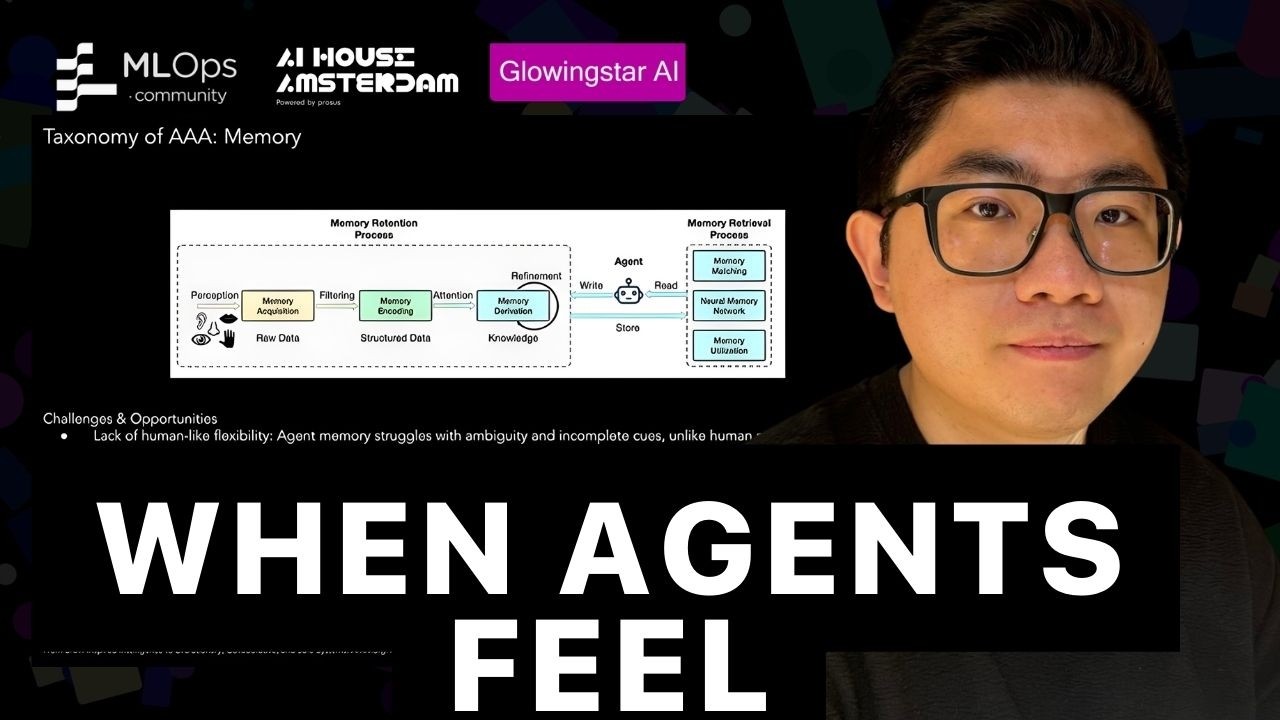
Memory: A significant blocker for current agents is their uniform memory system. Unlike humans, who retrieve emotionally charged experiences more readily, agents treat all inputs equally. This means crucial emotional signals often get lost. The opportunity lies in creating a shallow episodic memory with emotional tagging, which records not only what happened but also how the user felt. For instance, an AI tutor could remember a student’s frustration with a specific topic and adjust its pacing in future sessions.
-
Learning: Human learning is driven by internal motivations like curiosity, pride, or fear of failure. Agents currently learn only through externally defined goals. Emotional context can serve as an internal motivation signal. An agent that detects disengagement can adapt its strategy to re-engage the user, while one that senses excitement can deepen the challenge, personalizing the experience in real-time.
-
Tools: In an affective agent, tools are not just for executing tasks but for contextualizing emotional signals. A tool could store a user’s long-term affect history to help the agent interpret recurring patterns of frustration or disengagement, making tool orchestration a key part of the agent’s emotional intelligence.
Ethical and Societal Imperatives
The deployment of emotion-aware AI raises significant ethical concerns that demand careful consideration.
- Data Sensitivity and Privacy: Emotional data is far more sensitive than personally identifiable information (PII) or personal health information (PHI) because it reveals internal states that users may not even be consciously expressing. This raises critical questions about privacy, consent, data ownership, and transparency.
- Risk of Manipulation: When a system can detect fear, confusion, or enthusiasm, the line between supporting a user and manipulating them becomes dangerously thin.
- Offloading Emotional Labor: Relying on AI for emotional interaction could alter human relationships and hinder the development of personal emotional resilience.
- Scientific Validity: Emotion recognition models often fail to generalize across different cultures, contexts, and demographics. Misclassification is common, yet a system may express high confidence in its incorrect assessment.
These issues make it essential that emotional AI be deployed cautiously, with rigorous validation, clear ethical boundaries, and explicit user consent as a default requirement.