Multi-Agent Personalization with Shared Memory: From Email to Website to Proposal // Hamed Taheri
This talk explores the challenges of using multi-agent systems for mass personalization, highlighting the inconsistencies and inaccuracies that arise from traditional methods like RAG and function calling. The speaker introduces Cortex UCM, a unified customer memory system that proactively infers and standardizes customer insights. This shared, structured memory layer enables agents to achieve a deep, consistent understanding of customers, leading to high-quality, scalable generative personalization for emails, websites, and product pages.
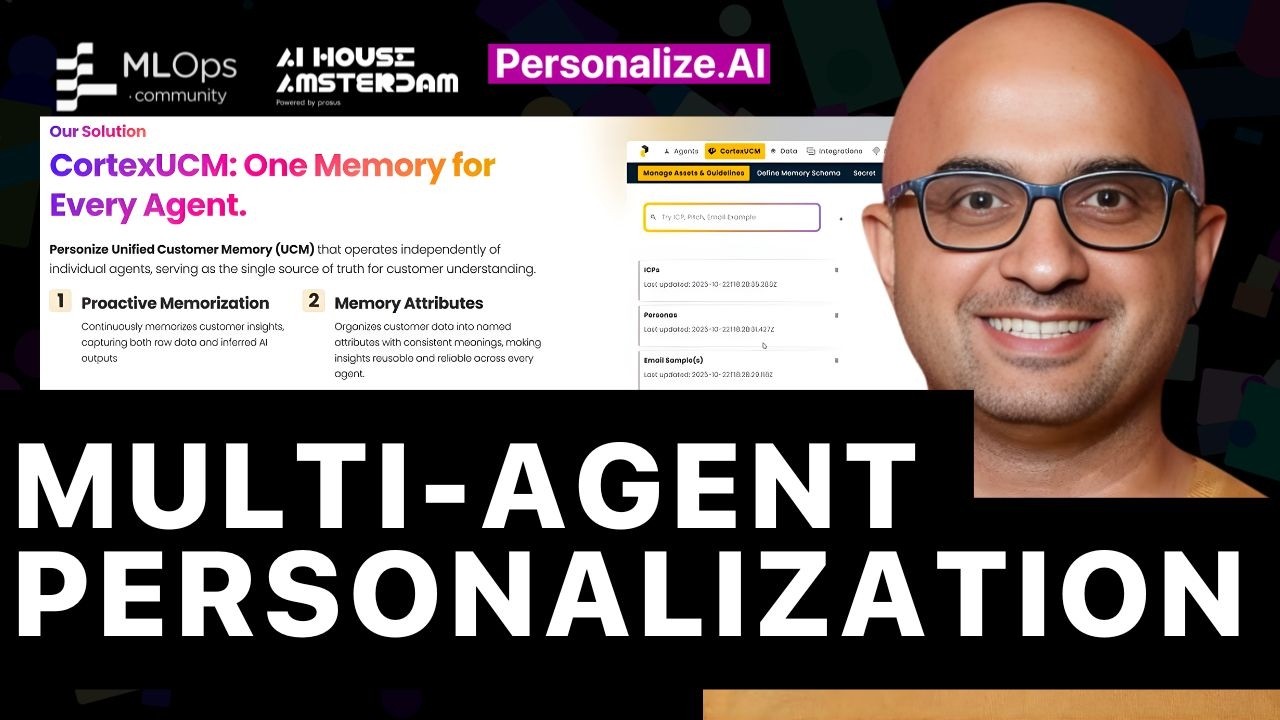
Traditional personalization, reliant on static, token-based templates, is giving way to a new category: generative personalization. This approach leverages AI agents not as conversational chatbots, but as systems that converse with databases to perform large-scale batch processing. The goal is to deliver highly tailored content for emails, websites, and product pages, a task that requires a sophisticated, multi-agent architecture.
The Challenge of Scalable Personalization
A single agent often produces poor and inconsistent quality. A multi-agent system is necessary for a robust, step-by-step process that includes deep research, inference, reasoning, planning, and finally, content generation. However, this introduces its own set of challenges, especially in autonomous, at-scale operations without a human-in-the-loop for each task:
- Consistency and Contradiction: Multiple agents, possibly built by different teams, can produce conflicting or inconsistent outputs for the same customer, creating a fragmented experience.
- Defining Accuracy: For business applications, accuracy isn’t just about beautiful, fluent text. It’s about factual correctness and adherence to company-specific definitions and goals.
- Cost and Latency: Operating multi-agent systems on large databases is computationally expensive and can be plagued by latency from tool calling and API interactions.
- Unified Customer Understanding: The core problem is ensuring that all agents operate from a shared, deep, and truthful understanding of each customer. Without this, consistency is impossible.
Limitations of Existing Memory Approaches
Common solutions for providing agents with knowledge fall short in the context of autonomous, scalable personalization.
- RAG and Vector Databases: While powerful for providing access to vast amounts of data, Retrieval-Augmented Generation has key weaknesses. Access to raw data does not equate to genuine customer understanding. The retrieval process is often sensitive to prompt phrasing, leading to inconsistent results even when the same agent is run multiple times. The retrieved data chunks can be partial or vary, introducing a risk of inaccuracy and undermining trust in the system.
- Function Calling: Giving agents tools to query databases and APIs directly also presents problems. This method is still sensitive to prompts and instructions. More significantly, it can lead to context overload, where function calls return large amounts of data that, while necessary for the function, are not all relevant to the specific task, bloating the context window. Different agents may also call and interpret the results of these functions differently, failing to establish a shared understanding.
Cortex: A Proactive, Unified Customer Memory (UCM)
To address these challenges, we developed Cortex, a unified customer memory system inspired by the human cortex. It operates on a few key principles to create a clean, structured layer of understanding between noisy raw data and the agents.
- Proactive Inference: Instead of passively storing raw data, Cortex uses internal agents to proactively run analyses, infer key insights, and synthesize information. For example, it can analyze a customer’s data to determine if they are a B2B or B2C company—a critical piece of information that is often not explicitly stated in the source data. This insight is then stored as a structured attribute.
- Standardized & Shared Attributes: All inferred memories and insights are captured with standard naming conventions on a per-customer basis. This makes the customer understanding searchable, filterable, and usable for routing, scoring, and other logic. It provides a level of predictability and trust that is difficult to achieve with on-the-fly data retrieval.
- Centralized Recall & Compaction: This system provides a single, consistent source of truth that all agents can reference. By moving from raw data to synthesized memories, the information is compacted, leaving more space in the agent’s context window for task-specific information. This keeps the agent’s operational context light and efficient.
Practical Implementation and Learnings
We moved away from hardcoded, multi-step prompts. Our architecture now treats memory as a layered, reusable asset, with specific contexts for the user, the company, and the contact. The agent’s prompt is shrunk to focus only on the immediate task, while the richer context is recalled from the UCM.
In experiments with over 20 B2B companies, a one-click implementation performs deep research for 5-10 minutes to build the initial Cortex memory. The results are impressive: the AI can write with the nuance and domain awareness of a senior employee, personalizing technical website sections and generating on-brand blog posts. This gives any agent, regardless of who built it, immediate and deep business context.
We are continuing to develop this technology, including building out a centralized memorization and recall platform and providing API access. A key area of ongoing work is developing more sophisticated, schema-based controls for memory access, allowing for departmental siloing and organization-wide guidelines to manage knowledge domains within a single company.