The Future of the Grid: How AI Transforms Power System Planning
Microsoft Research introduces GridSFM, an open foundation model designed to accelerate power grid analysis. By combining open data, machine learning, and physics-based modeling, GridSFM provides millisecond-level approximations of AC Optimal Power Flow (ACOPF) solutions, enabling faster scenario evaluation, planning, and research for increasingly complex energy systems.
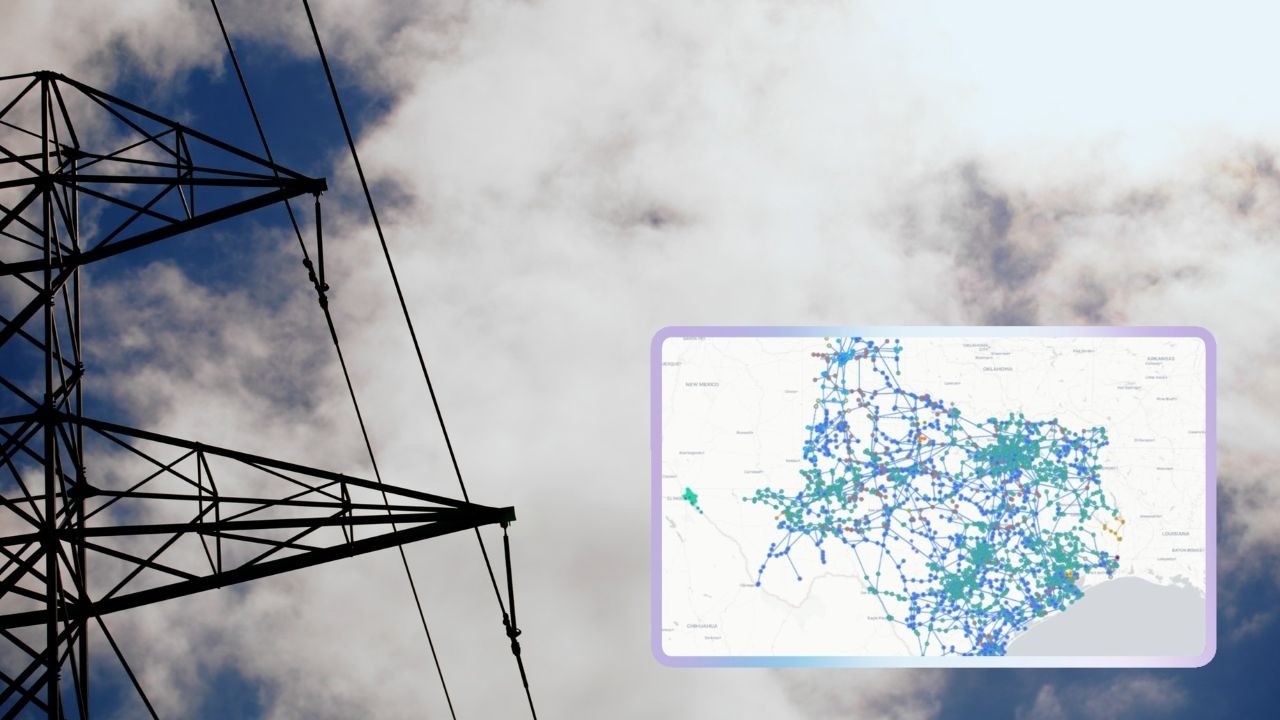
Power grids are facing unprecedented complexity due to renewable energy integration, electrification, extreme weather, and increasing demand. Traditional methods for grid operation, such as AC Optimal Power Flow (ACOPF), are highly accurate but computationally slow and do not scale efficiently for the multitude of scenarios grid operators must evaluate. Furthermore, realistic grid data is often proprietary, hindering research and development. Microsoft Research addresses these challenges with GridSFM, an open foundational model for power systems designed to provide rapid, physics-informed approximations of ACOPF solutions.
Open Data Pipeline for Realistic Grid Models
A critical first step was to overcome data restrictions. GridSFM leverages an open data pipeline that constructs realistic, large-scale grid models for the United States using exclusively publicly available sources. This pipeline involves five key steps:
- Feature Extraction: Pulling power-related features (transmission lines, substations, generators) from Open Street Map. This raw, crowdsourced data is often rich but fragmented and lacks electrical properties.
- Bus-Branch Model Creation: Transforming raw geographic features into an electrical bus-branch model. This includes inferring missing voltages, filtering to the transmission system (above 69kV), detecting HVDC links, stitching fragmented lines, classifying circuits, creating electrical buses per voltage level within substations, detecting transformers, and snapping generators to their nearest bus. The output is a clean, AC-connected network.
- Physical Parameter Assignment: Assigning physics to the network. Resistance, reactance, susceptance, and thermal ratings are determined based on voltage class and line length. Generator cost curves, reactive power limits, ramp rates, and voltage limits are estimated using EIA data combined with engineering defaults by fuel type.
- Demand Distribution and Dispatch: Fetching hourly demand from EIA for each balancing authority, spatially mapping buses to BAs, and distributing load to individual buses using census track population. Generators are then dispatched in merit order to match demand, including system losses and reserve margins.
- ACOPF Execution and Relaxation: Running AC and DC optimal power flow using the PowerModels package for Julia. Recognizing that models built from open data may not always be feasible out-of-the-box, the solver supports a hierarchy of relaxations (loosening line limits, voltage bounds, angle constraints) until a solution is found. The required relaxation level serves as a valuable signal for assessing model quality and stress across regions.
This pipeline results in fully open, physically consistent power grid models, ready for analysis, training GridSFM, or use by the community.
GridSFM: A Foundational Model for Power Systems
At its core, GridSFM is a small foundational model that approximates ACOPF in milliseconds. It treats the power grid as a graph, where electrical buses are graph vertices and transmission lines are graph edges. Voltages reside on vertices, power flow on edges, and the grid topology ties them together. This graph-based structure makes the model topology-agnostic, allowing it to generalize across systems of varying sizes without requiring per-grid parameters.
Model Architecture
Node and edge features are embedded into a shared representation and refined through attention blocks that operate directly on the grid structure. Prediction heads then decode the bus voltage, voltage angle, active and reactive generator dispatch, and a crucial feasibility verdict. Branch flows are computed analytically from the predicted bus state using standard AC line equations, ensuring physical consistency.
Training Methodology
GridSFM’s training approach significantly differs from prior work, which typically trains one model per grid over a narrow operating range. Instead, GridSFM is trained once across more than 150 distinct base grid topologies and approximately half a million diverse scenarios. This approach is akin to ImageNet pre-training, yielding a backbone model capable of zero-shot generalization or fine-tuning for downstream tasks, rather than requiring a specialist model for every grid.
The training scenarios are generated through a perturbation pipeline that stresses the grid along five axes: varying load profiles, extreme conditions, generator outages, line derating, tight voltage bands, and shuffled generator costs. This forces the model to learn underlying physics and cost structures, preventing simple memorization. The training signal combines:
- Solver Supervision: Direct supervision from conventional ACOPF solutions.
- Physics-based Penalties: Penalties for violating Kirchhoff’s laws, thermal limits, and voltage bounds. Crucially, GridSFM is also trained on infeasible scenarios (roughly half the training mix), including engineered failure modes like voltage squeezes and thermal bottlenecks. Infeasibility is not discarded as noise but is a first-class output the model learns to detect.
Capabilities and Impact
Upon receiving a grid topology, constraints, and a loading scenario, GridSFM returns two primary outputs in a single forward pass:
- Full Physics Snapshot: Predictions for grid voltage, voltage angle, generator dispatch, and power flow on every line. This is a non-linear approximation, explicitly including reactive power, a component often ignored by simpler methods like DCOPF.
- Feasibility Verdict: A confidence score indicating whether the given scenario can actually be solved.
GridSFM achieves these results in milliseconds, approximately 1,000 times faster than traditional AC solvers, unlocking several critical workflows:
Workflow Acceleration
- Feasibility Screening: For planning studies that require sweeping thousands of contingencies, GridSFM can triage scenarios instantly with over 95% accuracy, filtering out clearly infeasible cases and referring only borderline scenarios to conventional solvers.
- Fast Approximation: GridSFM matches DCOPF dispatch costs while preserving vital voltage and reactive power information, offering a more complete and accurate approximation than DCOPF.
- Warm Starting: When exact solutions are required, GridSFM can provide a strong initial starting point for conventional solvers, making them approximately 1.7 times faster on average, and over 7 times faster on some larger, more complex grids.
Foundational Model Behavior
The model demonstrates true foundational capabilities. When tested zero-shot on an unseen grid (6,470 buses, 40% larger than any training example), initial performance dropped (cost error ~10%, feasibility classifier calibration loss). However, the model still ranked scenarios by cost almost perfectly, indicating it had learned transferable grid physics. Critically, this degradation was cheaply mitigated: fine-tuning on just 10 scenarios reduced cost error below 2% and boosted visibility detection above 90%. With 1,000 scenarios, the model achieved in-sample accuracy on the new grid, even for held-out single-line outage scenarios.
Conclusion
GridSFM, with its open data, open code, and open weights, represents a significant step towards moving power systems analysis from slow, computationally intensive workflows to fast, data-driven decision-making. It provides a robust foundation for the community to develop the next generation of grid simulation and planning tools, crucial for the future of the electric grid.