Why AI Agents Forget Everything (And How To Fix That)
Mem0 is building a model-neutral, persistent memory layer for AI agents to solve the fundamental statelessness of LLMs. Co-founders Taranjeet Singh and Deshraj Yadav discuss their hybrid memory architecture, which reduces cost and latency compared to context stuffing, and their vision for a future where user memory is portable across all AI applications.
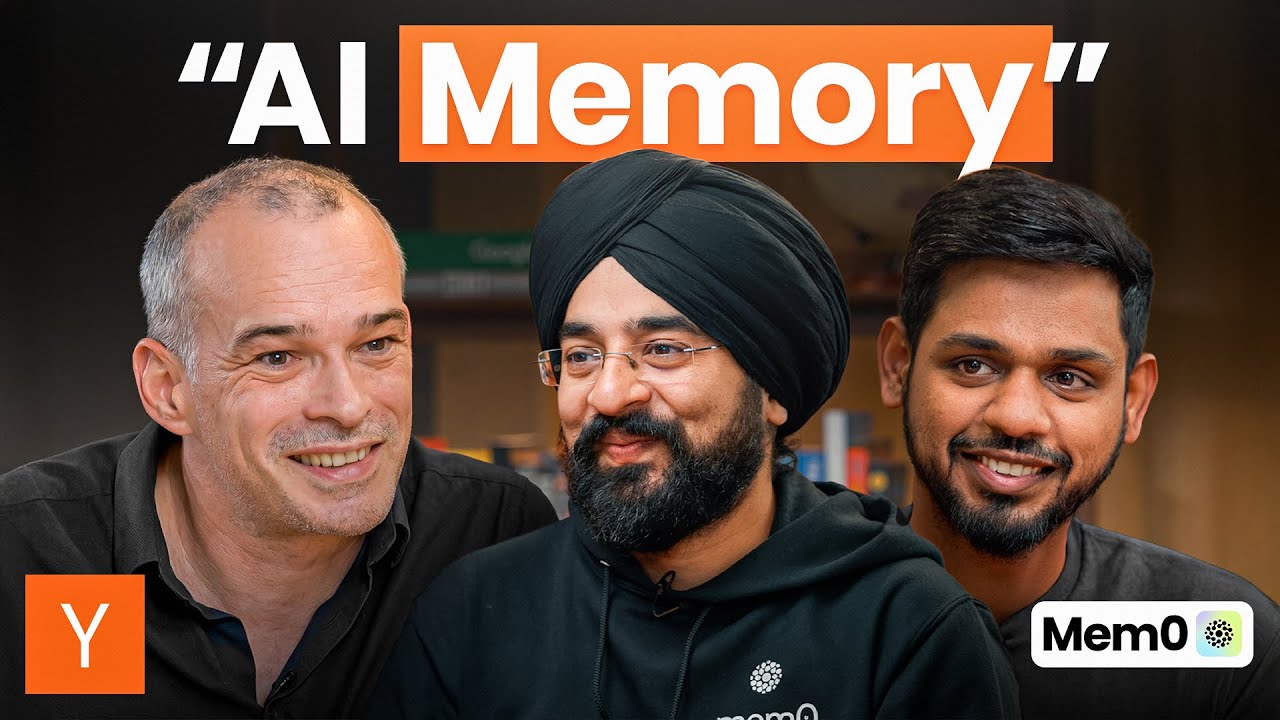
Large Language Models (LLMs) are fundamentally stateless, meaning they have no memory of past interactions and treat each prompt as a new event. This forces AI agents built on top of them to start from scratch in every session, leading to a disconnected and inefficient user experience. The startup Mem0 is building a dedicated memory layer to solve this problem, providing AI agents with persistent, long-term memory.
Optimizing Beyond the Context Window
The most common method for giving an LLM context is to “stuff” the conversation history into the context window with every new prompt. This approach is inefficient and suffers from two major drawbacks:
- High Cost: Sending a large number of tokens with every API call is expensive.
- High Latency: Processing a larger context window increases response times.
Mem0 provides a more intelligent solution by creating a structured memory layer that identifies and retrieves only the most relevant information for a given interaction. This significantly reduces the number of tokens sent to the LLM, saving both cost and latency for developers.
Under the Hood: A Hybrid Memory Architecture
Mem0’s platform is built on two core primitives: adding a memory and searching for a memory. Underpinning these actions is a sophisticated hybrid data store architecture designed to handle unstructured information efficiently.
When data is ingested, Mem0’s algorithm classifies it and stores it in one of three ways:
- Key-Value Pairs: For discrete pieces of information.
- Semantic Chunks: For larger blocks of related text.
- Graph Memory: To create and store relationships between different facts and entities, building a complex state of the user’s preferences and history.
This hybrid approach enables the system to perform real-time, low-latency retrieval with high accuracy, pulling relevant context from all three sources as needed.
Customization and Memory Management
Recognizing that memory is subjective and application-dependent, Mem0 allows developers to define custom rules for memory capture using plain natural language. These rules are interpreted by an LLM to create a tailored memory pipeline for each use case.
The platform also addresses the challenge of memory decay, as not all memories remain relevant forever. Developers can implement various decay mechanisms based on their needs:
- Hard Decay: Memories are deleted after a fixed period (e.g., six months).
- Exponential Decay: Recent memories are given more weight, while the importance of older memories gradually fades.
- Preference-Based Decay: Core user preferences (e.g., “I always stay in Airbnbs in New York”) are retained indefinitely, while less critical information is allowed to decay.
The Case for a Neutral, Decoupled Memory Layer
While major AI labs like OpenAI are introducing native memory features, Mem0 argues for a decoupled, model-neutral approach. Developers often use multiple LLMs and agentic frameworks, and tying memory to a single model provider creates lock-in. A neutral memory layer allows developers to own their users’ context and switch between models or frameworks without losing history.
Mem0 is designed to be a universal, neutral utility, integrating with major agentic frameworks like AWS Agents SDK (as the exclusive memory provider), CrewAI, and Flowise, ensuring that memory remains centralized and independent of the underlying model or framework.
Vision: Towards Portable, Universal Memory
The ultimate vision for Mem0 is to “make it work, make it neutral, and make it portable.” As users begin to interact with hundreds of specialized AI agents, they will expect a seamless experience where their preferences and history are universally understood. The friction of teaching each new application about oneself from scratch will become unacceptable. Mem0 aims to build the infrastructure that allows user memory to be portable across all applications, enabling a future where any agent can instantly “just get you.”