MCP Apps: Extending the Frontier — Ido Salomon & Liad Yosef
MCP Apps transforms chat and coding assistant interactions from text-heavy responses into rich, interactive user interfaces, preserving brand identity and enhancing user experience. It allows services to send "UI atoms" directly into assistants like Claude and ChatGPT, enabling a "write once, run anywhere" model across a massive user base. This standard defines how hosts render web components, manage user interactions, and shifts control of the user journey to the agent, ushering in a new era of the agentic web.
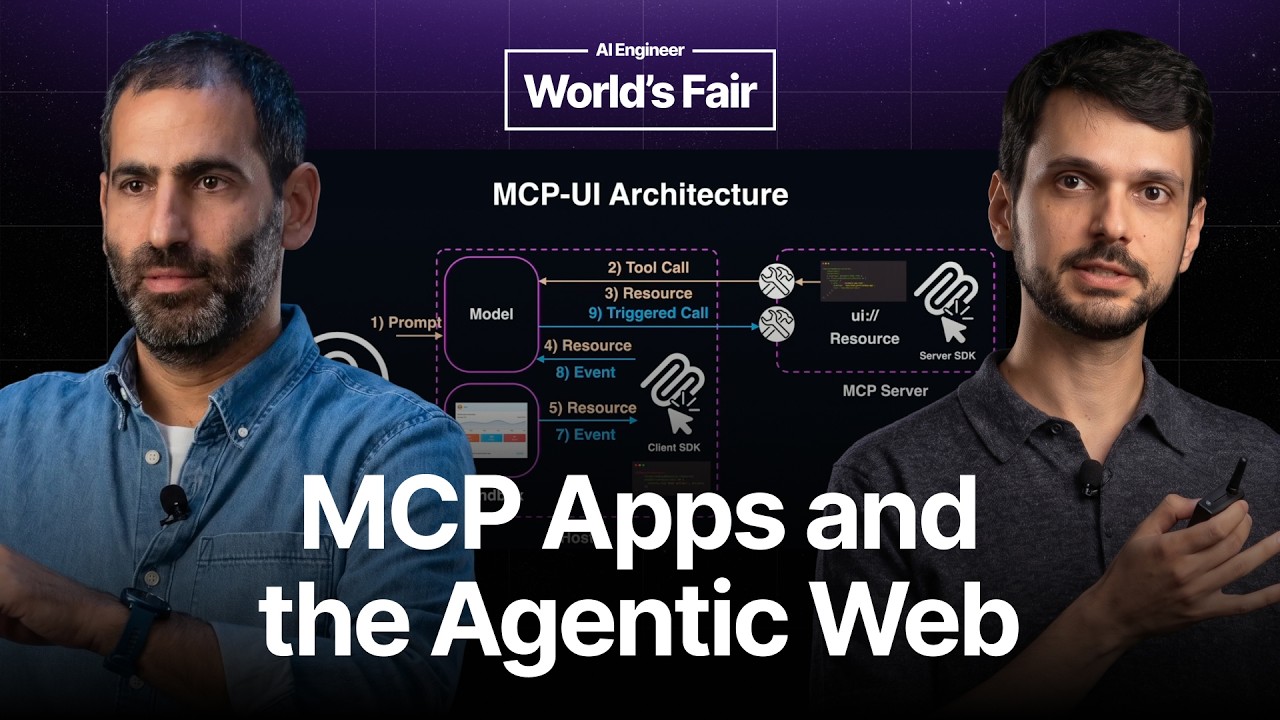
Liad Yosef and Ido Salomon introduce MCP Apps, a groundbreaking initiative to transform chat and coding assistant interactions from text-based responses into rich, interactive user interfaces. They highlight that while text is a natural interface for chat, it’s often inefficient for conveying complex information, leading to “walls of text” and a loss of brand identity for services integrated into assistants. The core idea is to allow services to send their own UI chunks directly into the chat, enabling users to interact with familiar interfaces from brands like Shopify, Hugging Face, or Monday within the assistant environment.
MCP Apps evolved from MCP UI, an open protocol for interactive applications created by Liad Yosef in May 2023. This protocol defines not just how UI is transmitted, but also how it communicates with the host. A few months ago, MCP UI, MCP SDK, and other solutions were officially extended into MCP Apps through a partnership with Anthropic and OpenAI, now supported by major platforms like Claude, VS Code, ChatGPT, Cursor, and GitHub Copilot. Early adopters included 11 Labs, Shopify, and Postman, with Block’s agentic commerce solution now leveraging MCP Apps. The project fosters a large community, with an open working group in the MCP committee that includes Anthropic and OpenAI, convening tri-weekly to evolve the protocol.
Core Concepts and Mechanics
The speakers elaborate on how a tool call in an agentic workflow is transformed into an interactive interface:
- Resource-based UI: Instead of returning a textual response, an MCP server can return an HTML resource. For example, if Claude supports MCP Apps, it can take this HTML and render it as an interactive application.
- Interactive Flow Standardization: When a user interacts with the rendered UI (e.g., clicking a “favorite” button), MCP Apps standardizes this flow. The app doesn’t directly communicate with its backend; instead, it sends a message to the host (e.g., Claude) indicating the user’s action and recommending a tool call (e.g., Spotify’s “favorite” tool). The host retains control, deciding whether to execute the recommended tool.
- Example: PostHog Funnel: A product manager asking for funnel status in Claude would traditionally receive a “useless” textual response. With MCP Apps, the PostHog server can return an interactive widget, allowing the user to see and act on data at a glance, with PostHog’s branding. Furthermore, the interactivity allows for deeper engagement; clicking on a specific funnel step can send a prompt back to the model, asking for explanations, demonstrating a fluid, agentic interaction.
Architecture
The technical architecture involves:
- Prompting: User input initiates the process.
- Tool Call: An agent’s tool call is sent to a server supporting MCP Apps.
- Resource Linkage: The tool call links to a resource, typically an HTML payload, which is simple to integrate (e.g., a basic HTML string within the resource).
- Host Consumption and Rendering: The host (e.g., Claude, ChatGPT) preloads or consumes this HTML resource. It uses an MCP UI SDK (e.g., a React component or web component) to render the HTML within a sandboxed environment. This SDK also includes a callback mechanism for communication.
- User Interaction and Agentic Loop: User clicks or interactions within the sandboxed UI trigger events sent back to the host via the callback. The host then processes this event, potentially initiating another tool call or continuing the agentic flow.
The New Web Philosophy: Agentic Web
The speakers propose a “new vision to the web” where personal assistants become the primary interface for consuming services, rather than traditional browsers and tabs. Instead of users navigating multiple websites and their full UIs (e.g., for planning an anniversary, interacting with Google Calendar, Amazon, Booking.com), the assistant composes “UI atoms.” These are small, context-aware chunks of UI provided by services.
- Benefits:
- User: The assistant, having context, presents only relevant UI atoms, simplifying tasks.
- Service: Brands maintain their identity and UX within the assistant.
- Host: Does not need to develop capabilities for every service.
- Control Shift: In this agentic web, the host (the chat assistant) gains control over the user journey, not individual applications. MCP Apps standardizes this by defining three levels of control: an app can notify the chat, ask the chat to run a prompt, or release all responsibility to the chat. This ensures auditability and a unified user experience.
Evolving Spec and Future Directions
The MCP Apps specification is continuously evolving with community contributions. Key areas of ongoing work include:
- Reusable Views: Optimizing for heavy applications by allowing hosts to update existing views rather than re-rendering from scratch.
- App Tools (View Tools): Standardizing communication from the host to the app (e.g., an agent filling out a form within an app). This is part of the spec and will be released soon.
- Generative UI Spectrum: Exploring interoperability across predefined UI (MCP Apps), declarative UI (e.g., JSON render, A2UI where the chat builds the UI from instructions), and fully generative UI. A guide for interoperability between A2UI and MCP Apps has recently been released, allowing servers to write A2UI for Gemini and wrap it as an MCP App for ChatGPT.
Distribution and Call to Action
MCP Apps represents “an entirely new way to distribute applications.” With platforms like ChatGPT reaching hundreds of millions of weekly users, adopting MCP Apps allows servers to reach a massive audience immediately, offering a total addressable market significantly larger than traditional app stores at their launch. The ability to “write once, run anywhere” is a critical advantage, demonstrated by the same codebase running in different hosts like LibreChat and ChatGPT.
Developers are encouraged to visit the X apps repository (the official SDK and spec) to get involved, propose ideas, contribute to the open issues, and embrace the future of the agentic web.