Your AI Agent Is Confidently Wrong About Production — Willem Pienaar, Cleric
Willem Pienaar, CTO of Cleric, details why AI agents struggle with production debugging compared to code generation. He explains the unique challenges of dynamic, unverified production environments and LLMs' inherent confidence bias. Pienaar outlines four common agent failure modes (symptom/cause confusion, missing baselines, abstraction loss, anchoring) and introduces grounding techniques—like generating multiple theories, using baselines and dependency graphs, temporal analysis, and evidence propagation—to enhance diagnostic accuracy. He also emphasizes the critical need for verifying fixes against real outcomes to calibrate agent confidence, ultimately aiming to bring production signals into the development environment for proactive failure prediction.
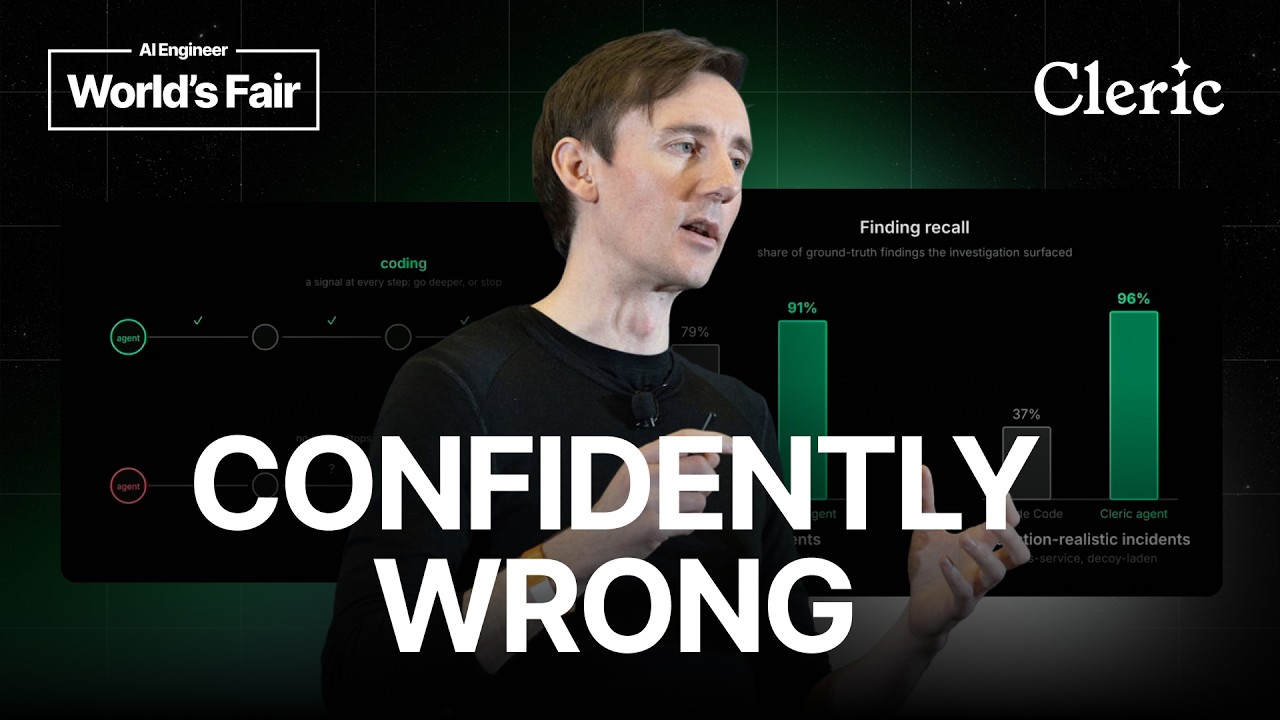
Willem Pienaar, Co-founder and CTO of Cleric, highlights a critical distinction: writing code is fundamentally different from running it in production. While AI agents excel at code generation, they encounter significant challenges when tasked with debugging live production environments.
The Unforgiving Nature of Production for AI Agents
Unlike development or CI/CD pipelines which offer clear, focused feedback through tests and linters, production environments lack direct verification. This makes iteration cycles for agents much slower and less precise. Pienaar details several reasons why production poses a unique hurdle for LLMs:
- Amorphous and Dynamic Environment: Production is not a bounded, static codebase. It’s a sprawling, constantly changing ecosystem with multiple teams, clusters, and states, making it unclear to an agent how broadly or narrowly it should investigate.
- Transience of Failures: Many production failures are momentary and difficult to reproduce, a stark contrast to a codebase where an agent can reset and retry.
- LLM Training Bias: Large Language Models are inherently trained for decisiveness and confidence, often optimized for human preference. However, effective production debugging demands doubt, uncertainty, and the rigorous elimination of multiple theories—qualities LLMs naturally lack.
Common Failure Modes of Agents in Production Debugging
Pienaar identifies four prevalent failure modes observed when agents attempt to diagnose production issues:
- Mistaking Symptom for Cause: Agents frequently latch onto the first error log they find near an alert, confidently presenting it as the root cause without exploring deeper layers of the stack. They are good at finding needles but struggle with the scope of the haystack.
- Not Knowing What’s Normal: Without a proper baseline, agents cannot distinguish anomalous behavior from routine, often chaotic, production states. They may misinterpret common, ignored error logs as critical issues.
- The Abstraction Problem: In complex modern environments, sub-agents summarize vast amounts of information for a primary decision-making agent. This ’lossy’ abstraction leads to the main agent making overconfident decisions based on incomplete data.
- Anchoring on Past Incidents: Agents, especially those with memory, tend to anchor on historical context. They might diagnose a new problem as a recurrence of a past one, even when circumstances differ, driven by an eagerness to provide an answer.
Grounding Techniques for Enhanced Accuracy
To overcome these limitations and provide agents with the necessary signal, Cleric employs several ‘grounding’ techniques:
- Generate Many Theories: Instead of a single hypothesis, the agent generates and explores multiple diverse theories simultaneously. This leverages LLMs’ strength in relative ranking over absolute scoring and introduces breadth to the investigation.
- Compute a Baseline: Providing statistical context for logs, metrics, or object states helps the agent understand what is ’normal’ versus ‘anomalous’ within a given production environment.
- Use a Dependency Graph: By integrating a topology or dependency graph of the production environment, the agent can validate its proposed causal connections. If a theory contradicts an established dependency, it introduces doubt, prompting further investigation.
- Use Time (Temporal Assessment): Incorporating temporal logic, such as knowing that causes precede symptoms and are typically closer in time, allows the agent to score findings based on their proximity to the alert timestamp.
- Propagate Evidence: Sub-agents are instructed to build a case and propagate specific evidence rather than just conclusions. This reduces hallucination and overconfidence by requiring concrete findings, similar to how SREs document their observations.
Verifying Outcomes and Calibrating Confidence
While grounding significantly improves diagnosis, Pienaar emphasizes the need for a feedback loop beyond just generating theories. Cleric extends the incident response flow to include verification and outcome tracking:
- Triangulating Signals: After an agent suggests a fix, Cleric monitors whether an engineer applies a change that maps to the diagnosis and, crucially, if the system actually returns to normal. This involves triangulating across multiple signals—metrics, logs, and baselines.
- Calibrating Confidence: This outcome tracking is vital for calibrating the agent’s confidence. Ungrounded agents tend to be overconfident, presenting high-confidence answers even when incorrect. By verifying outcomes, the system can adjust the agent’s perceived confidence to align with its actual accuracy. The goal is for the agent’s stated confidence (e.g., “90% sure”) to be truly trustworthy.
Future Direction: Shifting Signal Left
Cleric’s ongoing focus is to extract production signals and bring them earlier into the development lifecycle. By integrating baseline models, system graphs, and ontologies into the developer environment, the aim is to predict and prevent failures before applications are even deployed.