AI Agents: Transforming Anomaly Detection & Resolution
Martin Keen explores how agentic AI can significantly reduce IT downtime and Mean Time To Repair (MTTR) by moving beyond naive data dumps and embracing context-aware analysis. The key lies in using topology-aware correlation to curate relevant data for an AI agent, which can then systematically identify the root cause, provide explainable insights, and generate actionable remediation steps, ultimately augmenting human SREs rather than replacing them.
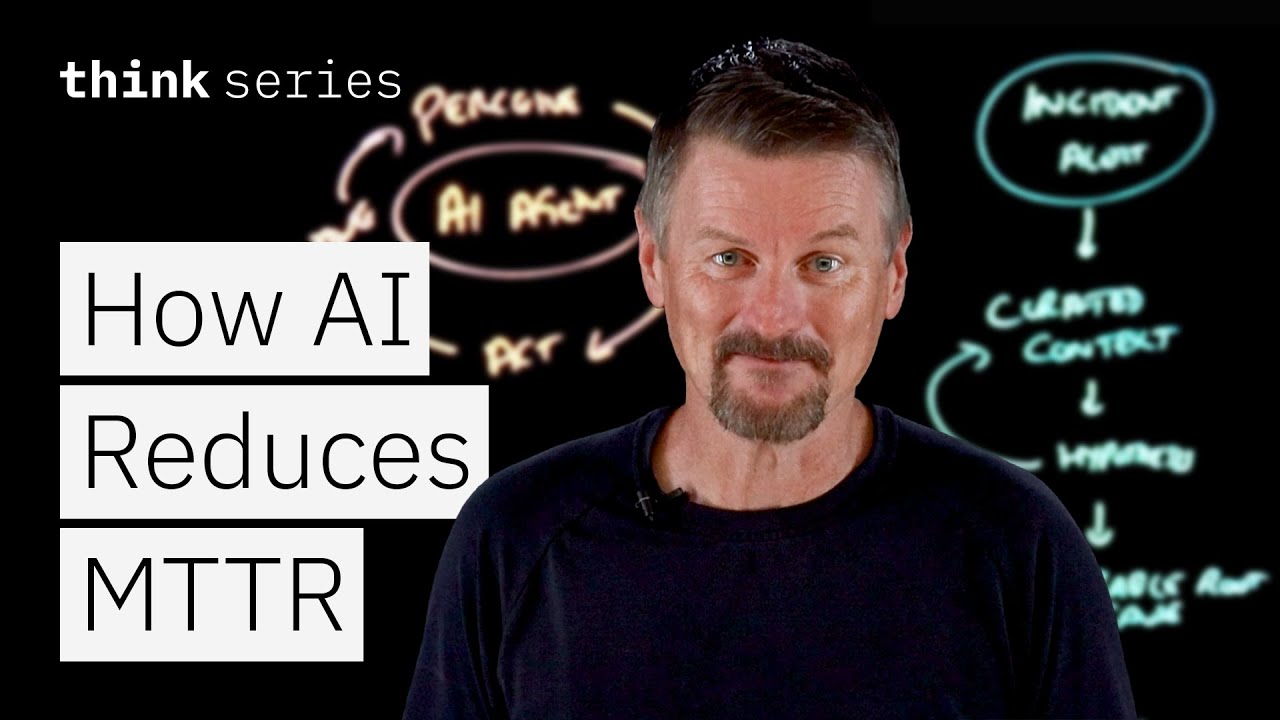
The initial moments of an IT system anomaly are critical. With every minute of downtime costing thousands of dollars, the 22-minute average it takes for a woken-up Site Reliability Engineer (SRE) to reach full cognitive productivity—a phenomenon known as sleep inertia—can be incredibly expensive. Agentic AI offers a powerful solution to accelerate anomaly detection and resolution, but its application requires a nuanced approach.
The Pitfall of the Brute-Force AI Approach
A common but flawed idea is to pipe the massive volumes of telemetry data (logs, traces, metrics) generated by IT environments directly into a Large Language Model (LLM) and ask it to find the root cause. This “brute-force” method is doomed to fail for several reasons:
- Context Window Limitations: While LLMs have large context windows, they are not infinite. A single node cluster can generate gigabytes of log data per hour, easily overwhelming the model.
- Noise-Induced Hallucination: Overfeeding an LLM with vast amounts of unrelated, noisy data causes it to “hallucinate.” The model’s goal is to predict plausible words based on statistical patterns, not to verify facts. It will confidently fabricate causal links between coincidental events like benign restarts and old warning logs, creating a neat but entirely imaginary narrative.
The Solution: Context Curation and Topology-Aware Correlation
To effectively use AI, we must move from a brute-force dump to strategic context curation. Instead of feeding the AI a firehose of data, an AI agent should be given only the signals that matter for the specific incident at hand.
This is achieved through topology-aware correlation. A modern observability platform maintains a real-time dependency graph—a map of how all services connect and depend on each other. When an incident occurs, such as an authentication service failing:
- The agent uses this dependency graph to pull telemetry data only from involved components (e.g., the user database it relies on, the Redis cache it uses for sessions).
- It intelligently ignores data from unrelated components, even if they are running on the same cluster (e.g., a reporting microservice).
The Agentic Investigation Process
Once an incident alert is triggered, the AI agent begins its work using the curated MELT (Metrics, Events, Logs, Telemetry) data. The process follows a continuous feedback loop:
- Perceive: The agent takes in the curated data related to the incident.
- Reason: Using causal AI, it analyzes the data to form a hypothesis about the probable root cause.
- Act: Based on its hypothesis, it systematically requests additional, specific data to validate or refine its understanding. For example, if a web service is slow, it might fetch logs, see a database connection error, then retrieve database metrics, notice a recent update, and finally check for configuration changes.
- Observe: It analyzes the results of its actions and data requests, feeding this new information back into the loop.
This iterative process leads to the identification of the probable root cause, backed by crucial explainability. The agent presents its chain of thought and the supporting evidence that led to its conclusion, allowing a human SRE to supervise and validate the analysis.
From Analysis to Action: AI-Assisted Resolution
Identifying the root cause is only half the battle. Agentic AI also assists the SRE in the resolution process in four key ways:
- Validation: The agent generates specific steps an SRE can take to manually validate that the identified root cause is correct, ensuring a human remains in control before applying a fix to a production system.
- Runbook Generation: It produces a step-by-step runbook—an ordered action plan to remediate the issue. This guides the SRE through the fix, which is especially helpful if they aren’t an expert on that specific component.
- Automation Scripts: The agent can translate the runbook steps into executable code, such as Bash scripts or Ansible playbook snippets, providing the exact command syntax and parameters needed.
- Automatic Documentation: The AI can generate a summary incident report for a post-incident review and maintain an ongoing summary as the incident unfolds, helping to bring new team members up to speed quickly.
Ultimately, agentic AI redefines how IT teams handle outages. These agents operate under human oversight, augmenting rather than replacing human decision-makers. By handling the data-sifting and initial analysis, they allow SREs to focus their energy on verification and remediation, leading to a substantial reduction in Mean Time To Repair (MTTR), less operational stress, and more effective responses to those 2 a.m. alerts.