GLM-5.2: Open Weights, Near-Frontier Intelligence — Zixuan Li, Z.ai
Zixuan Li, head of Z.ai, introduces GLM-5.2 and explains the company's history, from the 2021 GLM paper to a new high thinking level and near-frontier benchmark results. He makes the case for open weights through enterprise on-prem deployment, domain fine-tuning and community co-design, and closes by announcing Z Code, an open-sourced coding harness that works with other frontier models.
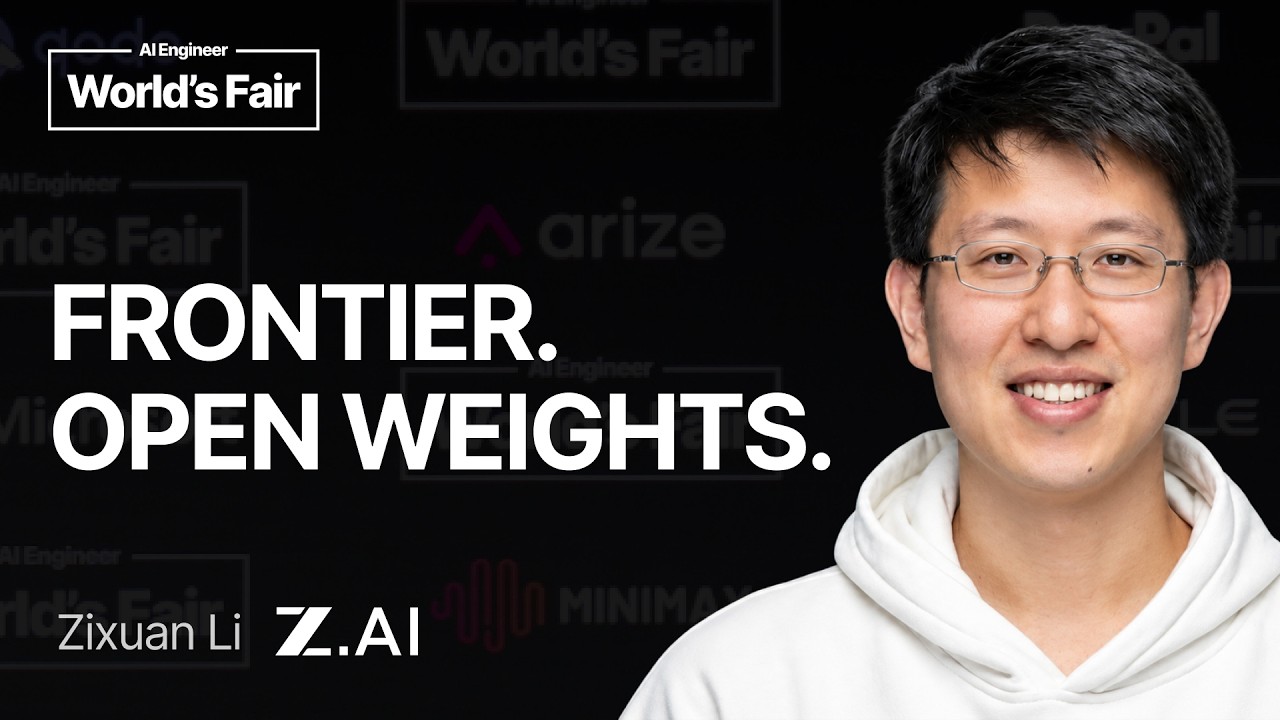
Zixuan Li opens by joining remotely and noting that he cannot see his own slides, so a colleague advances them for him. The talk is mostly about introducing Z.ai and GLM-5.2 to an audience that may not know the company, and about explaining why it releases near-frontier models as open weights.
Who Z.ai is and where the GLM name comes from
The company is Zhipu, which operates under the Z.ai name. GLM is not a marketing brand invented for the product line. It is a generic technical term: General Language Model pre-training with autoregressive blank infilling, taken from a 2021 paper. Li presents this as evidence that Z.ai was among the first labs exploring large language models, alongside OpenAI, Anthropic and DeepMind. The architecture has since changed, but the GLM name stayed as the brand for the 5.x line, which has become the company’s most widely deployed model family.
Redefining intelligence beyond IQ
Li pushes back on the idea that intelligence is IQ, or competition math and physics problems. When DeepSeek R1 launched, the conversation centered on those tasks, but Li argues they capture only a narrow slice of capability. From GLM-4.5 through GLM-4.7, the team treated reasoning, coding and agentic ability as a combined target. GLM-5.2 is the result, and Li says it is the first release where the team wanted to show what the model does rather than list version numbers.
Benchmarks and the new high thinking level
GLM-5.2 is specialized for coding and agentic work. On the hardest long-horizon benchmarks, which Li names as DeepSWE and Terminal-Bench 2.0 (transcribed as ‘Terminal Bench 211’), it lands between Claude Opus 4.7 and 4.8. It is at least on par with Opus 4.7 and shows a significant improvement over GLM-5.1. Li addressed rumors comparing the model to ‘Mythos’ and ‘Fable’ by sharing charts directly rather than speculating.
The release also adds a new ‘high’ thinking level. Harder tasks consume more tokens, and Li says the team cares a great deal about token efficiency, so a separate high budget gives users control over that tradeoff. The most striking result is that the non-thinking mode of GLM-5.2 beats GLM-5.1 with thinking enabled, which Li calls a huge improvement for open-weight models.
More than a coding model
Many users reach GLM through coding harnesses such as Claude Code, Codex-style tools and OpenCode, but Li wants people to see it as a general model. The team has trained on GDPval, math, role play and general chat, and aims to improve every aspect of the model. On the Artificial Analysis Intelligence Index, GLM-5.2 leads the other open-weight models by a wide margin and sits close to the frontier closed models.
Why open weights
Li frames the open-weight decision as a match between user needs and Z.ai’s own needs, rather than charity. He identifies three reasons.
First, security, control and trust. Enterprises and governments, especially in the Western world, want to run models on their own servers. Weights are published on Hugging Face so they can deploy on premise.
Second, diversity through fine-tuning. Legal, finance and security firms need specialized behavior. Li cites Harvey, which fine-tuned an earlier GLM release (transcribed as ‘GLM 4.1’) and may do the same with GLM-5.2. He says many other companies see fine-tuning GLM as a way to differentiate from other application builders.
Third, co-design. Customers who want to shape where the technology goes need to see architecture and training recipes. Li says the goal is to ‘co-shape the future’ with customers and the open-source community.
The ecosystem and the tech blog
Li credits the open-source community, naming partners and individual developers, and calls application builders the ’true heroes’ because their feedback and tooling push the models forward. The Z.ai tech blog covers how to try GLM-5.2 through the Hugging Face repository, the chatbot agent, and the API. It also describes a coding plan, similar to Codex or Claude subscriptions, for individuals. The post shares training pipeline details and the recipe behind the model, and Li argues that strong data is only part of the story.
One more thing: Z Code
The final announcement is Z Code, Z.ai’s own coding harness. It was built for GLM-5.2 but supports other frontier models, and users can bring their own API keys. Li describes it as similar in operation to Claude Code and says it uses context compaction techniques like those in other coding harnesses. This is the first time the company has shared the code publicly.
Closing remarks from the host
The host frames the event as a place where model builders and users can meet, do business and ask questions that cannot be asked publicly. He notes that the Z.ai team came to meet attendees and that several Hugging Face top contributors are present. He also mentions work with NVIDIA, Unsloth and Ollama on inference and local deployment tracks over the coming days, then introduces the next speakers from Hugging Face and MiniMax.