State of the AI Industry — the OpenAI Podcast Ep. 12
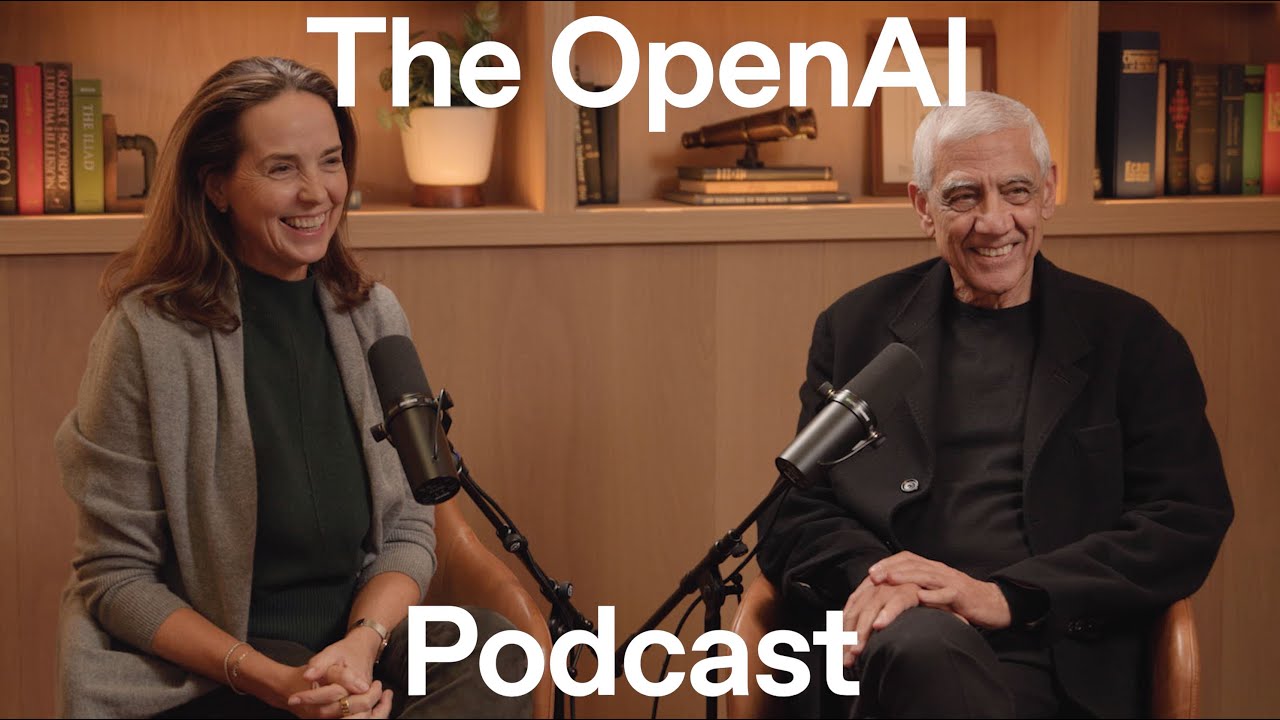
OpenAI CFO Sarah Friar and investor Vinod Khosla discuss the immense demand for AI compute, debunking the 'bubble' narrative by highlighting real-world productivity gains. They explore the future of agents, AI in healthcare, enterprise adoption, and the transformative potential of robotics on the global economy.
The Future is Agentic and Multi-Modal
Vinod Khosla predicts that 2026 will be the year multi-agent systems mature to the point of having a “real visible impact.” In the enterprise, this could manifest as agents managing entire ERP systems, handling daily reconciliations, accruals, and contract tracking. For consumers, complex tasks like planning a trip—which involves coordinating preferences, reservations, schedules, and calendars—will become seamless. He also anticipates significant progress in robotics, real-world models that build general intuition, improved memory and continual learning in LLMs, and a reduction in hallucinations.
Sarah Friar frames this as “closing the capability gap.” While users have been given powerful intelligence (the “keys to the Ferrari”), most are still only learning how to use it for simple call-and-response queries. The next step is to guide both consumers and enterprises toward true agentic, task-oriented outcomes.
“We have handed them the keys to the Ferrari, but they are only learning how to take it out on the road for the first time… How do we help them really move from simple questions into actual outcomes that make my life better?” - Sarah Friar
The adoption curve is distinct from the capability curve. Just as mobile apps evolved from simple mobile-formatted websites to unique applications leveraging GPS and cameras (like Uber), AI applications will become more sophisticated as users discover its full potential.
Debunking the “AI Bubble”
Both speakers firmly reject the idea of an AI bubble, arguing that it’s a fundamental paradigm shift, not a speculative frenzy.
- Measure by Usage, Not Stock Price: Vinod Khosla argues that a bubble should be measured by underlying usage metrics, like API calls, not by volatile stock prices driven by “fear and greed.” He draws a parallel to the dot-com era, where internet traffic continued to grow steadily even as stock prices crashed. He asserts, “You’re not going to see a bubble in API calls.”
- Tangible, Immediate Value: Sarah Friar contrasts the current AI boom with the dot-com era by pointing to the immediate and tangible value AI is creating. She provides a concrete example from her own finance team at OpenAI. Previously, employees performed the mundane task of manually reading every new contract to find non-standard terms affecting revenue recognition. Now, an AI agent automates this process overnight, identifying non-standard terms, suggesting the correct revenue recognition, and even providing insights into business model shifts or sales coaching opportunities. This frees up the team for higher-level strategic work, improving productivity, morale, and retention.
Scaling Compute to Meet Insatiable Demand
The primary constraint on AI’s growth is the availability of compute. Friar states, “Demand is limited, not by anything other than availability of compute today.”
She reveals a strong correlation between OpenAI’s compute expansion and revenue growth:
- 2023: 200 megawatts of compute corresponded to a $2 billion ARR exit rate.
- 2024: 600 megawatts corresponded to a $6 billion ARR exit rate.
- 2025: 2 gigawatts corresponded to a $20 billion ARR exit rate.
To manage this, OpenAI has shifted from a simple structure to a multi-dimensional “Rubik’s Cube” strategy:
- Infrastructure Layer: Multi-cloud and multi-chip to create maximum optionality.
- Product Layer: Expanding from just ChatGPT to platforms like Sora and other transformational research projects.
- Business Model Layer: Diversifying from a single subscription to multiple price points, SaaS-based enterprise pricing, credit-based models, and exploring commerce, ads, and technology licensing (e.g., for drug discovery).
Enterprise Adoption and Startup Opportunities
AI is already driving significant productivity gains. A McKinsey study shows that top-quartile companies adopting AI see productivity boosts of 27-33%. Khosla cites a company with $150 million in ARR running its accounting department with a single controller, and another replacing ten Sales Development Representatives (SDRs) with one person supervising an AI.
For startups, the key is to build on top of foundation models in specialized areas. Friar highlights opportunities for companies that have unique data access combined with complex workflow management.
“95% of the world’s information actually sits behind corporate firewalls… Where have you got access to unique data with a complex workflow? It feels like there’s more of a moat around that.” - Sarah Friar
Other opportunities exist in data permissioning, model customization for specific company histories, and managing the identity and security of interconnected agents.
AI in Healthcare and Robotics
Healthcare is a prime area for AI’s impact. Currently, 230 million people ask ChatGPT a health-related question every week, and 66% of U.S. physicians report using it in their daily work. AI serves as a powerful augmentation tool, helping doctors with differential diagnoses (e.g., identifying a rare disease like malaria in a Scottish ER) and providing patients with the ability to get second opinions or manage their health with personalized plans. However, regulatory hurdles from bodies like the FDA and institutional resistance remain significant challenges.
Looking further ahead, Khosla predicts the robotics industry will be larger than today’s entire auto industry within 15 years. This will be driven by advances in AI and real-world models. Friar suggests that the initial breakthrough in home robotics might not be complex labor like folding clothes, but rather providing companionship to combat the “epidemic of loneliness” among aging populations.
Ultimately, the combination of near-free intelligence and near-free labor from robotics could lead to a “massively deflationary economy” by the end of the next decade, fundamentally reshaping society and raising the minimum standard of living.