What Breaks When You Build AI Under Sovereignty Constraints - Bilge Yücel, deepset GmbH
Bilge Yücel explains that true AI sovereignty is a technical challenge, not just a policy issue, built on four pillars: data, model, infrastructure, and operations. This talk explores the common pitfalls of retrofitting sovereignty—from performance regressions after swapping models to discovering deep vendor lock-in when moving on-prem—and presents a checklist for building genuinely sovereign systems.
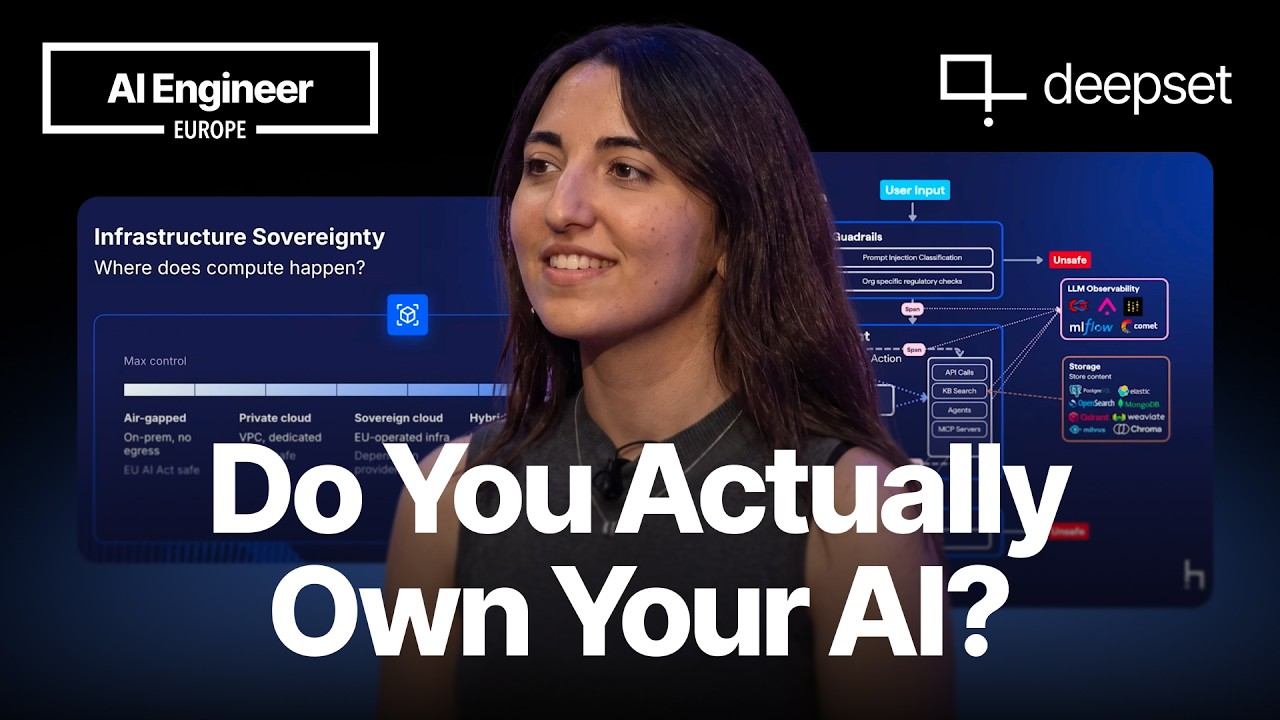
Sovereign AI is the ability of an organization to design, deploy, and operate AI systems on its own terms. For engineers, this translates to having explicit control over data flow, model choice, infrastructure, observability, and operations. This control can be broken down into four distinct pillars.
The Four Pillars of AI Sovereignty
1. Data Sovereignty
Data must be processed and stored within trusted jurisdictions to meet compliance requirements like GDPR. A common violation occurs when data from EU citizens is sent to an embedding API hosted in the US (e.g., Virginia), immediately breaking data sovereignty. Beyond storage location, this pillar also covers internal access permissions, ensuring users within an organization cannot access data they are not authorized to see.
2. Infrastructure Sovereignty
This pillar addresses where the AI application layer—including RAG pipelines, agents, and tools—actually runs. There is a spectrum from maximum control to maximum convenience:
- Air-gapped Environment: Offers the highest level of control and safety (e.g., for EU AI Act compliance).
- Private VPC: Provides GDPR compliance.
- Sovereign Cloud: Varies depending on the provider.
- SaaS: Offers the most convenience but poses risks like the Cloud Act, where a US-headquartered company may be compelled to provide access to your data, even if it’s stored in Europe.
3. Model Sovereignty
This is about who controls the model and the origin of its training data. Key aspects include:
- Freedom of Choice: You should be able to choose and switch models without being tightly coupled to a single provider. If their API is down or prices increase, your system should not break.
- Swappability: It must be possible to swap models without requiring significant architectural or application logic changes.
- Training Data Origin: Although controversial and difficult to verify, knowing the origin of a model’s training data is part of true model sovereignty.
4. Operational Sovereignty
Building an AI system is only half the battle; maintaining it through monitoring, evaluation, and management is the other. Operational sovereignty involves:
- Traceability: Monitoring how systems behave in production, including model inputs and outputs.
- Human-in-the-Loop: Essential for high-stakes environments like HR or finance to ensure control and accountability.
- Controlled Updates: Managing versioning and updates to models and the application layer in a controlled, auditable manner.
The Pain of Retrofitting Sovereignty
When an organization decides to make an existing AI system sovereign, the process often reveals hidden dependencies and breaks the system in unexpected ways.
- Swapping Models: Replacing a frontier API with a self-hosted model is a common first step. This immediately requires translating API logic, updating prompts, and re-evaluating the entire system’s performance from scratch.
- Moving Data: Migrating private data to a required jurisdiction can lead to the complexity of managing multiple databases and instances. This introduces new challenges, such as how to handle search across different jurisdictions—do you classify queries first or search everywhere and merge results?
- Going On-Prem: Replacing managed infrastructure with an on-premise solution instantly exposes the depth of vendor lock-in. Teams must suddenly deal with Kubernetes cluster management, hardware limitations (e.g., connecting CPU-based application layers to GPU-based models), and network management.
- Adding Observability: If observability wasn’t built-in from the start, you are faced with a black box. You must now instrument the entire application to log inputs, outputs, and intermediate steps to make the system auditable and traceable.
An Orchestration Framework as a Solution
A good orchestration framework like Haystack can mitigate many of these challenges by providing:
- A Consistent Interface: Simplifies the transition from cloud to self-hosted models, often requiring only a few lines of code to change.
- Explicit Data Flow: With typed and declared inputs/outputs, the entire data flow is traceable, even in non-deterministic systems like agents.
- YAML Serialization: Makes AI pipelines easy to version, review, and manage within standard version control systems.
- Open-Source Transparency: Eliminates black boxes and hidden assumptions, allowing for deep customization and extension.
A Sovereignty Checklist
To assess the sovereignty of your AI system, ask these three questions:
- Can you swap models without changing the application logic?
- Do you have reproducible run logs stored in a compliant location?
- Can your team respond to an incident without calling a hyperscaler?