How RAG, GraphRAG, and Context Engineering Improve AI Performance
Martin Keen explains that context, not model intelligence, is the biggest bottleneck in AI. He introduces Context Engineering, its four pillars (Connected Access, Knowledge Layer, Precision Retrieval, Runtime Governance), and advanced techniques like GraphRAG to build more reliable, context-aware AI systems.
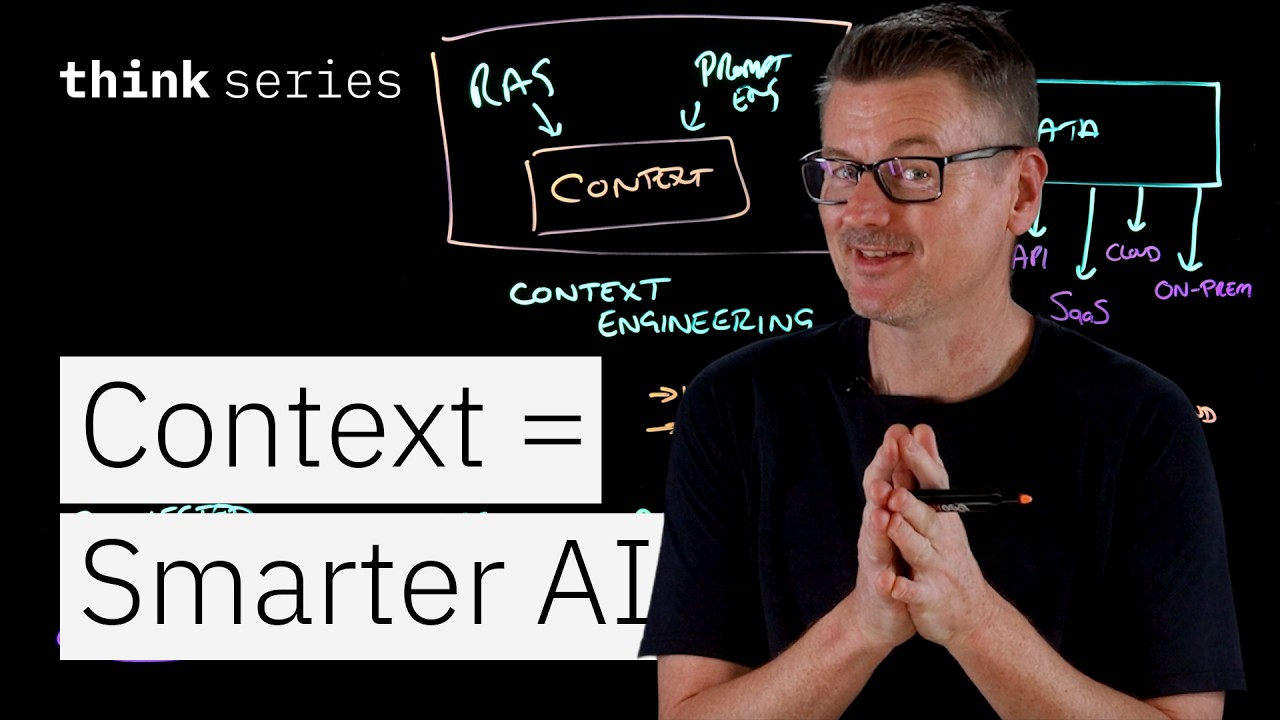
The primary inhibitor in AI performance today is not the model’s reasoning capabilities, but rather the quality and relevance of the context it receives. While frontier models demonstrate remarkable intelligence, their failures often stem from a lack of specific, relevant information—a problem addressed by the practice of Context Engineering.
Understanding Context Engineering
Context Engineering is the discipline of designing AI systems to discover the right data, understand its meaning, and apply it correctly in real-time, all while adhering to the constraints and governance of its operating environment.
Consider an AI assistant tasked with preparing a client meeting brief:
- Without context, the model produces a generic, beautifully formatted but empty template.
- With good context engineering, the system identifies the specific client, pulls in relevant data like recent support tickets and upcoming contract renewals, and—crucially—respects governance by excluding sensitive information the user is not authorized to see, such as internal pricing discussions.
This demonstrates that the value isn’t derived from superior model reasoning, but from providing the model with relevant “contextual intelligence.”
An Infrastructure-Wide Challenge
Context Engineering is more than just Retrieval-Augmented Generation (RAG) or sophisticated prompt engineering; it is a complex infrastructure problem. An organization’s data is typically fragmented across numerous sources:
- Databases and document stores
- SaaS platforms and APIs
- Cloud and on-premise environments
This data exists in varying states—some structured, some a mess—and is subject to strict, role-based access controls. Delivering the right context at the right time with the right permissions is the core bottleneck.
The Four Pillars of a Context Engineering Solution
A robust context engineering solution is built on four essential pillars:
- Connected Access: Instead of centralizing data, the system should use a zero-copy federation approach. This allows the AI to query data where it lives, ensuring the information is always fresh and the original access controls remain intact.
- The Knowledge Layer: Raw data lacks inherent meaning. A knowledge layer enriches it by applying entity resolution across systems, mapping relationships and hierarchies, and adding institutional knowledge to give the data useful semantic context.
- Precision Retrieval: Better context is not more context; it’s more precise context. This involves advanced filtering based on user intent, role, time, and policy to avoid overwhelming the AI model with irrelevant information.
- Runtime Governance: Governance must be enforced live, at the moment of data retrieval and response generation. The system must continuously check permissions, ensuring an agent can query a data source and that the results are appropriate for the user asking.
Beyond Basic RAG: Advanced Precision Retrieval
While standard RAG—chunking documents and performing vector similarity searches—is useful for simple lookups, precision retrieval employs more sophisticated techniques:
- Agentic RAG: This is an iterative process where an AI agent makes an initial data request, evaluates the response, and intelligently decides if it needs to perform subsequent queries to gather sufficient context.
- GraphRAG: This method leverages a graph structure to navigate context. Instead of only asking what documents are semantically similar, it can ask, “What entities are connected to this client, and what documents relate to those entities?” This provides greater precision and structure, with vector search filling in the details within that defined scope.
- Context Compression: Models have finite context windows, and excessive noise degrades performance. Compression techniques summarize long documents or rank information by relevance to maximize the signal-to-noise ratio, ensuring the context provided to the model is lean and potent.
Ultimately, model intelligence is no longer the bottleneck. The path to better AI decisions and outcomes lies in building contextually intelligent systems that master the flow of relevant, timely, and governed information.