Anthropic Claude Opus 4.6 vs OpenAI GPT-5.3-Codex: The AI "big game”
The release of Anthropic's Claude Opus 4.6 and OpenAI's GPT-5.3-Codex within an hour of each other signals an intensifying "AI Super Bowl." Experts Chris Hay and Mihai Criveti compare the models, discuss the strategic battle for the enterprise market, and reveal their practical, multi-agent workflows that leverage the unique strengths of both.
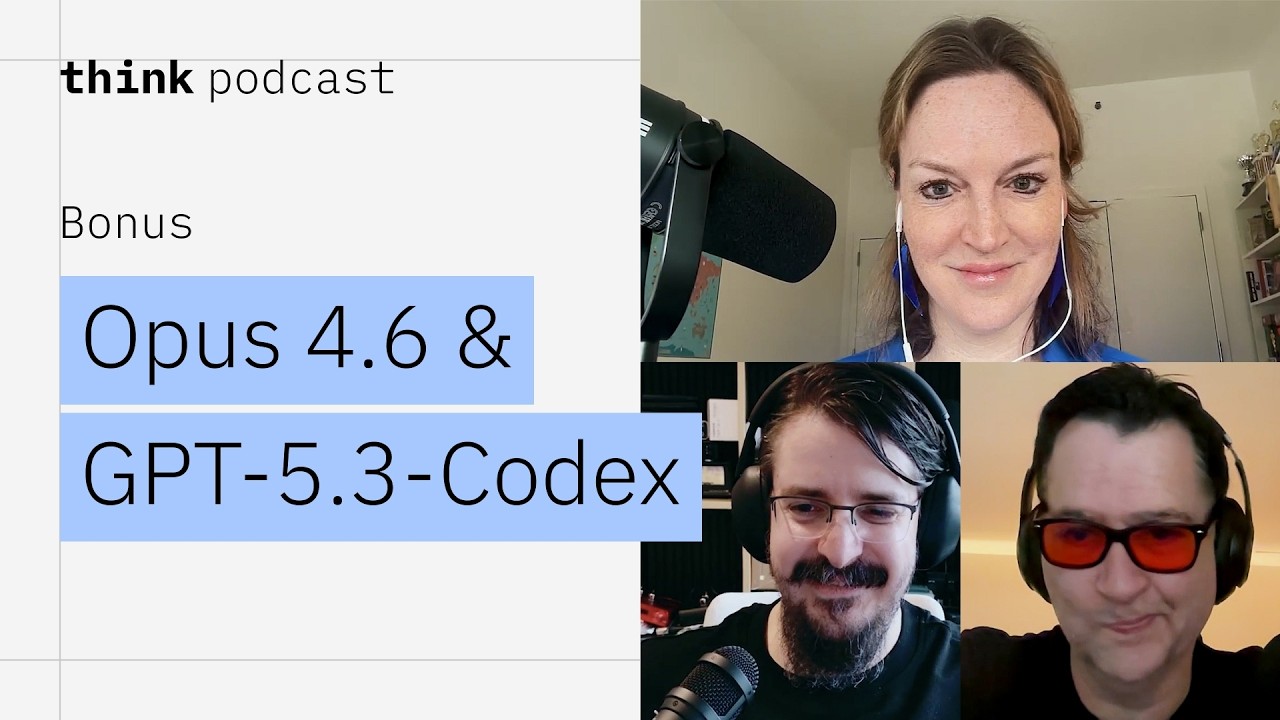
The recent back-to-back releases of Anthropic’s Claude Opus 4.6 and OpenAI’s GPT-5.3-Codex, dropped within an hour of each other, highlight an intensifying “AI Super Bowl” between the two major labs. This competitive dynamic, while potentially beneficial for users who get earlier access to models, raises questions about whether testing cycles are being rushed for marketing purposes.
Model Comparison: Claude’s Reasoning vs. Codex’s Review
While benchmarks exist, hands-on experience reveals distinct strengths and optimal use cases for each model.
-
Claude Opus 4.6: It is favored for its superior planning and reasoning capabilities. The model feels more “friendly” and provides more interactive, high-level feedback, making it a preferred choice for primary development and higher-order tasks. Its ability to discuss roadmaps and provide comprehensive feedback makes for a better overall workflow.
-
GPT-5.3-Codex: This model has improved significantly and excels in deep, technical analysis and edge cases. While its focus on benchmarks like
terminal benchaligns with its push toward agentic coding, it can be less intuitive to prompt. Its true power shines when used as a code reviewer. It is exceptionally good at identifying bugs and security vulnerabilities, providing crisp, direct feedback, even if it lacks a “friendly” tone.
The Rise of Multi-Agent Workflows
The discussion signals a significant “vibe shift” in AI adoption. The concept of multi-agent systems is no longer a future prediction but a current reality. Sophisticated users are already moving beyond choosing a single “best” model and are instead creating hybrid workflows that leverage the unique strengths of different models.
A powerful, real-world workflow has emerged:
- Primary Developer: Use Claude Opus 4.6 for its high-level reasoning and code generation capabilities.
- Code Reviewer: Use GPT-5.3-Codex to meticulously analyze the generated code for bugs, security flaws, and other issues.
This approach combines Claude’s creative and planning strengths with Codex’s critical and analytical prowess, leading to superior outcomes.
The Intensifying Battle for Enterprise AI
These releases underscore a strategic pivot toward the enterprise market.
-
Anthropic’s Strategy: Anthropic has consistently focused on the enterprise segment, building its brand on safety, trust, and reliability. The release of a Claude plugin for PowerPoint is a clear example of tailoring offerings for business consumers, and it’s noted to be highly effective.
-
OpenAI’s Counter-Move: OpenAI is making a significant play for the same market with the release of the Codex app. While branded as a developer tool, it’s seen as OpenAI’s “first toe in the water” to compete directly with enterprise solutions like Anthropic’s CoWork. The Codex app includes a desktop interface, automation, task scheduling, and a marketplace of connectors for business automation, signaling ambitions far beyond a simple CLI tool.
This creates a complex dynamic where OpenAI is not only competing with Anthropic but also potentially overlapping with its key partner, Microsoft, which has traditionally been the “safe” enterprise gateway for OpenAI models.
Tooling and Ecosystems as the Next Frontier
Ultimately, the long-term competition in the enterprise space may not be won on model capabilities alone, which will continue to evolve and leapfrog one another. The decisive factor will be the surrounding ecosystem. The battle will be fought over:
- Tooling and Integration
- Safety, Trust, and Governance
- Observability and Monitoring
- End-to-end Integrated Platforms
While other players like Google have powerful models, their current lack of competitive tooling and a cohesive ecosystem platform is a significant gap in the race for enterprise dominance.