Alexandr Wang: From Los Alamos to Superintelligence
Alexandr Wang discusses his journey from Scale AI to Meta's superintelligence lab, emphasizing the importance of conviction, systems thinking, and identifying exponential growth opportunities in AI. He highlights Meta's vision for 'personal superintelligence,' the strategic role of open-source and affordable models, and the immense potential of agentic looping for driving innovation and outcompeting incumbents. His core advice for young entrepreneurs is to develop an unshakeable internal compass for the future, embracing vision and ambition as the new scarce resources.
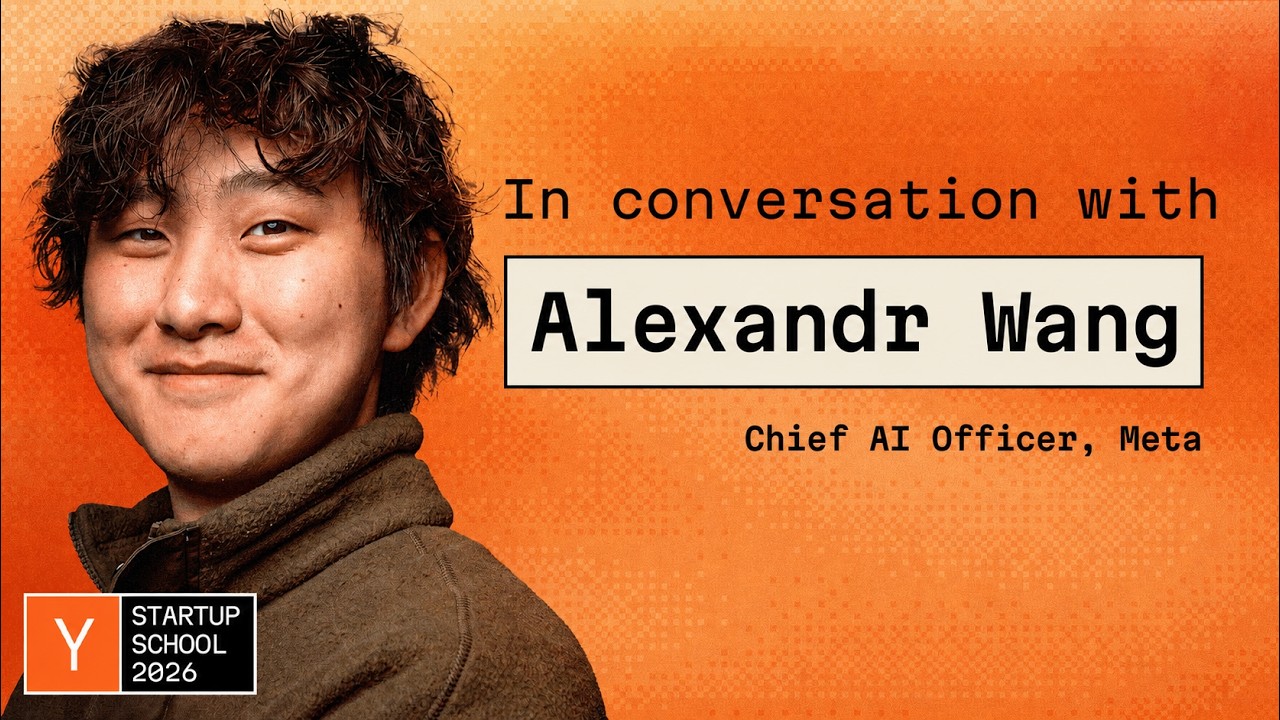
Alexandr Wang, founder of Scale AI and now leading Meta’s superintelligence lab, reflects on his journey and offers insights for entrepreneurs and builders in the AI era. His early experiences at Quora and MIT, where he first encountered TensorFlow and conceived Scale AI, highlighted the importance of practical company experience and academic exploration. The initial idea for Scale AI, an AI medical agent, proved to be ill-timed. Wang and his co-founder pivoted based on a first-principles realization: while compute and code were abundant, data for training models was scarce. This led to Scale AI’s focus on data labeling for computer vision and self-driving cars, a vision initially met with skepticism from investors who now champion data’s importance.
Wang emphasizes the critical need for conviction before consensus. Successful companies identify truths about the world long before they become popular. Entrepreneurs must develop an internal compass for the future and constantly learn and improve, as no one starts a company being good at it. He believes this is an unparalleled time to start a company, as the bottleneck isn’t AI model progress but its diffusion across industries. Startups, powered by AI agents, can become “mecha Goliaths” and outcompete incumbents.
At Meta, Wang is building a frontier AI lab focused on “personal superintelligence”: billions of tailored AIs that expand human agency and foster an explosion of entrepreneurship. The lab’s success hinges on talent density, which naturally compounds. Frontier AI work is scientific research, demanding an operating model that can scale with the exponential growth in AI capabilities, compute, and adoption. Meta’s approach includes releasing competitive models like Musepark (notably 8x cheaper than Opus to ensure broad accessibility) and developing a developer “harness” for agentic workflows, all while championing open-source to empower a decentralized AI ecosystem.
Looking back, Wang predicts that vision and ambition will matter more than intelligence in an era of abundant AI. The historical bottleneck of smart people collaborating will shift, with AI making building 10-100 times easier, enabling grander visions. While acknowledging the risks and the need to prepare the world for this technology, he sees unprecedented opportunities in science, health, and new businesses. He advises against solely focusing on “Word Cell” skills, stressing that systematic and rigorous thinking remain crucial as abstraction layers evolve from writing code to orchestrating complex armies of agents. The biggest immediate opportunity lies in agentic looping: developing systems where agents continuously optimize feedback loops, potentially outperforming large human teams. Ultimately, his advice to his 18-year-old self is to cultivate a strong internal compass for the future and identify the “exponential” curves (like AI progress today) to bet on, even if their early stages seem unexciting.