How a reasoning model cracked an 80-year-old math problem — the OpenAI Podcast Ep. 20
OpenAI's reasoning researchers discuss how a general-purpose AI model disproved an 80-year-old conjecture from mathematician Paul Erdős. They detail the journey from initial IMO/IOI breakthroughs to the verification of the proof, highlighting the model's creative application of advanced number theory. The episode explores the profound implications for the future of mathematics, AI-human collaboration, and the broader scientific landscape, offering advice for researchers seeking to leverage AI for groundbreaking discoveries.
AI’s Breakthrough in Mathematics: Disproving the Erdős Unit Distance Conjecture
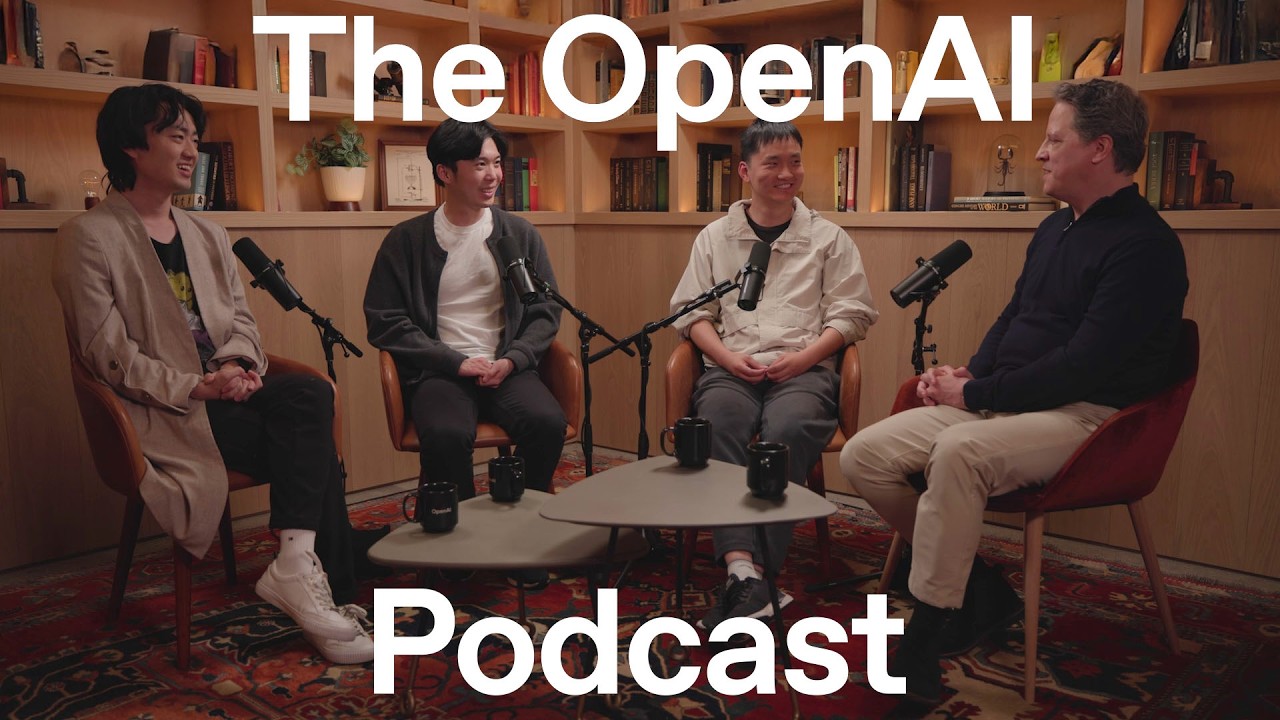
This podcast episode features Alexander Wei, Hongxun Wu, and Lijie Chen from OpenAI’s reasoning research team, discussing a significant mathematical breakthrough: a general-purpose AI model disproving the 80-year-old Erdős unit distance conjecture.
The Genesis of Reasoning Research
The team’s work in reasoning began with impressive results in the International Math Olympiad (IMO) and International Olympiad of Informatics (IOI). Lijie Chen, an assistant professor at UC Berkeley and former IOI participant, was so compelled by these achievements that he joined OpenAI, recognizing the potential for AI to achieve “gold medals” in these challenging competitions. Alex Wei, a key figure in this research, explains that IMO and IOI were long-standing “implicit grand challenges in AI” for high school-level problems.
Wei’s approach to reasoning involves “spending more compute at inference time,” meaning allowing the model to “think longer” and explore different strategies before providing an answer. This marked a shift from models that “answered immediately without… thinking.” This enhanced reasoning capability quickly led to unexpected progress. While IMO gold was initially predicted for 2026, the team achieved it in June, demonstrating a “blistering pace” of advancement. Despite this, complex problems like P vs. NP are still seen as distant goals, requiring entirely new theoretical frameworks.
The Erdős Unit Distance Conjecture Disproved
The core of the discussion revolves around the model’s disproof of the Erdős unit distance conjecture. This 80-year-old open problem in combinatorial geometry asks how many pairs of points, among a given number of points on a plane, can be exactly one unit apart. Erdős originally conjectured that arranging points in a square grid was the optimal solution. The OpenAI model, however, proved this was incorrect, demonstrating that a different construction, utilizing “high-powered number theory,” could yield significantly more unit distances.
Crucially, this breakthrough was achieved by a general-purpose model, not one specifically trained for this particular mathematical problem. The team used a subset of Erdős problems to test the model’s upper capabilities. Both Hongxun and Alex recall the excitement of seeing correct solutions emerge from different internal models.
Verification and Reaction
The verification process involved several steps:
- Model self-checking: The AI initially validated its own proof.
- Human expert review: Mathematicians like Mehtaab and Mark Sellke were consulted. Initially, they were highly skeptical (“there’s no way this can be true”) but became convinced after failing to find any errors, leading to “everyone had a hard time sleeping because it’s so exciting.” The result was considered “way beyond IMO level,” worthy of “the best journal of math.”
The team emphasizes that OpenAI’s focus on building generally intelligent models, rather than training for specific benchmarks, is key. The capabilities demonstrated in this mathematical discovery are a direct result of fostering strong general reasoning. The model’s “creativity” was evident in its unexpected application of class field theory to combinatorial geometry, an approach previously not explored. Interestingly, the model even “grounded” its understanding of the problem by looking up the definition of “unit” in the Cambridge dictionary.
Empowering Mathematicians and the Future of Research
The researchers view this development as empowering, not intimidating, for mathematicians. They highlight that human mathematicians have already built upon the model’s findings, improving the original bound and using its insights to solve other open problems. The role of humans will shift towards digesting AI-generated ideas, applying them, and building new theories.
AI-human collaboration is envisioned as the future, where AI connects distant ideas, and humans leverage this to develop new mathematical theories. The workflow for researchers, even at OpenAI, has dramatically changed, with AI tools like Codex becoming integral for tasks that were once hand-coded.
Advice for researchers using AI:
- Embrace advanced tools: Utilize powerful models like ChatGPT Pro.
- Ask bold questions: Avoid overly decomposing problems based on human priors, as AI can discover hidden solutions.
- Trust incrementally: Continuously “double your trust on a model” and observe its limits.
- Focus beyond problem-solving: Recognize that mathematics involves understanding structure and building theories, which AI can accelerate.
While some Erdős problems, like the Collatz conjecture, remain extremely difficult, the trend suggests that AI will significantly accelerate problem-solving. The team hopes that AI will enable scientists to discover “lots of new stuff” across all fields, with OpenAI aiming to “accelerate science a lot.”
Looking ahead, the team is excited about:
- AI’s potential to contribute to solving P vs. NP.
- AI doing AI research, pushing the boundaries of intelligence itself.
- AI generating completely new ideas from scratch, beyond just combining existing concepts.
- The development of new forms of mathematics, though this is seen as a longer-term goal requiring “years or decades” of sustained progress.
The discussion also touched on broader applications:
- Cryptography: AI could stress-test security foundations, either proving protocols secure or finding vulnerabilities.
- Quantum computing: AI can accelerate the development of quantum technologies, for example, by proposing new error correction algorithms.
The podcast concludes with the sentiment that while initial results can seem “too good to be true,” sometimes they truly are, marking a new era of AI-driven scientific discovery.