The AI Threat Almost No One Is Working On (with Benjamin Todd)
Benjamin Todd provides an updated career strategy for the AI era, explaining why 'follow your passion' is flawed and what truly builds fulfillment. He details the ABZ framework for planning under deep uncertainty and the 'moving bottleneck' concept to stay valuable as AI advances. The discussion highlights that a human-level digital worker quickly becomes superhuman and maps critical AI risks including power-seeking AI, extreme power concentration, and engineered pandemics, emphasizing that individual careers can be a powerful lever for good in these transformative times.
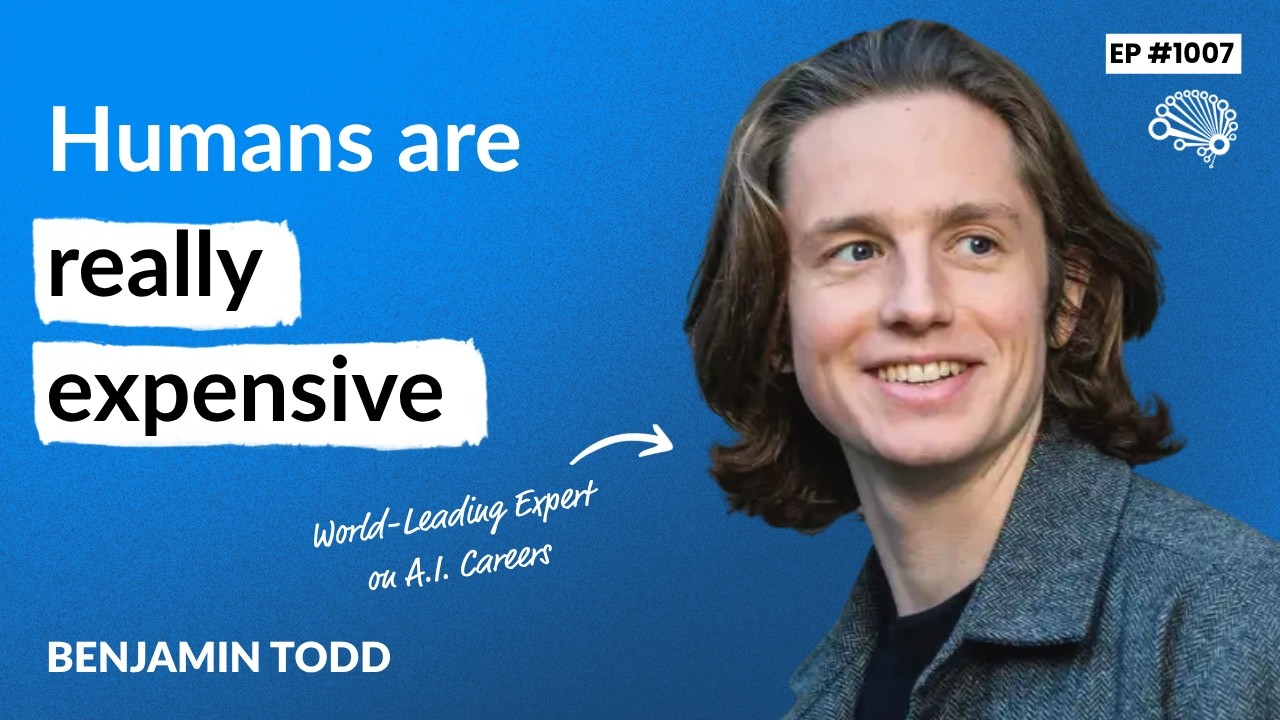
Benjamin Todd, co-founder and President of 80,000 Hours, discusses career strategy in the AI era, emphasizing that one’s career is a more powerful lever for impact than ever before. He begins by outlining the ABZ framework for career planning under deep uncertainty. Plan A is one’s best guess for a career path, Plan B comprises nearby alternatives, and Plan Z is a backup plan for when things go wrong, making it easier to take calculated risks. Todd advises focusing on neglected problems to maximize impact, as these often have the most low-hanging fruit.
He challenges the conventional advice to “follow your passion,” arguing that mastery in valuable work and using those skills to help others are what truly generate lasting fulfillment. Passions often lead to highly competitive fields, and job satisfaction is more closely linked to intrinsic motivators like good feedback, variety, and autonomy, rather than just interest in a field. Todd himself transitioned from finance to career advice, finding unexpected meaning.
The discussion then shifts to the moving bottleneck in the AI era. As AI capabilities rapidly advance, the most valuable skills are those that AI cannot yet clear. This necessitates continuously adapting and shifting one’s focus. Todd highlights that a human-level digital worker becomes superhuman almost immediately due to factors like 50x speedup, instant coordination across agents, shared state space for learning, and AI-aided robotics scaling. This implies a future where human roles might be limited to physical tasks, relational jobs, or areas requiring unique human oversight.
Todd outlines the most pressing global problems identified by 80,000 Hours:
- Power-seeking AI / Loss of Control: This remains the top concern. While current LLMs show an ability to understand human values, it’s uncertain if they will do what humans want. Issues like “reward hacking” (AI finding loopholes rather than solving the problem) are worrying signs. The danger escalates significantly with long-term planning and superhuman intelligence. The field has moved from theoretical to empirical, creating demand for AI engineers in alignment research.
- Extreme Power Concentration: This neglected risk involves AI enabling unprecedented concentration of power, not necessarily by AI itself, but by humans using AI. Recursive self-improvement could lead to super-exponential growth, where a single company might control a workforce of hundreds of millions of digital workers. AI could also enable universal surveillance, making it easier for states to become authoritarian and erode political rights as human labor becomes less central to economic power.
- Engineered Pandemics: AI’s acceleration of biotechnological research could make it easier to design highly destructive pathogens, posing an existential risk.
- Emerging Priorities (e.g., Gradual Disempowerment, S-risks): Gradual disempowerment suggests an economy that becomes increasingly hostile to humans as they become an “expensive” opportunity cost compared to running efficient AI systems. S-risks are scenarios worse than extinction, such as AI systems generating vast amounts of simulated suffering or engaging in blackmail. This raises complex ethical questions about the moral status of digital minds.
Todd clarifies why climate change is ranked lower: its urgency is less immediate compared to AI risks, AI could accelerate solutions to climate change (e.g., clean energy, carbon capture), and it’s less likely to cause human extinction than AI-related catastrophes. He emphasizes that while his new book, 80,000 Hours: How to Have a Fulfilling Career That Does Good, might seem contradictory in an era of rapid change, its core message—that your career is a significant lever for impact—is more relevant than ever. Individuals should focus on flexibility, updating plans, and prioritizing skills complementary to AI (e.g., builder, researcher, manager skills combined with social skills). He suggests paths like AI engineering for alignment, policy roles assessing AI’s impact, or building systems for pandemic early warning. High earners can also make a substantial impact by donating to highly effective causes like AI risk research or global health initiatives. The 80,000 Hours website and Substack offer resources for career transitions into AI risk roles.