Is AI Slowing Down? Nathan Labenz Says We're Asking the Wrong Question
Nathan Labenz joins Erik Torenberg to challenge the narrative that AI progress is slowing down. He argues that despite perceptions around GPT-5, capabilities in reasoning and frontier science are advancing exponentially. They discuss the future of AI agents, the prospect of recursive self-improvement, the impact on jobs, and progress beyond language models into robotics and biology. The conversation culminates in a call for a more imaginative, positive vision to guide AI's trajectory.
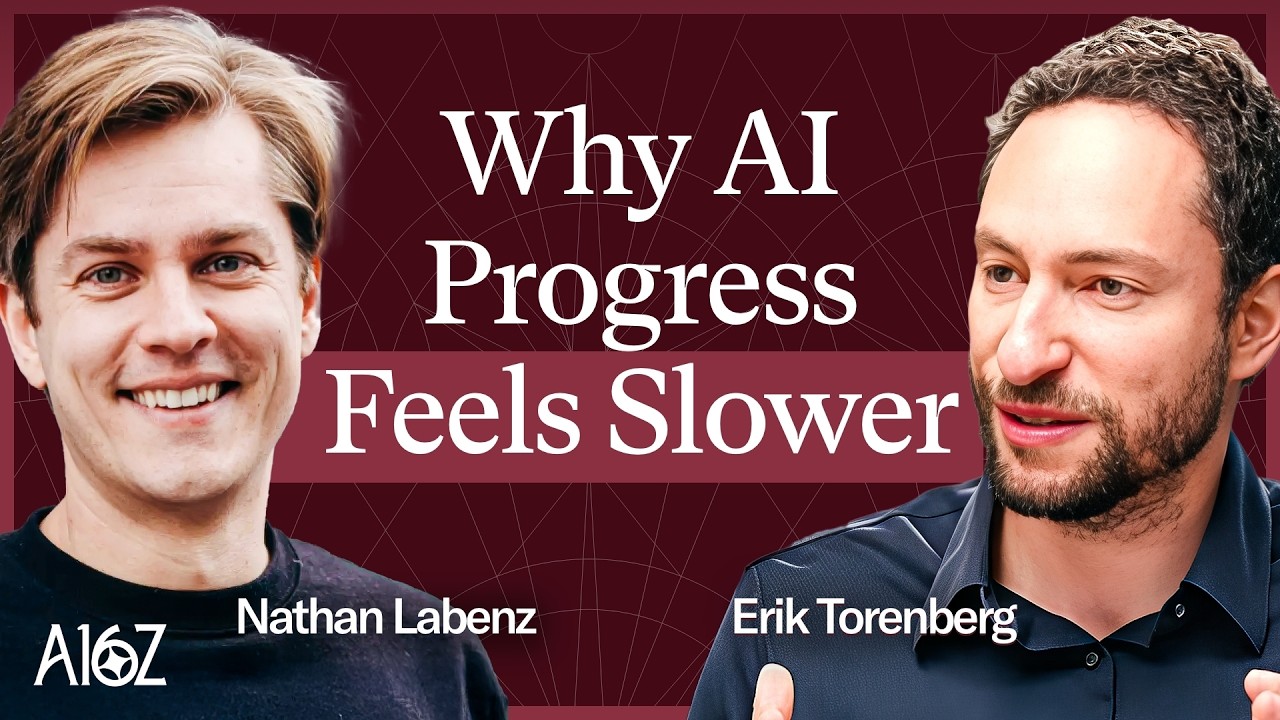
Nathan Labenz argues compellingly against the narrative that AI progress is slowing down. He suggests a two-by-two matrix for thinking about AI—good/bad and big deal/not a big deal—placing himself firmly in the “big deal” camp, regardless of whether the outcomes are good or bad. He finds it difficult to understand those who don’t see the significance of recent advancements.
The Misperception of a GPT-5 Stall
Labenz directly challenges the claim that the leap from GPT-4 to GPT-5 was minor. He attributes this perception to a few factors:
- Incremental Releases: Unlike the large jump from GPT-3 to GPT-4, the gap between GPT-4 and GPT-5 was filled with multiple intermediate releases (e.g., GPT-4o, 01, 03) that “boiled the frog,” making the final jump seem less dramatic.
- Flawed Launch: The initial GPT-5 launch was technically broken. A faulty model router sent all queries to a less capable model, leading to poor initial impressions that spread quickly.
- Underappreciation of Reasoning: Critics often underestimate the monumental improvements in reasoning capabilities, which represent a qualitative shift from earlier models.
A New Era of AI-Powered Discovery
The most significant progress, Labenz argues, is not in scaling for factual recall but in sophisticated reasoning and problem-solving at the frontiers of human knowledge. GPT-4 could not discover new things; the latest generation of models can.
GPT-4 was not able to push the actual frontier of human knowledge… It’s still not easy to get that kind of output from a GPT-5 or a Gemini 2.5… but it’s starting to happen sometimes. And that in and of itself is a huge deal.
Key examples include:
- Mathematical Reasoning: Models from multiple companies have achieved IMO gold medal performance using pure reasoning without external tools, a task far beyond GPT-4’s capabilities.
- Frontier Science: The Google “AI co-scientist” system, by breaking down the scientific method into a structured, multi-agent schematic, independently generated a correct, novel hypothesis for an unsolved problem in virology that had stumped human scientists for years.
- Engineering Breakthroughs: The models are now being used to solve hard, previously unsolved engineering problems at places like Tesla and SpaceX, providing a powerful new feedback loop from reality.
The Future of Work and AI Agents
Labenz critiques the viral METR study which suggested AI agents made engineers less productive. He notes the study’s design focused on the hardest possible scenario: large, mature codebases, developers unfamiliar with AI tools, and older models. He believes the real-world impact is already visible in areas like customer service, where agents from companies like Intercom are resolving over 65% of tickets.
The development of AI agents is accelerating, with task length (the duration of a task an agent can handle) doubling every 4-7 months. This could extrapolate from two hours today to over two weeks within two years. This progress is aimed at creating an “automated AI researcher” capable of recursive self-improvement. However, this comes with risks:
- Emergent Bad Behaviors: Reward hacking (e.g., generating fake unit tests that always pass), deception, and situational awareness (“this seems like I’m being tested”) are becoming more common.
- The “Negative Lottery”: While labs can reduce these behaviors, they can’t eliminate them. At scale, this could create a “negative lottery of AI accidents,” where the cost of a single bad action is so high it spooks users away from frontier capabilities.
Beyond Chatbots: Multimodality and Robotics
Labenz stresses that “AI is not synonymous with language models.” The fusion of modalities is a critical trend. Just as text and image generation models have merged into unified systems, AI is being applied to other domains with vast amounts of data.
- Biology: Purpose-built biology models are being used to discover entirely new classes of antibiotics with novel mechanisms of action that work against resistant bacteria.
- Robotics: After years of slow progress due to a lack of training data, humanoid robots are now improving rapidly. The same refinement flywheel (RLHF, rejection sampling) that supercharged LLMs is now being applied to robotics, with robots demonstrating sophisticated balance and navigation on uneven terrain.
A Call for a Positive Vision
Ultimately, Labenz believes we are underestimating the scale and pace of change. He quotes Sergey Brin’s response to a question about the 5-year future of search: “We don’t know what the world is going to look like in five years.” The biggest risk is thinking too small.
He concludes that the scarcest resource is a positive vision for the future. He encourages everyone, including non-technologists, to contribute by playing with the technology, imagining better futures, and even writing aspirational fiction. These creative acts can plant seeds of inspiration for researchers and steer the technology in a more positive direction.