Inside the New Media Team with Marc Andreessen & Ben Horowitz
Erik Torenberg, Ben Horowitz, and Marc Andreessen of a16z dissect the paradigm shift from old to new media. They explore why an offensive strategy of 'flooding the zone' has replaced defensive PR, how authentic individuals have eclipsed sterile corporate brands, the strategic importance of speed and the OODA loop, and the nuanced interplay between oral and written cultures on the internet.
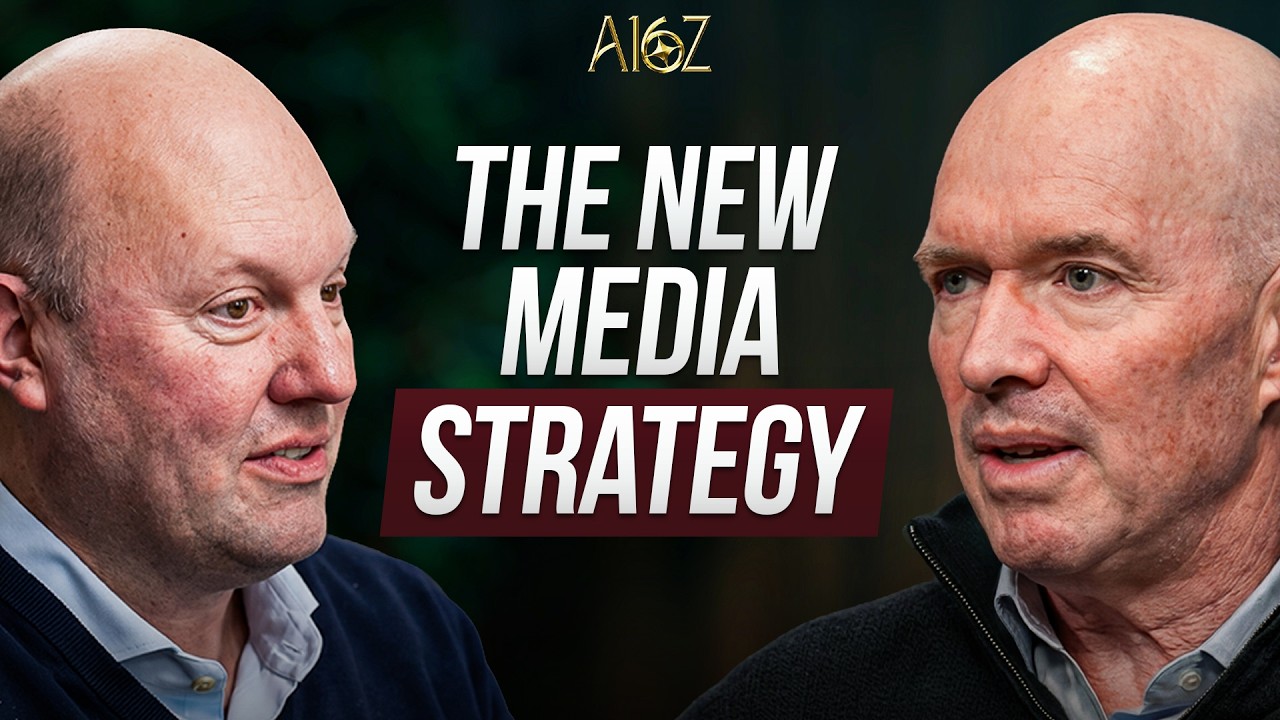
The New Media Playbook: Offense Beats Defense
In the old media landscape, the primary strategy was defensive. A single negative story in a major publication like the New York Times could pose an existential threat to a firm, as it was nearly impossible to correct a narrative once it was set by a handful of powerful channels. The fear of being misinterpreted or having results leaked led to a cautious, risk-averse posture.
The new media world operates on a completely different set of principles. The core idea is that “offense is always better than defense.” Instead of fretting over a single negative story, the strategy is to “flood the zone” with a high volume of interesting content. With countless platforms available—from podcasts to social media—organizations can now directly reach audiences far larger than those of traditional outlets. A negative story can be quickly drowned out by a wave of more engaging content, effectively erasing it from the collective memory. This requires a fundamental shift in mindset, embracing the physics of the new world rather than clinging to the outdated rules of the old one.
The Death of the Corporate Brand, The Rise of the Individual
For decades, the concept of the “corporate brand” reigned supreme. This involved abstracting the company away from the individuals within it, presenting a synthetic, polished, and often boring facade to the world. Communication channels were narrow, forcing messages to be compressed into the least offensive, most minimal form possible. The job of a CEO was often to say nothing newsworthy.
This era is over. The internet has blown the narrow media funnel “to smithereens,” making it possible for people to hear directly from the leaders and decision-makers themselves. As Marc Andreessen notes, “corporations are people too.” Authenticity now trumps polish. When leaders like Elon Musk speak their minds directly, it resonates because it’s real. This new reality is far better for founder-CEOs, who are inherently interesting due to their original ideas, than for “professional” CEOs who often rise by being uncontroversial. In today’s world, to be powerful, you must be interesting, and being interesting will inevitably lead to controversy.
Long-Form Content as the Ultimate Shield
While the new media landscape encourages rapid and direct communication, it also presents its own pitfalls. Short-form content, particularly on platforms like Twitter (now X), is highly susceptible to being taken out of context, which is where public figures often get into trouble.
The antidote to this is long-form content. An idea expressed in a tweet can be easily misinterpreted, but the same idea explained over an hour-long podcast or in a detailed essay is “fully in context.” This depth provides a powerful shield against misinterpretation. For complex topics in technology and politics, the long-form format is not just beneficial; it’s necessary. There is no sound bite that can adequately explain a systems problem. The internet, paradoxically, provides the ultimate medium for both the shortest and the longest forms of expression.
The Medium is the Message: From TV Show to Viral Post
Marshall McLuhan famously argued, “If it’s on TV, it’s a TV show.” The medium itself dictates the nature of the content. Television, with its linear format, turned everything—including news and politics—into a simplified, emotional, self-contained story with good guys and bad guys.
Andreessen extends this theory to the current era: “If it’s on the internet, it’s a viral internet post.” The defining characteristics of a viral post are its speed and its emotional impact. A story explodes within 12 hours, dominates the conversation, and then vanishes 24 hours later as the next “current thing” takes its place. This cycle is driven by content that “gets people cranked up,” spiking cortisol and sparking debate. Traditional media outlets are no longer setting the agenda; they are merely chasing and covering yesterday’s viral posts, perpetually one step behind.
Speed Wins: The OODA Loop in the Media Arena
The military strategy of maneuver warfare, encapsulated by Colonel John Boyd’s OODA loop (Observe, Orient, Decide, Act), is directly applicable to the new media landscape. The principle is simple: the person or organization that can cycle through the decision-making process the fastest wins.
By operating with a faster OODA loop, you can “get inside” your opponent’s cycle. You act before they have finished processing the last change in the environment, forcing them to constantly restart their own decision-making process. The result is psychological breakdown and paralysis. The internet’s incredible speed has done this to traditional media, which cannot move its bureaucratic organizations fast enough to keep up. This is why a “rapid response” capability is critical; you must be able to react and shape the narrative in real-time to dominate the playing field.
Oral vs. Written Culture on the Internet
Human communication has two fundamental modes: oral and written. Oral culture (e.g., stories around a campfire) is inherently emotional, immediate, and interpersonal. Written culture (e.g., a scientific paper) is built on abstraction, logic, and analytical rigor.
The internet is unique in that it is home to both, often in counter-intuitive ways.
- A short tweet, though written, functions as oral culture. Its brevity forces it to be a burst of emotion designed to trigger a reaction.
- A long-form podcast, though spoken, functions as written culture. A multi-hour discussion allows for the depth, abstraction, and rigorous exploration of ideas.
This duality allows for a “choose your own adventure” experience. Users can doomscroll through the emotional rage of oral culture on TikTok and X, or they can raise their IQ by engaging with the deep, analytical written culture of Substack and long-form YouTube. For creators, it’s crucial to understand these distinctions and choose the format that best suits the message.
Building the a16z New Media Machine
a16z is operationalizing these principles to create a “superpower” for its portfolio companies. The strategy involves:
- Building Owned Channels: Creating a media empire across platforms, with platform-native experts running each one.
- Launch as a Service: A dedicated offering to ensure company announcements go viral, using expert messaging and custom video production.
- Founder Go Direct: Actively coaching and helping founder-CEOs build their personal platforms and communicate directly with their audience.
- Talent Development: Creating the “New Media Fellowship” to identify and train the next generation of talent who understand this new world.
The goal is to move beyond traditional PR and marketing and build a formidable machine that can shape narratives, reach customers, and attract talent by mastering the rules of the new media game.