Reflections of AI: A Trilogy in 4 Parts • Rasmus Lystrøm • GOTO 2025
In a talk styled as "A Trilogy in Four Parts", Rasmus Lystrøm critically examines the real-world impact of Generative AI, debunking productivity myths and highlighting hidden costs like degraded code quality and environmental strain, while advocating for a return to solving real user problems with valuable, often simpler, technology.
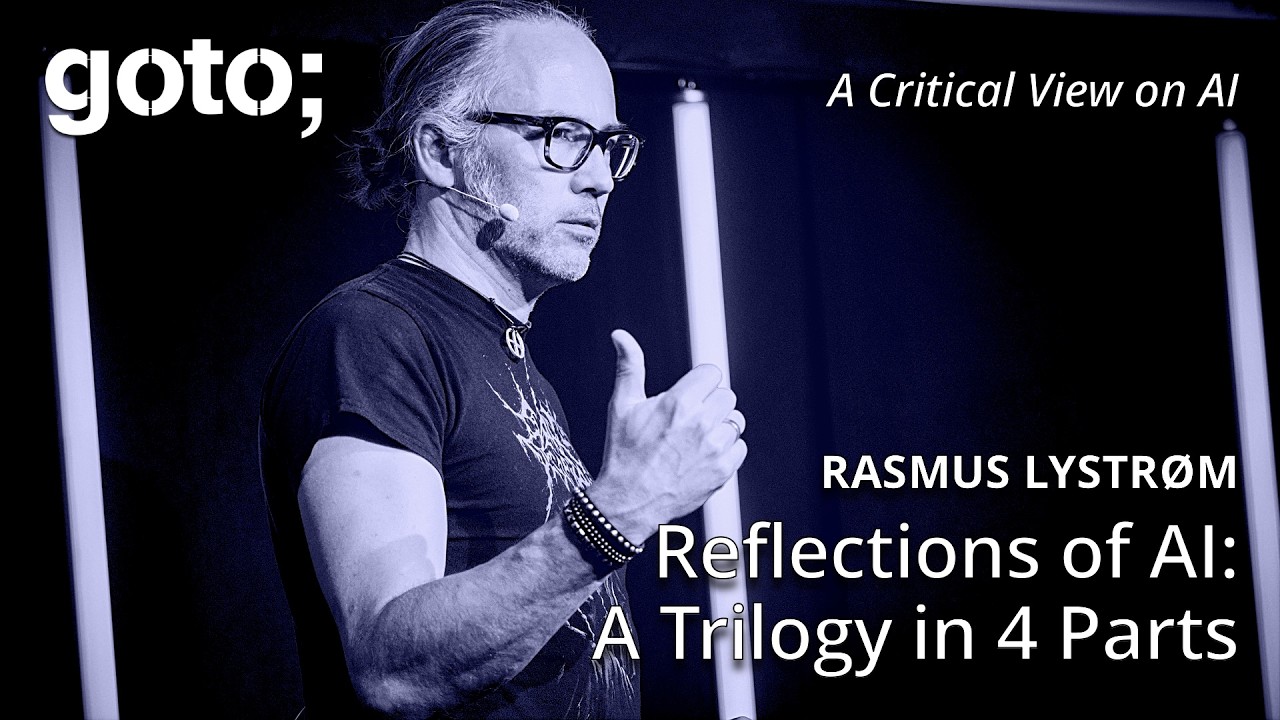
Drawing inspiration from Douglas Adams’ “The Hitchhiker’s Guide to the Galaxy,” this talk presents a critical reflection on the state of AI, structured as “a trilogy in four parts.” The central thesis challenges the pervasive hype surrounding Generative AI, arguing that its purported benefits are often illusory and come at a significant, often hidden, cost.
Part 1: The Impact of Generative AI Adoption
The initial wave of Generative AI adoption was fueled by FOMO, with companies hastily integrating “company name-GPT” solutions and employees inputting sensitive data into public interfaces. This rush was bolstered by seemingly impressive statistics, such as a study claiming a 55.8% increase in developer productivity. However, this is likened to “The Emperor’s New Clothes,” where AI vendors sell an invisible, magical solution that everyone is afraid to admit they cannot see.
More sober analysis paints a different picture:
- A BlueOptima study found only a 4% productivity boost, with moderate users (i.e., those who used it less) seeing the most benefit. Crucially, only 1% of AI-generated code was committed without significant rework.
- Research from the University of Copenhagen and Chicago found no significant impact on earnings or hours worked. At best, users reported an average time saving of 100 seconds per hour.
- Newer, “reasoning” models are not a panacea. They perform worse than older models on low-complexity tasks, take orders of magnitude longer on medium-complexity tasks, and “collapse completely” on high-complexity problems.
- AI agents are only effective in idealized scenarios: well-tested, debt-free codebases where they might save 30 minutes on a minutely described problem.
The conclusion is that writing code was never the primary bottleneck. The real productivity problems are inefficient processes, excessive meetings, and a fundamental lack of trust within teams.
Part 2: The Hidden Price of AI Adoption
Continuing to use these tools, despite their limited benefits, introduces significant hidden costs.
- “Work Slop”: A Harvard Business Review study highlights the rise of AI-generated content that masquerades as meaningful work but lacks substance. Receiving this “slop” makes colleagues appear less creative, capable, trustworthy, and intelligent.
- Degrading Code Quality: A GitClear study from January 2024 revealed alarming trends in codebases using AI assistants:
- Refactoring (“moved code”) is decreasing, meaning code is not being improved.
- Code churn (code added and then removed within two weeks) is high.
- Duplication is rising dramatically.
- A staggering 57% of code co-authored with an AI assistant is involved in bugs.
- Business Failure: Klarna famously fired 700 customer service representatives in March 2024, replacing them with an AI. By May 2025, they were rehiring them because the AI failed to handle the sensitive and complex nature of their customers’ issues.
- Erosion of Critical Thinking: The more an individual uses and trusts GenAI, the less they engage in critical thinking. This leads to a de-skilling effect, where GenAI makes everyone a “bad architect, a bad designer, a bad journalist.”
- Environmental Impact: The computational cost of AI is enormous. Training GPT-3 required 5 million liters of water, and a single 100-word email written with AI consumes half a liter. The proposed “solution” of reopening hazardous nuclear power plants like Three Mile Island to meet this energy demand is absurd.
We’re no longer living in the era of AI. As the emperor says, we’re living in the era of the business idiot.
Part 3: Useful AI in a World Saturated with LLMs
Despite the critique of LLMs, there is still a place for valuable AI. The key is to distinguish hype from utility.
- Good Use Cases: Nike’s e-commerce search is presented as a prime example of a well-implemented AI solution. Years before the current hype, they used a Retrieval-Augmented Generation (RAG) model to understand user intent (“CrossFit shoes, size 12”) and provide highly relevant results, unlike competitors who failed at the same query.
- Machine Learning is Still Here: The focus should not be solely on LLMs. Traditional machine learning offers powerful solutions. For example, the Danish healthcare system has successfully used ML for three years to augment doctors’ ability to scan for breast cancer, resulting in earlier detection and fewer false positives.
- A Silver Lining: The immense hype around GenAI may create a beneficial side effect: securing funding for legitimate data science and ML projects that can deliver real value.
Part 4: How to Build Valuable Solutions
The path forward is not to add AI to broken processes but to fundamentally rethink how we build technology.
- Focus on Outcomes, Not Technology: Stop chasing hype. No customer is asking for a chatbot to replace human interaction. The goal should be to solve user problems and address what is difficult, boring, or slow in their workflow.
- Integrate Technology with the Business: The old model of a separate IT department is obsolete. Technology builders must be integrated as the business, not just work for it.
- Embrace Diverse Roles: Acknowledge the different roles needed for innovation (Pioneers, Settlers, Town Planners) and allow people to work according to their strengths rather than expecting one person to do everything.
- Stop Making Innovation a Part-Time Job: To succeed, innovation requires focus.
- Build Small, Ship Fast, and Test in Production: Follow the principle of delivering small, working increments to users quickly. This allows for real-world feedback to validate whether a solution is actually valuable.
Ultimately, if you build a great piece of software that solves a real problem, you can always market it as an “AI-powered solution” to satisfy the hype. The label is irrelevant; the value is what matters.