The Infinite Software Crisis – Jake Nations, Netflix
In an era of the "Infinite Software Crisis" where AI-generated code outpaces human understanding, this talk argues for choosing "simple" design over "easy" generation. The speaker presents a three-phase methodology—Research, Planning, and Implementation—that forces developers to think critically before generating code. This approach leverages AI for mechanical tasks while ensuring that human judgment, context, and a deep understanding of the system remain the core of the software development process, turning human insight into the ultimate competitive advantage.
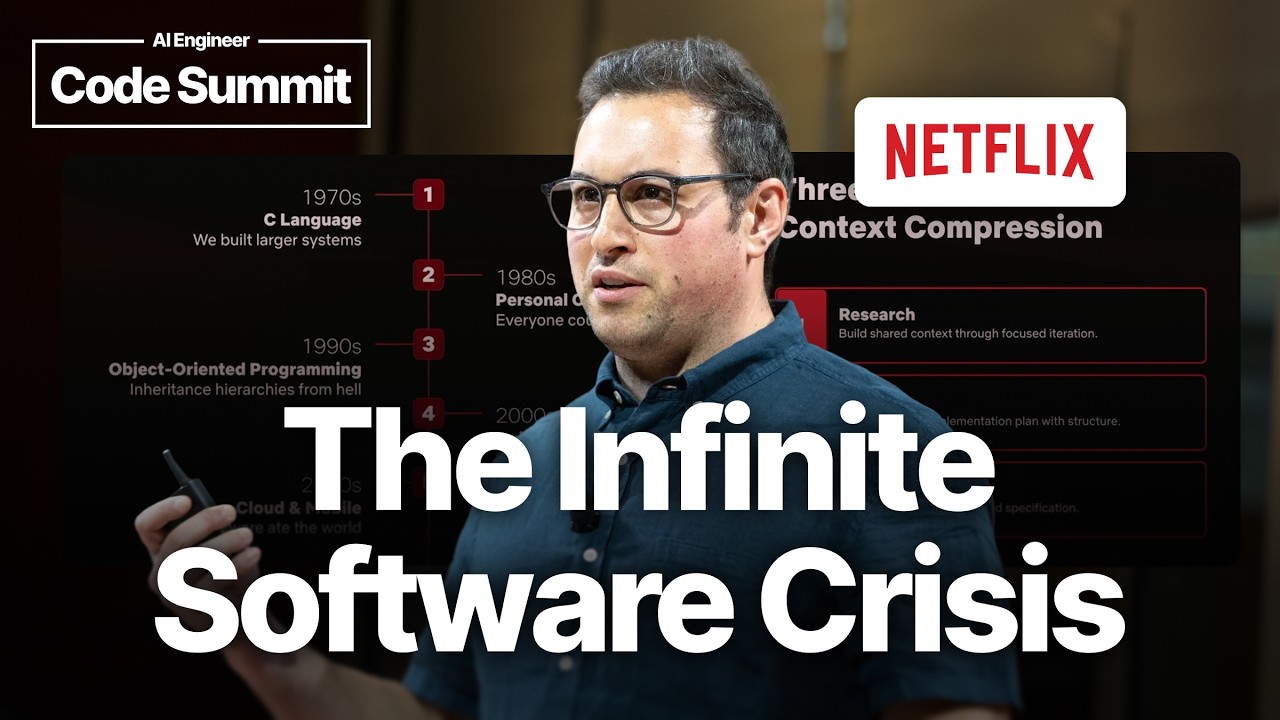
The Infinite Software Crisis
The speaker, Jake Nations from Netflix, begins by confessing to a shared experience among modern developers: shipping AI-generated code without fully understanding how it works. This isn’t a new problem but an acceleration of a historical pattern. Every generation of software engineers has faced a “Software Crisis” where system complexity outgrows their ability to manage it. As Dijkstra noted, more powerful computers led to proportionally larger programming problems. We’ve seen a cycle of solutions—from C and object-oriented programming to Agile and the cloud—each making development easier, only to enable even larger, more complex systems. Today, AI represents the ultimate step in this cycle, leading to what the speaker terms the “Infinite Software Crisis,” where code can be generated as fast as it can be described.
Simple vs. Easy: The Core of the Problem
The talk argues that the root cause of this crisis is the confusion between “simple” and “easy.” Drawing on Rich Hickey’s (creator of Clojure) definitions:
- Simple: Means one-fold, unentangled. A system is simple when its components are separate and do one thing.
- Easy: Means adjacent, within reach. An action is easy if it requires little effort, like copying from Stack Overflow or generating code with an AI prompt.
We naturally gravitate towards the easy path, but choosing “easy” consistently means choosing speed now at the cost of complexity later. AI is the ultimate “easy button,” making the path of least resistance so frictionless that thoughtful, simple design is often bypassed. Conversational coding interfaces, while powerful, exemplify this trap. An initial clean request can devolve over many iterations into a tangled mess of conflicting constraints, abandoned approaches, and dead code, as the AI simply morphs the code to satisfy the latest request without architectural coherence.
Essential vs. Accidental Complexity
Quoting Fred Brooks’s paper “No Silver Bullet,” the speaker distinguishes between two types of complexity:
- Essential Complexity: The inherent difficulty of the problem the software is solving (e.g., processing payments).
- Accidental Complexity: The complexity we add along the way—frameworks, workarounds, and abstractions that make the code itself work.
AI agents struggle to differentiate between these two. To an AI, technical debt is just another pattern to be preserved and replicated. A real-world example from Netflix illustrates this: an attempt to refactor an old authorization system using AI failed because the accidental complexity was so deeply intertwined with the essential business logic. The AI couldn’t see the seams and either gave up or, worse, recreated old, undesirable patterns with new tools.
A Three-Phase Methodology for Clarity
To combat this, the speaker proposes a structured, three-phase approach that prioritizes human thinking and planning before generation:
-
Research: This phase involves feeding the AI all relevant context—architecture diagrams, documentation, design docs, and even Slack threads. The developer then uses the AI to analyze the codebase, probing and correcting its understanding. The output is a validated research document that summarizes the existing system and the impact of the proposed change.
-
Planning: Using the research document, the developer creates a detailed implementation plan. This is a “paint-by-numbers” specification with function signatures, data flow, and type definitions. It’s at this stage that critical architectural decisions are made, service boundaries are defined, and potential problems are spotted by a human who has experienced past failures. This plan can be reviewed in minutes, far faster than reviewing thousands of lines of generated code.
-
Implementation: With a clear and validated plan, the implementation phase becomes straightforward. The AI is given a clean, focused context and generates code that adheres to the pre-approved design. This avoids the complexity spiral of long, meandering conversations and results in cleaner, more understandable code.
Human Judgment is the Silver Bullet
This methodology is not magic. The speaker emphasizes that it works because human understanding is earned and encoded into the process. For the challenging Netflix refactor, the team first had to perform one migration manually. This painful but crucial step revealed hidden constraints and provided the necessary understanding. The pull request from this manual effort then became the seed for the AI’s research phase, enabling it to see what a “clean” migration looked like.
The ultimate danger of the AI era isn’t just code we don’t understand, but the atrophy of our own skills—our ability to recognize bad patterns and architectural flaws. The developers who thrive will be those who use AI to accelerate mechanical work while retaining the critical role of thinking, planning, and exercising judgment. The key question is not if we will use AI, but whether we will still understand our systems when AI writes most of the code.