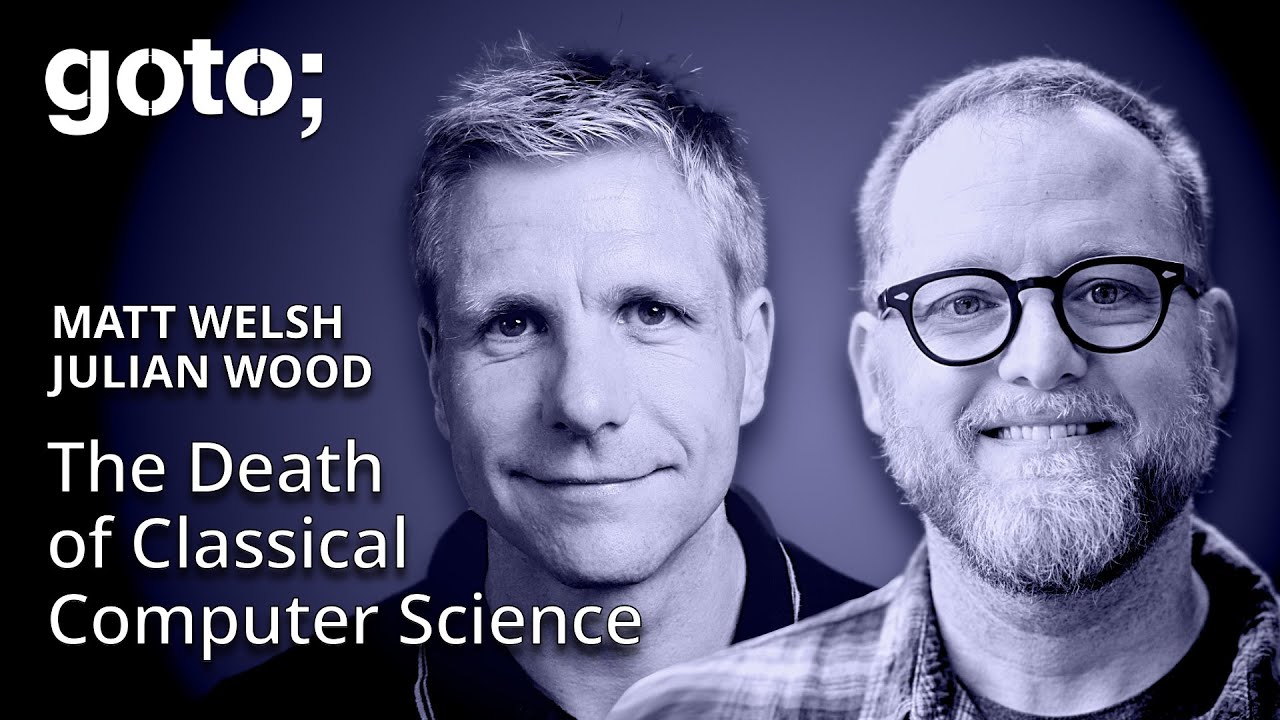
The Death of Classical Computer Science • Matt Welsh & Julian Wood • GOTO 2025
Matt Welsh, former Harvard professor and AI researcher, posits that Large Language Models (LLMs) are not just tools but are evolving into new, general-purpose computers. He argues this signifies the "death of classical computer science," as direct, natural language problem-solving will replace human-written code. This shift promises to democratize computing, moving beyond a "programming priesthood" to empower everyone, while also raising critical challenges regarding job displacement, societal equity, and our adaptation to this powerful technology.
LLMs as the New Computer: The End of Classical Programming
The fundamental nature of computation is on the verge of a monumental shift. Large Language Models (LLMs) are rapidly evolving from specialized tools for tasks like text summarization or translation into general-purpose reasoning and problem-solving engines. The future of computing will not be about humans writing code in Python or JavaScript that compiles down to machine instructions. Instead, we will state a problem in natural language, and the language model will solve it directly. In this new paradigm, the LLM is the computer.
This transition means we are witnessing the death of classical computer science as we know it. The entire industry is poised to move away from human-authored code within the next five years. While this is a scary proposition for those who make a living as programmers, it represents an exciting leap forward in how we interact with technology.
The Evolution of the Interface: From Siloed Agents to Integrated Voice
Today’s interaction with LLMs is largely confined to a siloed text box in a web browser, disconnected from our other data and applications. The next stage of this evolution will see AI agents deeply integrated into our operating systems. An AI should know how to use every application on a computer—from spreadsheets to web browsers—just as a human would. You could ask it to “fill out a spreadsheet with the findings from this set of research reports,” and it would perform the task without you needing to manually open applications and copy-paste data.
The ultimate interface, however, is likely to be voice. Current voice assistants are limited to single-step commands, but the future lies in real-time, nuanced conversation. A key innovation is the development of models that operate directly from voice-to-voice, bypassing the intermediate step of converting speech to text and back again. This is critical for two reasons:
- Latency: It eliminates the delay inherent in the text conversion process, allowing for natural, real-time conversation.
- Information Fidelity: A vast amount of information—tone, emotion, annunciation, stress—is lost when speech is converted to text. A direct voice-to-voice model preserves this richness, enabling a more profound level of interaction.
Open Source, Commoditization, and the Democratization of AI
A significant challenge is the immense cost and expertise required to train foundational models, which has concentrated power in the hands of a few large corporations like OpenAI. However, this is starting to change. The future lies in the commoditization of the base level of intelligence, with open-source models like Meta’s Llama serving as a baseline that anyone can build upon.
This openness is essential for several reasons:
- Security and Privacy: Many use cases, especially in enterprise and government, cannot rely on sending sensitive data to a third-party API. Open models that can be deployed anywhere are a necessity.
- Academic Research: For the first 50 years of computing, universities could be at the cutting edge. Today, the resource requirements for training large models lock out most academic institutions. Open-source models allow researchers to innovate on top of a powerful foundation without needing billions in funding, as demonstrated by university projects that fine-tune models for low-resource languages not covered by major commercial offerings.
- Avoiding Monopolies: A single company holding a monopoly on this powerful technology is untenable. Openness ensures that innovation can flourish everywhere.
While some envision a future of many small, specialized models with an orchestration layer, the current trajectory of AI development—throwing vast amounts of data at a single, massive, self-organizing model—has been surprisingly effective. This trend may continue, even if we don’t fully understand its internal workings.
From a “Programming Priesthood” to Universal Computing
In the early days of home computing, it was expected that users would program their machines. Over the past few decades, we’ve moved to a model where a “priesthood” of trained software developers creates applications for everyone else. This has created a widening gap between what computers can do and what most people are empowered to do with them.
AI, instructed by natural language, can eliminate this barrier. People don’t necessarily want to program, but they want to solve problems and get jobs done. They want to create. By removing the need for arcane coding knowledge, we can put the full, general-purpose power of computing into everyone’s hands. This will unleash human creativity, allowing individuals to tailor computational tools to their unique, bespoke needs—tasks that are currently done manually because no off-the-shelf software exists.
Challenges and Societal Adaptation
This transformative future is not without significant challenges and concerns.
- Job Disruption: We must accept that the number of people employed as programmers will be significantly lower in 10-20 years, and their compensation may decrease. This follows a historical pattern of technology disrupting vocations.
- Equity and Access: The current cost of AI—from a $20/month subscription to the necessary hardware and internet access—is far out of reach for most of the world’s population. Furthermore, models are often biased toward the languages and cultures (e.g., English, North American) on which they were predominantly trained, creating a cultural and linguistic divide.
- Societal Risks: The greatest danger of AI is not a malicious superintelligence but our own failure as a society to adapt. We must thoughtfully manage its integration to avoid negative consequences, much like the unforeseen societal damage caused by platforms like Facebook. The problem is not the technology itself, but how we choose to use it.
- Truth and Regulation: With the rise of deep fakes and AI-generated content, the nature of truth becomes malleable. Regulating a technology that is evolving this rapidly is incredibly difficult, but it’s a conversation we must have to navigate issues of public safety, intellectual laziness, and critical thinking in a world where AI is omnipresent.
Ultimately, we have an opportunity to embrace this future and steer it toward positive outcomes. Instead of focusing on enriching a few individuals, we should focus our collective energy on using this technology to increase equity and access for people all over the world.