From Self-driving to Autonomous Voice Agents — Brooke Hopkins, Coval
Brooke Hopkins, founder of Coval, discusses how evaluation methodologies from the autonomous vehicle industry, particularly from her experience at Waymo, can be adapted to build reliable, scalable, and trustworthy voice and conversational AI systems.
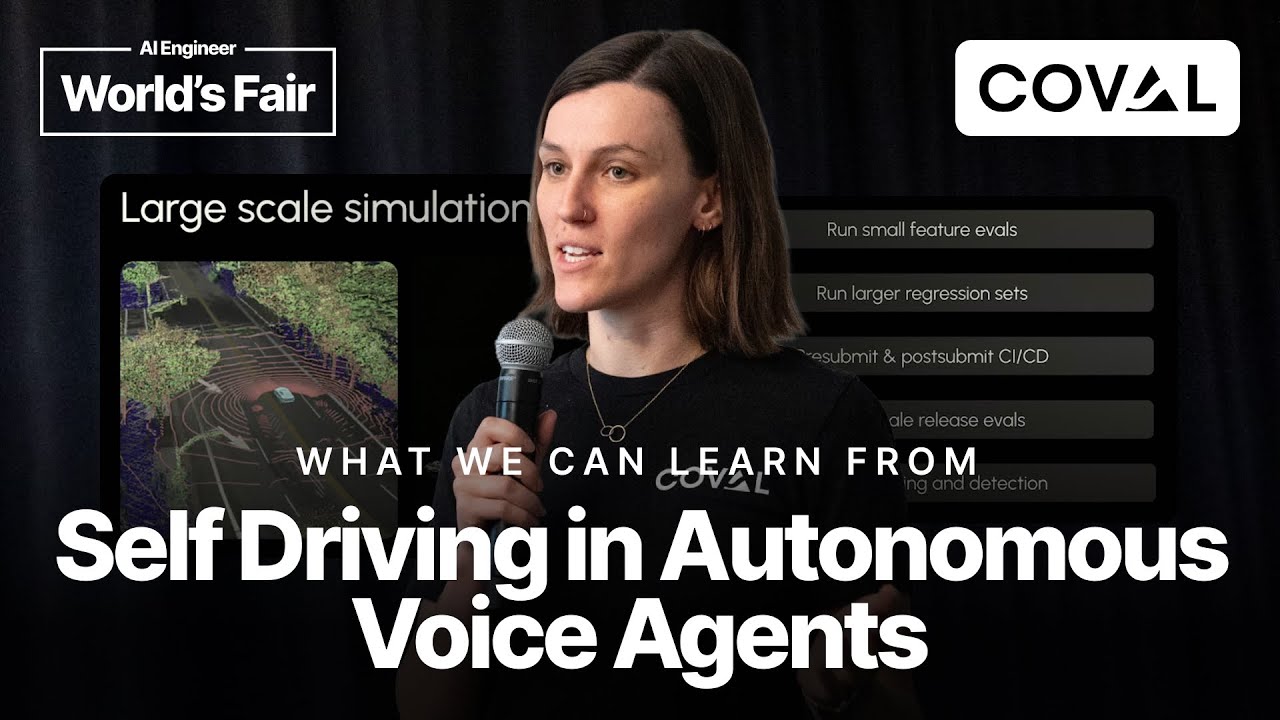
The primary obstacle to the widespread adoption of enterprise-grade voice agents is a lack of trust. This creates a paradox where organizations either create overly restrictive, deterministic agents that function like expensive IVR trees or they allow for full autonomy, which leads to unpredictability and a reluctance to deploy in customer-facing scenarios. This is a false choice; it is possible to achieve both reliability and autonomy. The path to achieving this balance for voice AI can be illuminated by the journey of the autonomous vehicle industry.
Lessons from Self-Driving Car Evaluation
The development of magical, reliable autonomous vehicles like those from Waymo was unlocked by large-scale simulation. The industry evolved its evaluation (eval) methodologies through several stages:
- Manual Evals: Initially, engineers would manually drive cars, note failures, and report back. This approach is not scalable.
- Specific, Brittle Tests: The next step was creating specific, scripted scenarios with expected outcomes. These tests were expensive to create and maintain, quickly becoming obsolete.
- Large-Scale Probabilistic Evaluation: The current standard involves running massive numbers of simulations to understand the frequency of certain events. Instead of asserting “in this specific scenario, do X,” the focus shifts to understanding the agent’s performance characteristics across a vast range of situations.
This evolution holds critical lessons for building conversational AI. Both self-driving cars and conversational agents are systems that must continuously interact with and respond to a dynamic environment.
Applying Self-Driving Principles to Voice AI
1. Simulation for Durable, Scalable Testing In a conversation, just as in driving, each action (or utterance) changes the state of the environment, requiring a new response. Simulating these back-and-forth interactions is crucial.
- Durable Tests: Static, step-by-step tests are brittle and break easily. Simulation allows for dynamic, durable tests that adapt to the conversational flow.
- Coverage: The non-determinism of LLMs is an asset here. By simulating a single scenario hundreds of times, you can explore the wide array of possible user responses and measure the probability of your agent succeeding, thereby achieving broad testing coverage.
2. Probabilistic vs. Input-Output Evals The traditional method of testing LLMs involves feeding a set of inputs and checking the outputs against a “golden dataset.” Conversational AI demands a more sophisticated, reference-free evaluation approach. Instead of checking for an exact expected output, you should define and measure key performance metrics at scale:
- How often does the agent successfully resolve the user’s inquiry?
- What is the frequency of the agent repeating itself?
- How often does the agent say something it shouldn’t (e.g., hallucinations, off-brand comments)?
This probabilistic approach, focused on high-level behaviors rather than specific outputs, is what enables scalable and meaningful evaluation.
3. Continuous Evaluation Loops Evaluation cannot be a one-time step before deployment. The autonomous vehicle industry implements rigorous, continuous evaluation loops, a model that voice AI development should emulate:
- Iterative Debugging: An engineer finds a bug, runs evals to reproduce it, fixes it, and runs more evals.
- Regression Testing: After a fix, a larger regression suite is run to ensure the change hasn’t introduced new problems (e.g., fixing a failure to stop at one sign by making the car stop every 10 seconds).
- CI/CD Integration: Automated presubmit and postsubmit workflows ensure code quality and system reliability are maintained continuously.
- Release & Monitoring: Large-scale automated and manual evals are performed before a new release, followed by live monitoring to detect issues in production, which feeds back into the development cycle.
The goal isn’t to automate everything. The objective is to “leverage auto evals for speed and scale and then use the manual time that you have to really focus on those very human touch judgment calls.”
Building a Practical Voice AI Eval Strategy
An evaluation strategy is not just an engineering best practice; it is a core component of your product development.
1. Hierarchy of Simulation Realism You don’t always need hyper-realistic simulations. The level of realism should match what you are trying to test, controlling for variables just as in any scientific experiment.
- Text-Based: For core logic like workflow adherence, tool calls, and instruction following, text-based simulations are often the fastest and cheapest way to iterate.
- Simple Voice: When testing behaviors like handling interruptions, latency, or instructed pauses, basic text-to-speech voices are sufficient.
- Hyper-Realistic Voice: Complex audio characteristics (accents, background noise, varying audio quality) are only necessary when you are specifically testing the system’s robustness to these factors, often to recreate issues found in production.
2. Denoising Failures When a failure is detected in one evaluation, it’s crucial to understand its probability. The “denoising” technique involves taking that specific failure scenario and re-simulating it hundreds of times. This helps determine if the failure was a one-off fluke (1 in 100) or a systemic issue (99 in 100). This allows you to define and target a specific reliability level, similar to the “nines” of reliability in cloud infrastructure.
3. The Eval Process A comprehensive strategy involves a multi-layered approach:
- Start with Public Benchmarks: Get a rough directional sense of model performance.
- Benchmark on Custom Data: Use your own domain-specific data (e.g., medical terminology for a healthcare agent) to test components like transcription.
- Run Task-Based Evals: Test smaller, modular parts of your system to identify problem areas.
- Perform End-to-End Evals: Run the entire system as it would operate in production to get a holistic view of performance.
- Establish a Continuous Process: Create dashboards and formal processes to continuously monitor performance, manage test sets (e.g., per-customer, per-feature), and ensure regressions are caught and fixed.
Voice is poised to be the next major platform shift after web and mobile. Soon, a high-quality voice experience will be a baseline expectation for any enterprise. Building this future requires moving beyond ad-hoc testing and embracing integrated, continuous evaluation as the foundation for creating scalable, reliable, and truly magical voice AI.