Machine Learning Explained: A Guide to ML, AI, & Deep Learning
A breakdown of Machine Learning (ML), its relationship with AI and Deep Learning, and its core paradigms: supervised, unsupervised, and reinforcement learning. The summary explores classic models and connects them to modern applications like Large Language Models (LLMs) and Reinforcement Learning with Human Feedback (RLHF).
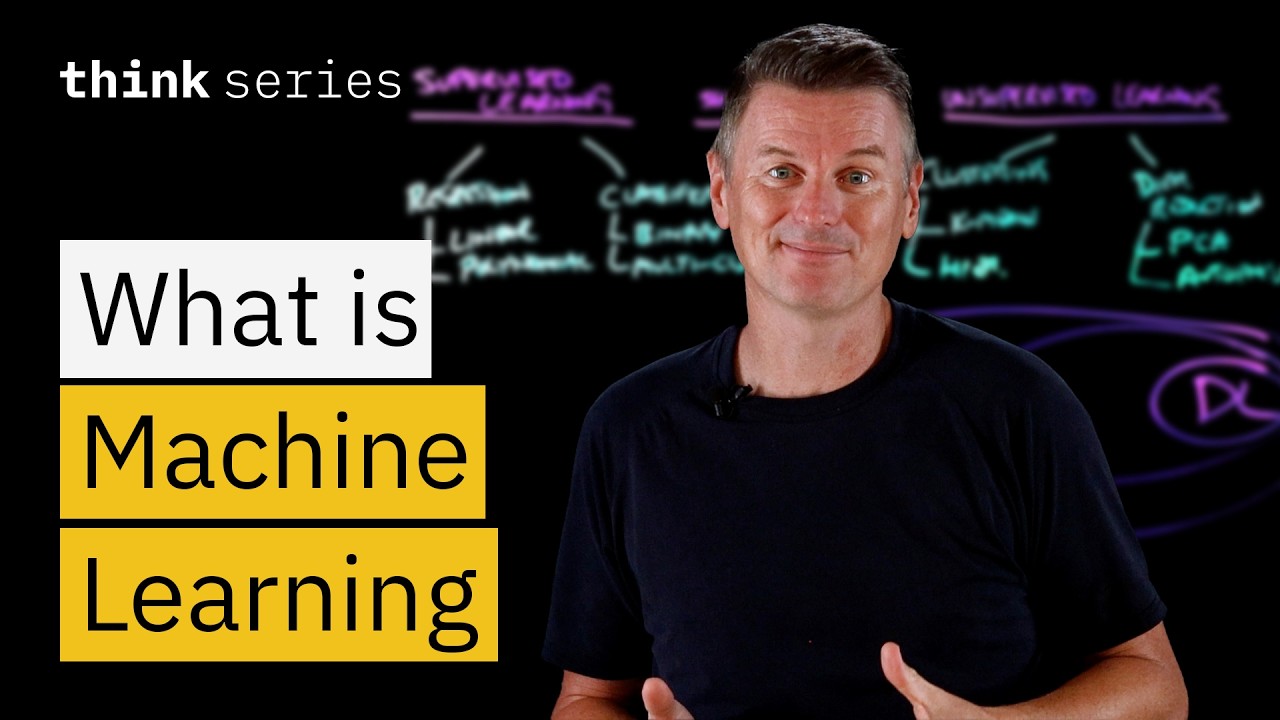
Machine Learning (ML) is a subset of Artificial Intelligence (AI) that focuses on algorithms that learn patterns from training data to make accurate inferences about new, unseen data. It sits within a hierarchy where AI is the broadest field, ML is a subfield of AI, and Deep Learning (DL)—which uses neural networks with many layers—is a subfield of ML.
The central premise of ML involves model training, a process where a machine’s performance is optimized on a dataset that resembles real-world tasks. A well-trained model can then apply the patterns it has learned to infer correct outputs for new data. The deployment of this trained model is called AI inference, where it actively makes predictions on new, live data.
The Three Learning Paradigms
Most machine learning can be grouped into three main paradigms:
1. Supervised Learning
Supervised learning trains a model to predict a correct output using labeled examples, often referred to as “ground truth.” This process typically requires a human to provide the correctly labeled data.
- Regression Models: Predict continuous numerical values, such as price predictions or temperature forecasts.
- Linear Regression: Finds the best-fit straight line through data points.
- Polynomial Regression: Captures non-linear relationships in the data.
- Classification Models: Predict discrete classes or categories.
- Binary Classification: Assigns an item to one of two categories (e.g., spam or not spam).
- Multi-class Classification: Assigns an item to one of many categories.
- Multi-label Classification: Assigns multiple relevant tags or labels to a single item.
Modern techniques often use ensemble methods, which combine multiple models to achieve higher accuracy.
A related approach is semi-supervised learning, which uses a small amount of labeled data along with a large pool of unlabeled data. This method allows the model to generalize from the labeled examples to the unlabeled data, reducing the need for costly and time-consuming data labeling.
2. Unsupervised Learning
Unsupervised learning works with unlabeled data to discover hidden structures and patterns on its own.
- Clustering: Groups similar items together.
- K-Means Clustering: Assigns items to a pre-determined number (k) of groups by repeatedly calculating group averages (centroids) until they stabilize. This is useful for tasks like customer segmentation (e.g., bargain hunters, loyal customers).
- Hierarchical Clustering: Builds a tree of clusters by starting with each item as its own group and progressively merging the most similar groups. This allows for creating broad or fine-grained clusters depending on where the tree is “cut,” which is useful for organizing IT tickets into themes.
- Dimensionality Reduction: Reduces the complexity of data by representing it with a smaller number of features while retaining meaningful characteristics. This is often used for data preprocessing, compression, and visualization. Common algorithms include Principal Component Analysis (PCA) and autoencoders.
3. Reinforcement Learning (RL)
In reinforcement learning, an agent interacts with an environment. The agent observes the current state, chooses an action, and receives a reward or penalty from the environment. Through trial and error, the agent learns a policy that maximizes its long-term rewards.
A key challenge in RL is balancing exploration (trying new actions) with exploitation (repeating actions that have worked well in the past). A classic example is a self-driving car, where the state comes from GPS and cameras, actions are steering and braking, and rewards are given for safe progress while penalties are applied for hard braking or collisions.
From Classic ML to Modern Applications
Techniques like regression, classification, and clustering are considered “classic machine learning” and remain foundational in business today. However, these core ideas are now being applied in new and powerful ways.
The most prominent example is Large Language Models (LLMs), which are built on transformer architectures. While the architecture is newer, LLMs still rely on the fundamental ML principles of pattern recognition and model training.
Furthermore, reinforcement learning has seen a resurgence with Reinforcement Learning with Human Feedback (RLHF). In this approach, human annotators provide rewards and penalties on an LLM’s outputs, which helps fine-tune the model to better align with human preferences and values. This demonstrates that while the buzz is around generative and agentic AI, the foundations are still classic ML concepts, just scaled up and combined in innovative ways.